Key Details
- Read by: Tanya Eby handles the multiple first-person voices with care and consistency, conveying the emotional register of each subject without flattening their individual differences.
- At its heart: Gender identity and self-discovery, family acceptance and its absence, growing up trans in America
- Vibe: Intimate and honest, by turns joyful and quietly devastating
- Short version: A documentary-style oral history that treats its six subjects with full human complexity, and one of the more enduring works in LGBTQ+ YA nonfiction.
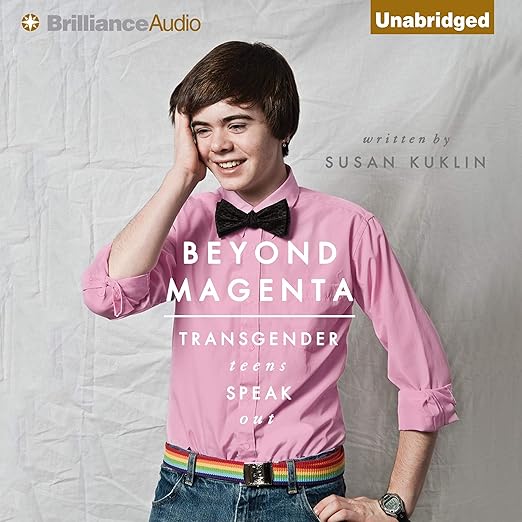
I first heard about Beyond Magenta years ago through a school librarian who mentioned that her students had a habit of borrowing copies and not returning them. She did not seem particularly bothered by that. I finally came to it properly through audio, and I think the format does something specific for this material: hearing the individual voices of Susan Kuklin's six transgender and gender-neutral young subjects read aloud by Tanya Eby gives the testimonies a presence that the page renders differently. These are not case studies. They are people talking about their lives.
Kuklin spent years as an author and photographer working with young adults, and that depth of relationship shows in the quality of what her subjects are willing to share. Beyond Magenta was published in 2014 and earned a 2015 Stonewall Honor distinction. In the decade since, the political and cultural context around transgender youth has changed enormously and in multiple directions. The book feels, in 2026, not as a historical artifact but as something more persistent: a document of what the interior experience of being a trans teenager in America actually looks and sounds like, before the cultural conversation became so loud that individual voices were hard to hear.
The structure is simple and effective: six subjects, each given their own section, each speaking in their own voice about the period before, during, and after their acknowledgment of their gender identity. What makes the book work is that the six stories are genuinely different from each other. Family dynamics range from devastating rejection to profound support. Living situations vary. Gender presentations and identities do not collapse into a single model. Kuklin did not assemble a representative sample for ideological reasons; she assembled six human beings with distinct histories, and the cumulative effect of their differences is the book's most important argument: there is no single transgender story.
The section on Christina is mentioned by reviewers as particularly powerful, with one noting that Christina's mother's final words in her chapter prompted tears. That is not accidental. Kuklin structures the parental voices carefully throughout, and the contrast between those who are willing to do the hard work of being present and those who are not carries an emotional weight that the book handles with restraint rather than sentimentality.
What Works
Tanya Eby's narration has to carry six distinct voices while making each one feel inhabited rather than performed, and she manages it. The register shifts between subjects without losing the feeling that you are hearing actual people rather than a narrator interpreting them. The book runs 4 hours and 35 minutes, which is proportionate to its format. It is not trying to be comprehensive; it is trying to be specific and real, and the runtime supports that intention without padding.
One teacher reviewer noted that students consistently took copies and did not return them. That kind of response from a young audience suggests the book is meeting a need that more distanced or theoretical treatments do not meet. In audio, that same quality comes through: these testimonies feel like something being shared with you specifically, not broadcast at a general audience.
What to Watch For in Beyond Magenta
This is a documentary oral history rather than a narrative with a traditional arc. Each subject's section is self-contained, and the book does not build toward a collective resolution or a thesis conclusion. Listeners looking for a unified story with protagonist and climax will find the format unexpected. What it offers instead is a kind of accumulation: six distinct accounts that together build a picture more complete than any single narrative could provide.
The book was written with a YA audience in mind and carries that framing in its accessibility and in Kuklin's light editorial presence. Adult readers will find nothing condescending in the material, but the framing assumes a reader who may be encountering these realities for the first time rather than bringing established knowledge to them.
Who It's For
Beyond Magenta has two clear audiences. First, young listeners who are navigating questions of gender identity and who need to hear that their experience has been lived before, in many different forms, by real people. Second, adults, whether parents, educators, or simply curious readers, who want to understand what these experiences actually involve at the level of individual human lives rather than as a political abstraction. Both of those audiences are genuinely served by the audio format, which brings the subjects' voices into the room in a way that the page cannot replicate. A teacher reviewing this described it as essential for a high school classroom library. That is an accurate assessment.