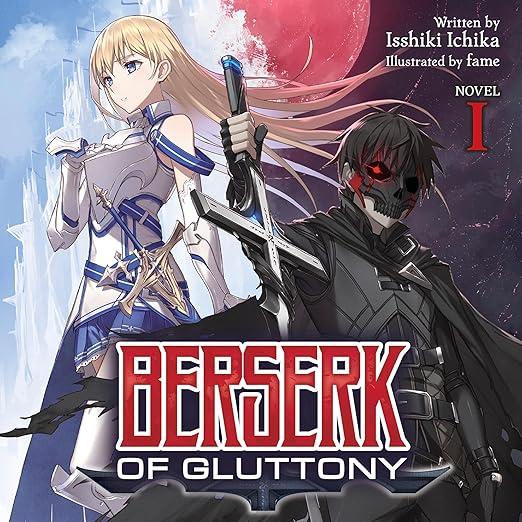
- Read by: Dan Bittner brings the right energy to Fate Graphite's awakening in Berserk of Gluttony - his narration has the urgency the premise requires, and he handles the tonal shift from Fate's powerless opening chapters to the more dangerous post-awakening material without overcorrecting.
- At its heart: Power born from curse, class hierarchy and the despised outsider, the ethics of consuming others to survive
- Vibe: Dark fantasy with momentum, faster and sharper than most isekai openers
- Short version: Berserk of Gluttony, Vol. 1 sets up its power system and its protagonist's transformation more efficiently than most light novel first volumes, and the audiobook makes Fate's hunger feel genuinely threatening.
Fate Graphite's curse is the premise that makes Berserk of Gluttony (Light Novel), Vol. 1 worth paying attention to. The audiobook, written by Isshiki Ichika and narrated by Dan Bittner across six hours and fourteen minutes, introduces a protagonist who has been designated as the lowest-status person in his world - a gate guard who has been assigned the skill "Gluttony," which everyone around him reads as useless. What they do not know, and what the first volume reveals in stages, is that the skill is not useless. It is catastrophically dangerous. When Fate kills a dying thief and devours the man's soul along with his strength, the real nature of Gluttony awakens, and everything that follows is the question of whether Fate can control what he has become.
The setup belongs to a specific sub-genre of Japanese light novel fantasy: the despised outsider with a misunderstood power who turns out to be more formidable than anyone around him realized. Fate's trajectory is, in its broad strokes, familiar to readers of Arifureta or Re:Monster. What distinguishes Berserk of Gluttony is the specific moral texture of the power. Fate does not just gain strength - he literally consumes the soul of what he kills. The ethical implications of that, for a character who starts the story as a victim of the same kind of dehumanization he will need to inflict on others to survive, give the story more weight than the standard power-fantasy setup delivers.
How Berserk of Gluttony (Light Novel), Vol. 1 Holds Up
The craft of the opening section is its patience. Isshiki Ichika spends time with Fate in his powerless state - his gate guard position, the casual contempt he receives from almost everyone around him, the specific way that contempt is institutionalized through the skills system. This investment in Fate's pre-awakening life is what makes his transformation register as something more than a narrative convenience. When the hunger fully awakens, you understand what it is a response to, not just what it is mechanically capable of.
Reviewers consistently note that Fate's power growth is gradual rather than immediate. He is not overpowered from the start. One reviewer compared the character development favorably to Arifureta for precisely this reason: Fate earns his growing strength through risk and loss rather than receiving it through arbitrary circumstance. For a genre where protagonist power escalation is often the primary pleasure and patience is often the sacrifice, this restraint in Vol. 1 is one of the stronger arguments for following the series.
Why Berserk of Gluttony (Light Novel), Vol. 1 Works as an Audiobook
Dan Bittner's narration suits the material's dual demands. The opening chapters, in which Fate is meek and overlooked, require a kind of contained delivery that does not undercut his eventual transformation by making him seem pathetic. Bittner pitches Fate's early sections at quiet competence - someone who has adapted to mistreatment but not been broken by it - which makes the shift after the awakening feel like emergence rather than replacement. The light novel format, with its relatively brisk pace and minimal narrative fat, also rewards Bittner's clean reading style. There is not much here to over-interpret, and he does not try to.
The six-hour runtime is proportionate for a first volume that functions primarily as setup. Isshiki Ichika builds the world's class hierarchy, the skills system, and Fate's specific vulnerabilities and capabilities within that length without the expository drag that first volumes in complex fantasy settings often suffer. Listeners who want to know whether the system is internally consistent and whether the protagonist is worth following will have their answer by the end of Vol. 1.
Weak Spots in Berserk of Gluttony (Light Novel), Vol. 1
The light novel form has specific conventions that the audiobook will introduce to listeners coming from Western fantasy rather than Japanese light novel tradition. The skills system - where every person in this world is assigned a quantified ability that largely determines their social status - is one of these conventions, and the way Gluttony operates within and against that system is the story's primary engine. Listeners unfamiliar with the genre will need a few chapters to calibrate, but the mechanics are explained clearly enough that prior light novel experience is not required.
One reviewer who came to the light novel after watching the anime adaptation noted that the novel adds texture the animation condensed away. The inner life of Fate's experience, and the specific quality of his hunger before and after the awakening, is more available in prose than in a visual medium. Listeners who watched the anime and want more of Fate's interiority will find the audiobook satisfying for exactly this reason.
Who Should Listen to Berserk of Gluttony (Light Novel), Vol. 1
This audiobook is for listeners interested in dark fantasy with a specific power system and a protagonist whose strength grows from genuine cost rather than plot convenience. Fans of the isekai and light novel tradition who want their chosen-one setup to have more moral complexity than usual will find Vol. 1 more interesting than the genre average. Teen and young adult listeners who found conventional fantasy heroes too invulnerable will find Fate's starting position - genuinely powerless, genuinely scorned - gives his eventual growth real stakes.
Skip this if you want your fantasy audiobooks to resolve completely in one volume. Vol. 1 is setup and transformation. The series' larger story is not contained here. But if you want a first volume that earns its sequel, and a narrator who handles the tonal range from vulnerability to threat without fumbling the transition, Berserk of Gluttony delivers both.
Do I need to have watched the Berserk of Gluttony anime before listening to this audiobook?
No prior knowledge is needed. Vol. 1 establishes Fate's world and skills system from the beginning. Listeners who have seen the anime will find the novel adds interiority and detail the adaptation condensed, making it worth their time even with the story already familiar.
How dark is this audiobook - is the soul-consuming premise treated seriously or is it primarily action-fantasy entertainment?
Seriously enough to give the series moral weight, though the book does not dwell in darkness gratuitously. The Gluttony skill's implications for Fate's identity - what it means to gain strength by literally consuming others - are present throughout. It is dark fantasy, not horror.
Is this audiobook a good starting point for listeners new to Japanese light novel fantasy?
Yes, with the caveat that some genre conventions - the skills-and-class system, the numerical power tracking - will take a chapter or two to calibrate to. Isshiki Ichika explains the mechanics clearly, and Dan Bittner's narration does not assume familiarity with the form.