- Performance: Talon David takes on a wide emotional range for this genre, assessed here on fit rather than confirmed listener feedback since no review addresses the audio performance directly.
- What it covers: villain-origin reframing, coming-of-age trauma and identity, found family among the Lost Boys.
- Feel: Adventurous with real emotional undercurrents, energetic more often than dark.
- Our call: A well-executed villain-perspective retelling for YA listeners who want Christina Henry's premise with a gentler, more romantic touch.
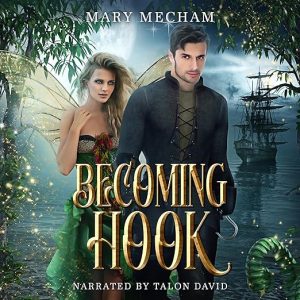
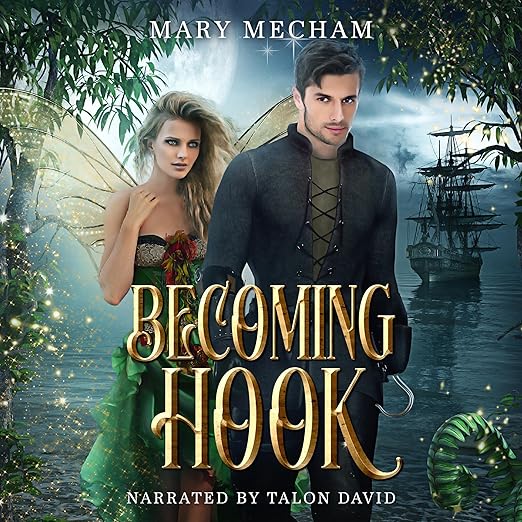
James Hook loses his hand, his best friend, and his own self-image as a hero within the first stretch of this audiobook, and Becoming Hook builds its entire premise on making that loss feel like the start of a real story rather than a footnote to Peter Pan's. Mary Mecham flips the familiar Neverland dynamic by letting Tinkerbell expose an uncomfortable truth: Pan isn't the benevolent boy-hero of legend, he's been kidnapping children and calling it adventure. I went in expecting a light genre romp and came out more invested than expected in a former sidekick learning that loyalty to the wrong person is its own kind of trap.
The villain-origin retelling isn't a new trick. Christina Henry's Lost Boy did something structurally similar, recasting Hook as the story's moral center against a monstrous Pan, and readers who loved that book's premise will recognize the appeal here immediately. Mecham's version leans younger and gentler than Henry's, closer to YA adventure-romance than dark literary revisionism, but the core move, letting the reader see Pan clearly for the first time through Hook's eyes, does real work in both books.
What keeps Becoming Hook from feeling like a retread is how directly it engages with James's physical and emotional aftermath. He loses a hand, and the book treats that as a real trauma to process, not just a visual signature for later. Combined with his fragmented memory of the family he can barely recall, the novel builds a genuinely affecting portrait of a boy figuring out who he is once the myth he'd organized his identity around collapses.
The romance thread, a fiery pixie stealing his heart even as he risks becoming Neverland's most notorious villain to save the Lost Boys, keeps the pacing brisk without overwhelming the rescue plot. Mecham clearly wrote this as the first book in an ongoing Legends of Neverland series, and the seams show a little in how much table-setting happens for future volumes, but the standalone promise mostly holds.
The supporting cast gets meaningfully reimagined alongside Hook himself. One reviewer specifically praised how the book reworks Tinkerbell, the Lost Boys, and Smee rather than leaving them as flat background figures once the central Hook-versus-Pan dynamic flips. That reworking matters more than it might sound: a villain-origin retelling only works if the rest of the cast also earns new dimension, otherwise the flip becomes a single clever trick rather than a fully realized alternate telling of the story.
The sympathetic-villain trend this book taps into has real precedent well beyond Peter Pan retellings specifically, from Wicked's reframing of the Wicked Witch to Maleficent's film reinvention of a classic Disney antagonist. Becoming Hook fits comfortably into that broader cultural appetite for hearing the other side of a story audiences thought they already knew, and Mecham's version earns its place in that lineage by giving James a genuine, specific reason to break from Pan rather than just flipping a moral label.
Hard-won happily ever afters is a specific, recognizable piece of romance-genre shorthand, signaling to readers that the eventual resolution will be earned through real conflict rather than handed over easily. Mecham uses that phrase deliberately in her own marketing copy, and it's an accurate promise: the romance here develops alongside genuine danger and loss rather than as a parallel, low-stakes subplot running underneath the adventure.
Why It Works in Audio
Talon David has no track record in this specific project's history that I can point to, so I'll assess her on what the material demands rather than a confirmed performance history: Becoming Hook needs a narrator who can shift convincingly between swashbuckling adventure energy and the quieter, more wounded register of a boy processing real loss, sometimes within the same chapter. That's a wide ask for eight and a half hours, and the relatable, energetic tone the publisher is clearly aiming for suggests the production is targeting exactly that range.
One listener called this her new favorite Peter Pan retelling and specifically praised the neat tie-ins to the original tale, which points to a book doing careful work with source material rather than just borrowing its names. In audio, those tie-ins depend heavily on a narrator who knows when a line is meant to land as a wink to readers who know their Barrie and when it needs to work as pure adventure storytelling on its own terms.
Eight hours and twenty five minutes sits comfortably within typical YA audiobook length, long enough to build real narrative momentum without demanding the kind of marathon commitment some YA fantasy series ask for. That runtime makes it a reasonable audiobook for a newer listener still building stamina for longer titles, without sacrificing the depth a coming-of-age villain-origin story needs to actually land.
What to Watch For in Becoming Hook
None of the reviews I have access to for this listing comment directly on narration quality, so treat any specific vocal-performance claim here as reasoned expectation rather than confirmed feedback. The story content itself has been well received across multiple reviewers, but the audio experience specifically hasn't been independently verified by the reviews attached to this listing.
Series entry point is worth flagging clearly: this is book one of Legends of Neverland, and while the publisher markets it as readable standalone, the ending sets up threads for future volumes. Readers wanting full closure on every plot thread should know some are left for later books.
The synopsis promises clean romance rather than anything explicit, which is accurate to the reviews available: the emotional beats lean toward coming-of-age longing rather than heat, so listeners expecting a spicier YA romance should recalibrate expectations accordingly.
The loss of James's hand is treated with real emotional weight rather than played as a purely visual signature borrowed from the character's eventual legend. Based on the available reviews, the trauma is handled seriously without becoming graphic, appropriate for the YA audience, though sensitive younger listeners or their parents may still want to know the injury and its aftermath get genuine narrative attention rather than a quick aside.
As the opener for an ongoing series, Becoming Hook is clearly setting up future volumes beyond just this one adventure, and listeners should expect some threads, particularly around the fiery pixie romance and the full scope of Hook's rivalry with Pan, to keep developing rather than close out completely by the final chapter.
Who Will Get the Most From It
This suits YA fantasy listeners who enjoy fairy-tale retellings with a genuine emotional core, especially fans of Christina Henry's Lost Boy looking for a gentler, more romance-forward take on the same premise. It also works well for readers newer to the genre who want adventure and coming-of-age themes without explicit content.
Skip it if you want your Peter Pan stories to stay firmly on Pan's side of the ledger, or if a slower emotional arc around grief and identity isn't what you're in the mood for. This is Hook's book through and through, and Pan comes out of it looking considerably worse than the legend suggests.
Common Questions
Does the Becoming Hook audiobook work as a standalone listen, or do I need to continue the Legends of Neverland series?
It's designed to work as a standalone, and the central rescue plot does resolve. That said, it's book one of an ongoing series, and a few threads are clearly left open for future volumes rather than tied off completely.
Does Talon David's narration capture both the adventure and the emotional weight of Hook's backstory in this audiobook?
Nobody among the listener reviews I have access to comments on her performance one way or the other, so that's worth knowing going in. Based on the material's demands, the book needs a narrator comfortable moving between swashbuckling energy and quieter grief, which is a fair description of what this story requires from its performer.