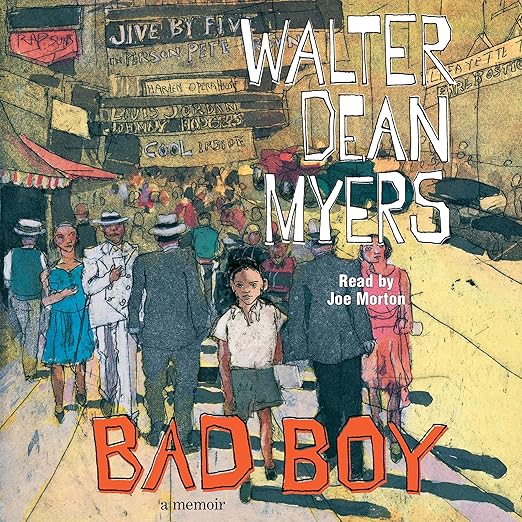
I read Walter Dean Myers's adult novel Sunrise Over Fallujah years ago before I encountered his memoir work, and I remember being struck by how clearly he could inhabit young minds in crisis. When I finally came to Bad Boy, his memoir of growing up in Harlem in the 1940s and 1950s, I understood where that capacity came from. This is the book that shows you the writer before he was the writer, when he was still the kid hiding books in brown paper bags so the other boys wouldn't mock him for carrying them home from the library.
Joe Morton narrates the Quill Tree Books audio edition, and at four hours and twenty-six minutes, Bad Boy does not outstay its welcome. Myers was a prolific writer who produced over 100 books during his career, and this memoir functions as an origin story, not in the triumphant, retrospective sense of a success story but in the more complicated sense of a boy trying to figure out who he is in a world that has very definite ideas about who he is allowed to be.
The Review
The Harlem Myers describes is vivid and particular. He was quick-tempered and physically strong, by his own account always ready for a fight. He was also reading everything he could find and hiding that reading because intellectual ambition in his neighborhood meant social exposure. That double life, street toughness and secret bookishness, is the engine of the memoir, and Myers traces it without sentimentality. He was not rescued by literature in a simple sense. He also failed school, spent time on the streets, and found himself caught between the class and racial structures of 1950s America with no obvious path through.
What gives the memoir its power is exactly what one reviewer found slightly limiting: Myers keeps emotional distance from his own material. His style is, in the reviewer's words, "simple and unemotional in a way that makes this account of a troubled childhood and adolescence digestible and also appropriate for younger readers." That same reviewer noted that as an adult they might have liked "to enter the author's head or emotional world a bit more." Both reactions are valid. Myers wrote a book that could be given to an eleven-year-old without overwhelming them, and he did it at some cost to the depth an adult reader might want.
Joe Morton handles the memoir's tonal register with considerable skill. He is an actor with real range, and he does not push the material toward drama it does not claim for itself. Myers's prose is direct and conversational, and Morton matches that directness without flattening it. The Harlem sections in particular benefit from his voice, there is a sense of physical place and social texture in his delivery that the spare prose alone might not provide.
For young listeners, the audio format has particular advantages. Myers's sentences are clean and image-driven, and they translate well to the ear. The memoir was used as assigned summer reading for at least one seventh-grader in the reviews, and the parent who bought it noted that even a son who was a "super picky reader" found it engaging. The audio version extends that accessibility: listeners who would resist picking up a memoir can be drawn in through their ears.
Weak Spots in Bad Boy
The memoir ends without a fully resolved conclusion. Myers describes his adolescence and early adulthood, the leaving of school, the turn to the streets and then away from them, but does not carry the story through to his literary success in any detailed way. A reviewer described the story as coherent and moving but placed within a world that had been largely hostile to Myers's ambitions. That openness is appropriate to the form; memoir is not biography, and Myers is not writing a success narrative. But listeners expecting a tidy culmination will find the ending more abrupt than satisfying.
The historical context of 1940s and 1950s Harlem is rendered through lived detail rather than historical explanation. Myers does not provide background; he provides experience. For younger listeners, some of the social context around racial segregation, class stratification, and the particular culture of mid-century Harlem may benefit from a brief supplementary conversation with an adult.
Who It's For
This works for middle schoolers and high schoolers as both assigned reading and genuinely chosen reading, which is a harder combination to achieve than it sounds. It is also worth a listen for adult readers who want to understand Walter Dean Myers's literary background and the experiences that produced one of the most significant voices in young people's literature. Readers who came to Myers through his fiction, Monster, Fallen Angels, Scorpions, will find Bad Boy illuminating as context. The four-and-a-half-hour runtime makes it approachable for readers at any level of audiobook commitment.
Key Details
- Voice: Joe Morton brings exactly the right kind of gravity to Myers's memoir, authoritative without being heavy, warm without being sentimental.
- Big ideas: Racial and class identity in mid-century Harlem, the tension between intellectual aspiration and street survival, the discovery of a literary vocation
- Atmosphere: Quiet and reflective, with an emotional restraint that reviewers find both appropriate and occasionally distancing
- Worth it?: A brief, exceptional memoir that works for young adult listeners and adults alike, strongest as a portrait of how a writer comes to understand his own voice against the odds.
Questions Listeners Ask
Is Bad Boy appropriate for middle schoolers to listen to independently, or does it address content that might need parental guidance?
It is appropriate for middle school and is listed as a young adult title. Myers writes about street life and some violence in Harlem, but the emotional register is restrained and the content is not graphic. Several reviewers specifically note its suitability for younger readers, including a parent whose 11-year-old completed it as assigned school reading.
Joe Morton is primarily known as a film and television actor. How does his narration work for a memoir format?
Reviewers do not flag any issues with the narration, and Morton's acting background serves the material well, he brings controlled authority to Myers's understated prose without performing it. The pairing of his voice with Myers's Harlem scenes is specifically praised for its sense of place.
Walter Dean Myers died in 2014. Is Bad Boy still widely available, and does it remain relevant to contemporary young readers?
Yes, it remains widely available in audio and print. The memoir's core concerns, racial identity, the cost of intellectual ambition in a hostile environment, finding one's voice against the grain of what the world expects, are as legible to young readers today as when the book was first published. Myers's reputation has only grown since his death.