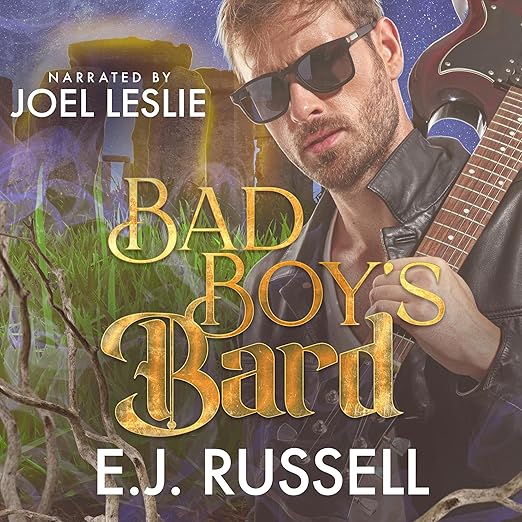
I hadn't planned to jump into a series at book three, but a recommendation from someone whose taste I trust in MM fantasy pushed me toward E.J. Russell's Fae Out of Water series, starting from the beginning. I finished books one and two in a week, which is less a reflection of their individual quality and more a comment on how well Russell builds anticipation for Gareth Kendrick's story. Gareth, the youngest brother and the last true bard in Faerie, appears in the first two books as a figure defined by a grief he won't explain. When Bad Boy's Bard finally gives him the spotlight, the payoff is considerable.
The setup: Gareth has spent two hundred years believing that Niall O'Tierney, his human lover, was taken by the Unseelie. What he didn't know is that Niall - half-human son of the Unseelie King - is very much alive, having spent those two centuries imprisoned as a consequence of a wager he lost. When they are suddenly face-to-face at the ceremony meant to join the Seelie and Unseelie realms, Niall makes the worst possible decision: he fakes amnesia. Russell, who has a gift for comic timing, wrings considerable dark humor from this choice without undercutting the real damage it does. Niall's logic is comprehensible - he's convinced that revealing his Unseelie heritage would destroy any chance of reconciliation - but the lie compounds a relationship already built on two centuries of accumulated misunderstanding.
Two Hundred Years of Grief Complicate Reconciliation
What elevates this book above standard paranormal romance is its commitment to the psychological weight of its premise. Two hundred years is not a small thing to build a relationship around. Gareth's grief has had time to calcify into something structural - it's not just that he lost Niall, it's that the loss became the organizing principle of his identity. Returning Niall to him doesn't resolve that; it complicates it. Russell is sharp enough to see that reconciliation after this kind of separation is not simply a matter of the parties involved wanting it badly enough. The trust has to be rebuilt from a foundation that no longer quite exists, and the book spends real time on that difficulty rather than fast-forwarding to a convenient resolution.
The Unseelie and Seelie political situation provides both the external plot pressure and a useful mirror for the central relationship. The threat to all fae - which forces Gareth and Niall into proximity before they're ready - is handled efficiently rather than elaborately. Russell is not writing hard fantasy; the worldbuilding serves the emotional story rather than competing with it. Readers who came to the series for the political intrigue may find the external plot a bit light. Readers who came for the relationship dynamics will find exactly what they're looking for.
Joel Leslie's Two Voices Need the Earlier Books
Joel Leslie is one of the most accomplished narrators working in MM fiction and MM fantasy, and his performance here is a reminder of why. He manages both of the central voices - Gareth's centuries-weathered bitterness and Niall's increasingly desperate attempt to maintain a lie he knows will eventually destroy him - without letting either collapse into a single emotional note. The scenes where Gareth is performing composure while clearly falling apart are particularly well-handled; Leslie finds the cracks without overselling them. At eight hours and five minutes, the pacing is comfortable for the emotional arc being traced.
It's worth noting that this book should not be listened to as a standalone. One Amazon reviewer is emphatic that the first two books are required reading to understand and appreciate the plot and characters, and that's accurate. The emotional stakes of Gareth's story depend almost entirely on what was established earlier in the series. Listeners who jump in here will get a functional story, but they'll miss the accumulated weight that makes the resolution land properly.
Niall's Amnesia Tests a Listener's Patience
The amnesia plot device is one that requires careful handling, and Russell mostly manages it. Some readers will find Niall's choice to maintain the lie past the point of reasonable deniability frustrating, and that's a legitimate response. The book leans into the dramatic irony of Gareth gradually figuring out something Niall can't seem to bring himself to confess, and whether that sustains interest or produces impatience is a matter of individual reader tolerance. The external threat that drives the third act feels somewhat abrupt in its arrival and resolution, though it serves its narrative purpose of forcing the central characters toward honesty. Russell's series works consistently at the level of character rather than plot architecture, and this book is no exception to that pattern.
Start With Books One and Two First
Start with books one and two first. If you've done that and found yourself as curious about Gareth as the earlier books intend you to be, this will deliver. It's the right book for listeners who want MM fantasy with genuine romantic stakes rather than romance with perfunctory fantasy scaffolding. Joel Leslie's narration makes it an easy recommendation for anyone who appreciates vocal performance as a significant part of the audiobook experience. Skip it if you're new to the series or expecting high fantasy world-building over emotional drama - Russell's priorities are clear, and the books reward those whose priorities match.
Common Questions
Can Bad Boy's Bard be listened to as a standalone without the first two books?
Technically yes, but not recommended. The emotional weight of Gareth and Niall's reunion depends almost entirely on setup from earlier books. Multiple reviewers explicitly note that books one and two should be read first for full appreciation.
Is Joel Leslie's narration accessible to listeners new to MM audiobooks?
Yes. Leslie is one of the most technically skilled narrators in the genre, and his performance here prioritizes emotional clarity over signaling genre conventions. New listeners won't feel like they're missing codes.
How much does the Seelie/Unseelie political storyline dominate relative to the central romance?
The political situation is present throughout and provides the external plot engine, but it's firmly secondary to the Gareth/Niall relationship. Russell uses the fae crisis primarily to force the characters into proximity and toward honesty, not as an independent fantasy narrative.
How does Book 3 compare to the first two entries in the Fae Out of Water series?
Most reviewers consider it the strongest book in the series, with the central pairing generating more genuine emotional stakes than the first two books. One reviewer specifically notes that Book 2 had slipped into formulaic territory and that Book 3 broke that pattern.