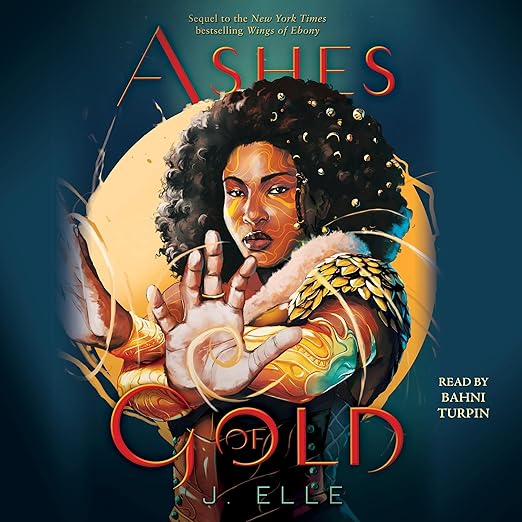
Duologies carry a structural problem trilogies mostly dodge: the second book has to serve as both the middle and the ending. Fourteen hours of audiobook is how J. Elle answers it. Ashes of Gold picks Rue up in a basement prison with her magic gone, her allies scattered and no memory of how she got there, then spends its full length on the question the first volume only gestured at, which is whether she can return the magic the Chancellor stole from her father's people. Simon and Schuster Audio credits Bahni Turpin with the reading, which means one voice holds two worlds for the duration.
Rue wakes with nothing, and the book is honest about how much of a problem that is. She is a girl from East Row, and the description leans hard on what that means: girls from East Row pick themselves back up when they fall, girls from East Row break themselves out. But unbreakable is a slogan, and the interesting material starts where the slogan runs out. Kminyat's four-star account puts a finger on it, describing Rue struggling against others and, more than that, against her own inner voice, and noting that if she cannot defeat her inner demons she will never defeat the Chancellor. That account also calls the reveal of her betrayer one of the best mysteries of the series, which is a fair assessment of the plot mechanism holding the middle together.
This is a more internal book than the first one, and the length is where the cost shows up. A fourteen-hour run is a lot of runway for a story whose main engine is a protagonist deciding whether she deserves to lead, and the stretches on Yiyo Peak sometimes circle the same doubt from a slightly adjusted angle. The compensation is that when the external stakes finally land, they have something solid to press against. Whether the trade works for you probably depends on how much you liked Rue's company in Wings of Ebony, because you get considerably more of it here and considerably less plot to dilute it.
Why Listen to Ashes of Gold
Language is what the review pool names first, and it is the right thing to name. The January 2022 account from Stephanie praises the way J. Elle built the world of Ghizon, pulling readers into the setting through details, new characters and the language, and adds that after all that time in Ghizon, another visit to East Row was the thrill of the book. That double register is the series' real signature. Rue talks like a Houston teenager and moves through a world with an idiom of its own, and the writing switches between them constantly instead of picking a side. In audio, that switching is carried by one credited reader, which makes casting a live question rather than a formality. The listing also quotes a starred Kirkus notice calling the book thrilling and masterful, which fits the last third and is generous about the first.
A second argument for hearing it is that the register sits closer to spoken than written. Rue speaks in direct address much of the time, the sentences run short, and the repetitions are rhetorical rather than accidental, which is a shape that can read as insistent on the page and land as natural in the ear. Anyone who bounced off the first book's style in print has a reasonable case for trying the sequel this way instead. That situation is rarer than it sounds: format usually changes the delivery method and not the verdict, and here it plausibly changes both.
What to Watch For in Ashes of Gold
Cassidy describes finishing the book inside two days of reading and reaching the very last page, which is the first sign that this pool is not primarily an audio pool. A second account carries a January 2022 date, six months before the July 2022 recording existed, so whatever it is praising, it cannot be this edition. Of five visible reviews, at least two are demonstrably about print. The 4.6 average across 155 ratings therefore tells you a great deal about the novel and comparatively little about the recording of it, which is the distinction that matters when you are choosing a format rather than a book.
Entry point is the bigger thing to watch. This is the second half of a duology and the description says so, but it does not soften the consequence: the book opens mid-catastrophe with Rue imprisoned, the Chancellor already in power, Yiyo Peak already lost, and not a line of recap explaining how any of it came about. Names, factions and the rules of magic all arrive as things you are assumed to have. The full running time is a long stretch to spend reconstructing a world you were supposed to already know, and the series is simply not built to be entered at this point. The listing gives you Wings of Ebony as the series name and this as book two, which is all the warning you get.
Who Should Listen to Ashes of Gold
Finishing Wings of Ebony is effectively a prerequisite, and if you have, this is the payoff you were promised. The audience that gets the most from it is named by the reviews without any hedging at all. Alia Peoples describes not normally writing reviews and doing so anyway, having not felt that much Black pride since Black Panther, and credits the book with restoring a belief in the power of a people. Niya Wallis frames it as a book for the Black girls and women who have the magic to love, heal and fight for those around them, and looks forward to their own children reading it one day. Those are not blurbs. They are statements about what the book actually did, and a duology closer that provokes them has done the job it was built for, whatever the pacing costs along the way.
Newcomers should start with book one or not at all, and the same applies to anyone allergic to a protagonist who talks through her own doubt at length. This is not a plot-forward fantasy. The external war is real, but the internal one gets far more airtime, and readers who wanted the momentum of the first book's opening will find this deliberately slower going. A love triangle is genuinely present and genuinely occupies space. Arrive wanting Rue's interior and the duology closes well. Arrive wanting escalation and the wait for a fight will feel very long indeed, which is the trade every duology closer eventually asks its readers to make.
Quick Take
- Read by: Bahni Turpin holds a Houston register and a Ghizon one inside one credited voice across a very long book.
- At its heart: Stolen magic and reclamation, betrayal, the doubt that comes with leadership, belonging to two worlds at once.
- Vibe: Angry, tender, and relentlessly internal.
- Short version: The duology closes properly, but only for listeners who already finished Wings of Ebony.
Frequently Asked Questions
Do I need to read Wings of Ebony before this audiobook?
Yes, effectively. Ashes of Gold opens on Rue locked in a cell with her magic taken, her allies scattered and the Chancellor already victorious, and no recap of how that happened. Factions, place names and magic rules all arrive assumed. Starting here means rebuilding what the first volume simply handed you.
Who narrates the Ashes of Gold audiobook?
The reading belongs to Bahni Turpin. The book asks a great deal of one voice, since Rue moves between a Houston register and the idiom of Ghizon and the prose refuses to settle into either, so casting a single reader is a real decision rather than a default.
Does this audiobook finish the story or set up another book?
It finishes it. The description presents Ashes of Gold as a duology's conclusion and the listing carries it as book two, so Rue's fight to return the stolen magic resolves inside this volume. The second act and the finale share one running time, which explains a good deal about the pacing.
How much romance is in Ashes of Gold?
Enough to notice. A love triangle runs alongside the main plot and takes up real space, though the dominant thread remains Rue's argument with herself about whether she is fit to lead her father's people. Listeners who came for the romance will be fed; listeners who came only for it will be outnumbered.