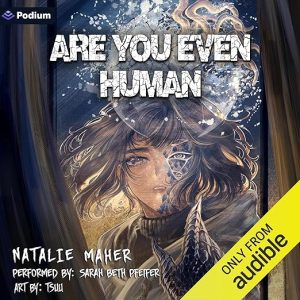
Few opening lines commit as hard as this one: "In 2025, the moon hatched and its child died. Things have since gotten worse". That is the entire setup for Natalie Maher's Are You Even Human: Volume 1, an audiobook running twenty-three hours and fifty-one minutes that has drawn 252 ratings to a 4.8 average on a Podium Audio recording released in June 2025. The reviews are loud, specific and unusually useful, and the sharpest of them is the one that stops short of five stars.
Is Are You Even Human: Volume 1 Worth Your Time?
Superpowers arrive in this world alongside the thing that necessitates them. Extradimensional invaders are grinding humanity down, and the war has been "loss after loss for far longer than she's been alive" by the time Julietta turns eighteen. When the sky splits open, the publisher's copy notes drily, she "can't bring herself to be terribly shocked". Survival is the surprise. What she surfaces with is shapeshifting, the ability to become any living thing she has touched, "mixing and matching parts with flesh as mutable as flowing water", with one catch that carries the entire book: the original form is the one she cannot get back to.
Everything worth caring about here sits in that catch. Trapped behind enemy lines wearing someone else's body, Julietta has a survival problem and an identity problem that cannot be separated, and the copy ends on the question rather than a promise: will she still be Julietta when she gets out. The listing files the book under an LGBTQ+ heading, and while the copy does not spell out what that reflects, a story whose engine is a body that refuses to return to a default is doing recognizable work with the question of who gets to say what shape a person is.
Readers respond to it as a genre hybrid that should not function and does. One five-star reviewer calls it "a combination of superhero and postapoctalyptic fantasy that fully feels real despite the fantastical elements", which is a decent description of the tonal trick Maher is pulling. Another, who came in skeptical after finishing a similar shapeshifting series, reports the premise and characters were distinct enough to avoid feeling like a rehash. My own view is that the apocalypse is scaffolding and the transformation is the book.
The Best Parts of Are You Even Human: Volume 1
Sarah Beth Pfeifer carries the reading credit, and the demand is enormous and easy to name precisely, because a reviewer named it accidentally. The four-star response praises the world building and the characters, then admits to "skipping whole paragraphs and pages" of inner monologue. That is a reading behavior with no audio equivalent. A listener does not skim; a listener waits. Almost twenty-four hours of first-person interiority has to be voiced at a pace and with enough variation that the reflective stretches feel like character rather than delay, because the escape hatch a paper reader used is closed.
Where the format wins is on the body horror. Flesh described as "mutable as flowing water", parts mixed and matched, a person occupying a shape that is not theirs: this is material that works better spoken, because a voice carries physical discomfort in ways a sentence has to work for. A single reader also gives the identity question a useful continuity, since the same voice persists through every borrowed body, which is exactly the tension Julietta is living inside.
The enthusiasm on this listing is worth quantifying. One reviewer stayed up "so late to finish this book, it became early". Another finished it in two days during finals week and describes finding it "criminal how hidden this book is". Another demands Volume 2 "preferably Yesterday". Praise of that temperature usually means momentum, and momentum is what carries a long recording.
Before You Commit to Are You Even Human: Volume 1
Length is the honest risk here, and it compounds with the interiority complaint rather than sitting beside it. Just short of twenty-four hours is a serious commitment for a first volume, and the reviewer who documented skipping was reading at speeds nobody achieves by ear. If long introspective passages test your patience, this is a book where that trait will be tested repeatedly and where you cannot flip ahead.
The same reviewer raises two content objections that deserve passing on straight. One is that a monologue arguing that physically disabled people should not be looked down on for skipping physical events went on longer than the point needed, which is a complaint about didacticism rather than about the position. The other is that the book struck that reader as "a little sexist, not much", with specific scenes and phrasings named as wrong. No other review on this page raises either point, though several break off before they finish, and I am in no position to adjudicate them from an excerpt, but a buyer weighing twenty-four hours deserves to know both are on the record.
Be realistic about where this leaves you as well. The title says Volume 1 and a reviewer is already begging for the sequel, which tells you this is an opening movement rather than a self-contained story. Anyone who resents cliffhangers or dislikes waiting on a series should check what has actually been published before starting. One reviewer's comparison also points at a specific neighboring series, so listeners who have recently finished similar shapeshifting fiction may find the opening chapters more familiar than they would like, even though the reviewer who feared exactly that came away satisfied.
Should You Listen to Are You Even Human: Volume 1?
Listeners who like their fantasy long, interior and physically strange are the natural audience. The book will suit anyone who reads for character under pressure rather than for plot velocity, anyone drawn to transformation stories where the transformation costs something, and anyone who wants apocalyptic stakes without the grimness that usually comes with them. The reviewer who called the characters easy to identify with because their struggles are recognizable is describing the book's real strength.
A tight, propulsive adventure sits at the opposite end of what Maher is doing. Anyone who wants a superhero story that moves in clean beats, or who has limited patience for a protagonist thinking at length about what is happening to her, should look at something a third of the length. Readers who need a complete arc in one purchase should also wait.
If I were choosing where to spend a credit on a debut-feeling series opener, the thing that would decide me is the reviewer who could not put it down during finals week. That is a specific, costly form of praise and it is hard to fake. Sample twenty minutes, and pay attention less to the action than to how the quiet stretches sound, because those are the hours that will decide whether this recording works for you.
The Short Version
- Performance: Sarah Beth Pfeifer has to hold a listener through reflective stretches that a paper reader can simply jump over, across a very long recording.
- What it covers: shapeshifting and identity, apocalyptic war, survival behind enemy lines, bodies that will not return to default.
- Feel: strange and physical, propulsive under the reflection.
- Our call: a rich, demanding series opener for listeners who welcome length and introspection rather than merely tolerating it.
Common Questions
Is the inner monologue a problem in the audiobook?
It may be. A four-star reviewer praises the world building but concedes that long stretches of introspection got skipped. Nobody skims a recording, so those passages play in full. Sample a quiet stretch rather than an action scene before committing this much time.
Does Volume 1 tell a complete story?
It reads as an opening movement. One five-star reviewer ends by demanding the second volume immediately, and the title itself flags a continuing series. Expect Julietta's central predicament to develop rather than resolve, and check what else has been published before you start.
How does this compare to other shapeshifting fantasy audiobooks?
One reviewer came in worried it would repeat a shapeshifter series just finished, then concluded that this book stands on its own terms. The apocalyptic superhero framing is the main differentiator, along with a body-horror streak that the format tends to sharpen.
Are there content issues listeners should know about?
One four-star reviewer flags two: a didactic monologue about disability that outstays its argument, and scenes and wordings that reader considered mildly sexist. No other review on the listing raises either, so treat both as one considered opinion rather than a consensus.