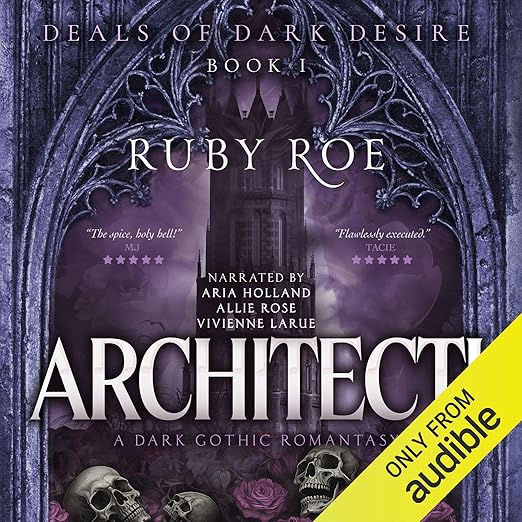
The Short Version
- Narrator: Allie Rose handles the dual-protagonist dynamic well, keeping Midnight's swagger and Lucy's rigidity consistently distinct across eleven-plus hours of dark academia atmosphere.
- Subjects: Sapphic forbidden romance, demonic contracts and power imbalances, found family in gothic institutional settings
- Tone: Dark and propulsive, with genuine steamy tension and a mythologically ambitious backdrop
- Bottom line: A confident debut in the Deals of Dark Desire series that delivers on its central romance and dark academia aesthetic, with world-building that some reviewers found underdeveloped but which the sequel will likely expand.
I came to Architecti after a reader recommendation that specifically cited the professor-student dynamic as the kind of slow-burn tension that is difficult to execute well and rarer still in sapphic fantasy. I was skeptical, because dark academia romance has become a crowded genre and the supernatural elements can often feel like decoration rather than architecture. Ruby Roe made me revise that initial skepticism fairly quickly. The book has genuine structural ambition, and the central pairing of Mercedes Midnight and Lucy Corvine earns its complexity before the first major plot complication arrives.
The premise is layered. Midnight is a reaper with one year before her debt to hell comes due. Lucy, the devil's daughter and a professor at Finis Academy, is imprisoned by a contract she never consented to. Their pact, Midnight infiltrates the academy and breaks Lucy's contract while Lucy trains Midnight to win the coveted demon favor, is the kind of mutual leverage arrangement that forces two guarded characters into sustained proximity with escalating stakes. The romance is not incidental to the plot; it is structurally embedded in the bargain itself.
What We Made of It
What Roe does better here than in some of her earlier work, according to reviewers who have followed her career, is plot construction. One reviewer specifically noted that this book introduced plot twists that set it apart from her previous titles, and the cult subplot, the conspiracy to resurrect a fallen angel, provides the kind of external pressure that keeps the central romance from becoming static. When the city is moving toward celestial war, the personal stakes of Midnight and Lucy's growing attachment feel genuinely imperiled rather than conventionally threatened.
The morally grey characterization of both protagonists is handled consistently. Midnight's cocky exterior conceals a desperation she cannot afford to show. Lucy's professional rigidity is a survival strategy in an institution controlled by her father's expectations. The reviewers who responded most enthusiastically to the book focused on this complexity, and Allie Rose's narration keeps those contradictions legible even in the steamer sequences, where maintaining character integrity while conveying genuine heat is a specific technical challenge.
Why Listen to Architecti
The audio format suits the gothic atmosphere Roe constructs around Finis Academy: the candlelit libraries, the demon-favor competition, the weight of institutional hierarchy. Allie Rose is a narrator clearly calibrated for this kind of material, comfortable with the tonal range required by a book that needs to be funny, threatening, romantic, and ominous within the same chapter. Her handling of the side characters, particularly Lex and Bastien, who serve as foils to Midnight and Lucy respectively, adds texture to scenes that might otherwise function as pure atmosphere.
At over eleven hours, this is a substantial listen for a romance-fantasy first installment, and the pacing earns that length. Roe does not rush the relationship development, which is the right choice for a pairing defined by mutual suspicion and escalating need. Reviewers who finished it described pre-ordering the sequel immediately, which suggests the cliff-hanger lands with the intended force.
What Might Not Land
The most substantive criticism in the reviews concerns the world-building. One reader, clearly engaged with the characters and central plot, found the demonic cosmology insufficiently explained: the nature of the Veil, the significance of the fallen angel, the distinction between various factions within the supernatural hierarchy. These ambiguities do not undermine the romance, but they create some confusion in the larger plot sequences, and the cliff-hanger ending arrives before several cosmological questions are resolved.
This is worth naming for listeners who prioritize watertight secondary-world logic. The Deals of Dark Desire series is clearly designed to expand its mythology across multiple volumes, and Book 1 is more interested in establishing characters and central tension than in comprehensively mapping the supernatural world they inhabit. That is a viable structural choice, but it does leave some threads deliberately unresolved.
Who Should Pick Up Architecti
The book is explicitly marketed for 18-plus listeners, and the content warrants that designation. Dark sapphic romance readers who want genuine fantasy stakes alongside the relationship arc, rather than a contemporary romance with supernatural window dressing, will find this satisfying. The gothic campus setting and the moral complexity of both protagonists make it a strong choice for readers who loved the dark academia trend but wanted something with more supernatural architecture than most of those titles offer. Listeners who require resolved world-building and closed-loop plots should wait until the series completes before committing.