Key Details
- Voice: Lance West handles the lyrical, shifting prose with considerable skill, capturing Lucifer's innocence in the early chapters and the growing dread of the later sections.
- Big ideas: Identity and self-discovery, religious myth retold through a queer lens, the nature of divine authority and blind obedience
- Atmosphere: Poetic and increasingly devastating, with prose that moves from crystalline to fractured as the story darkens
- Worth it?: A genuinely unusual debut that earns its devoted readership, demanding, uncomfortable in places, and unlike most other things in its genre.
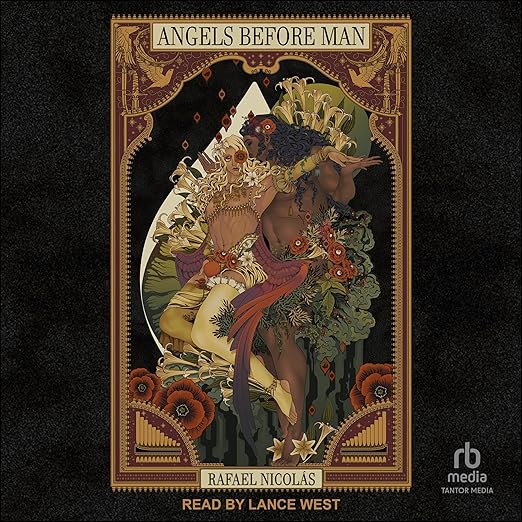
I was not expecting much from Angels Before Man. The premise, a queer retelling of Lucifer's fall, has been worked over enough times that it has become something of a cottage industry in the space between literary fiction and genre fantasy. But a reader I trust mentioned it in passing, and when I noticed the audiobook had nearly 500 ratings and a 4.6 average, I decided to give it an afternoon. I lost the afternoon and most of the evening. I did not listen to it; I was absorbed by it.
Rafael Nicolás is writing in a tradition that includes C.S. Lewis's retelling of myth, Anne Rice's theological horror, and the kind of prose poetry that treats narrative structure as secondary to texture and rhythm. But he has done something that is genuinely his own: he has taken Lucifer's story not as a story about pride or rebellion but as a story about shame, identity, and what happens when the person you become is not the person your world has a place for.
The Review
The novel's opening movement is among the most quietly beautiful things I have encountered in recent genre fiction. Lucifer, described as the most beautiful angel, is also the most fearful and timid, worshipping with no agenda beyond worship itself. The relationship that forms between him and Michael, the strongest angel, grows slowly and with a delicacy that feels unusual in a genre where intensity is often substituted for development. One reviewer described watching Lucifer's evolution and being engrossed enough to finish the book in a single day. That impulse is understandable; the first half builds with a patience that makes you reluctant to stop.
The second half is a different experience. Several reviewers have been candid about this: the book becomes genuinely difficult, confrontational in its depiction of what happens when love exists in a system that cannot permit it. One reader described it as an extremely unpleasant read for the second half while also arguing that there is something beautiful in its willingness to confront the worst things consciousness is capable of. Both observations are accurate. The novel does not flinch, and not everyone will want to follow it where it goes.
The Best Parts of Angels Before Man
Lance West's narration is one of the reasons the audiobook format works so well for this material. Nicolás writes prose that is aware of its own sound, with sentences that vary their rhythm deliberately as the emotional texture of the narrative shifts. West is clearly listening to those rhythms rather than simply moving through the words, and his handling of the transition from the novel's luminous early chapters to its increasingly dark second half demonstrates genuine craft. The difference in vocal texture between the two halves, while subtle, tracks the narrative deterioration with real intelligence.
The book is also one of the better arguments for audiobook as the preferred format for a certain kind of literary fiction. The poetic density of Nicolás's prose is not always easy to absorb on the page, where the eye can rush. Hearing it paced by a skilled narrator allows the language to land in the way it is intended.
The Caveats
The content warnings attached to this book are meaningful rather than performative. The mature themes described in the synopsis include depictions of coercive authority, psychological abuse, and violence that are presented without softening. Readers who found the depictions of divine power in similar works, Paradise Lost's God, for instance, uncomfortably cruel, will find Nicolás's God considerably more so. That is the point, but it is worth knowing before you begin.
One reviewer also noted that aspects of heaven feel occasionally too modern, which is a fair observation about a small number of passages where the contemporary register intrudes on the mythic. These moments are not frequent enough to undermine the world-building, but they do create occasional tonal disruptions.
Who Should Listen to Angels Before Man
This is for readers who take their queer fiction seriously, who are looking for something with genuine literary ambition rather than comfort reading with representation. It will appeal to listeners who have been moved by Philip Pullman's dismantling of divine authority in His Dark Materials, or who have found Anne Rice's theological horror compelling. It is not for listeners who want a romantic fantasy about angels, despite containing a love story. The love story is inseparable from the tragedy, and the tragedy is the point. This is the first book in a trilogy, and the ending makes clear that Nicolás is not finished with his characters. Given what the first installment accomplishes, that is a genuinely interesting prospect.