Quick Take
- Narration: B.J. Harrison brings warm, measured storytelling to Alcott's short tale - his voice suits the cozy, domestic atmosphere without overplaying the period charm.
- Themes: Family resourcefulness, holiday tradition, children's independence
- Mood: Warm, gently comic, and reassuringly old-fashioned
- Verdict: A lovely short audiobook for families or classrooms around the holiday season - brief enough for a single sitting and rich enough in character to hold children's attention throughout.
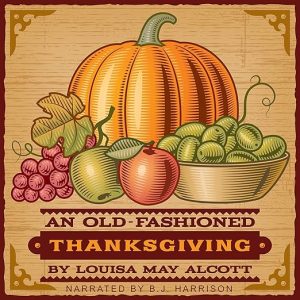
Louisa May Alcott's An Old-Fashioned Thanksgiving arrives as an audiobook running just over an hour, which is exactly right for what the story is: a charming domestic comedy about eight children left to manage a Thanksgiving feast they have no idea how to prepare. This is not the Alcott of March family drama and moral weight. It is Alcott in a lighter register, writing a story that she herself set in an era earlier than her own childhood - a story already nostalgic at the moment of its creation, now doubly so in the twenty-first century. Context matters for understanding how to approach this recording: the story was published in 1882, and Alcott deliberately chose a setting that would have felt old-fashioned even to her original readers. B.J. Harrison understands this, and he does not push the text toward period caricature.
Eight Kids Take Over a Thanksgiving Feast
The story turns on a simple premise: Mother and Father receive word that Grandma is failing, and they leave suddenly for her farm, entrusting the Bassett household to their oldest daughters, Tillie and Prue. Eight children are now responsible for a Thanksgiving feast, armed with good intentions, limited supervision, and no real knowledge of how plum pudding or stuffed turkey actually works. The comedy that follows is gentle and observational rather than farcical - Alcott finds humor in the gap between children's confidence and their competence, which is a comic vein that has not aged out of appeal across more than a century.
What reviewers highlight consistently is how unknown this story remains even to dedicated Alcott readers. One reviewer notes she had not come across it despite having read Alcott for years, and that discovery felt like a genuine find. That relative obscurity is partly a function of the story's brevity - it has not received the sustained pedagogical attention given to Little Women - and partly because its domestic holiday subject has kept it filed in the seasonal category rather than the literary one. The audiobook format, with its single-sitting accessibility, corrects for that somewhat and makes the story available to listeners who would not seek out the print edition specifically.
B.J. Harrison Matches Alcott's Warm Formal Register
B.J. Harrison's narration is a genuine asset. He is a narrator known for classical and period literature, and the voice he brings to this - measured, warm, slightly formal without stiffness - matches the register of Alcott's prose. The story is explicitly family-facing, and Harrison reads it in a way that works across ages: young children will follow the kitchen comedy with delight, while adults and older students will pick up the elegiac quality underneath the humor, the sense that Alcott is describing a way of life already fading even as she wrote it down. That dual register is one of Alcott's characteristic gifts in shorter fiction, and Harrison preserves it without making it explicit.
One reviewer notes the story is excellent for gifted elementary readers ready for above-grade-level material, and the audiobook reinforces that assessment. A child who has only encountered Alcott through Little Women will find the Bassett children recognizable in their energy and uncertainty, but the stakes are lower and the tone is lighter, which makes this a gentle entry or re-entry point for younger listeners. The hour passes easily, and the cooking-disaster comedy in the middle section is genuinely entertaining for child listeners who enjoy watching fictional children make a complete hash of adult responsibilities.
Adaptation Rather Than a Verbatim Reading
Listeners should be aware that the version narrated by Harrison has been noted by at least one reviewer as an adaptation rather than a verbatim reading of Alcott's original text. This distinction matters for educators or collectors seeking the unabridged original: the Harrison recording alters some material. That listener was disappointed; others may not notice or mind the difference. But it is worth confirming before purchasing if textual fidelity is a priority for your specific use case.
The story's brevity - just over an hour - may feel short relative to the purchase decision for some listeners. It functions best as a standalone holiday listen rather than a chapter-per-session serialized experience. The resolution is warm without being saccharine, which is typical of Alcott's craft in shorter fiction: she earns the comfort of the ending through specific comic suffering rather than simply declaring a happy outcome. Families looking for seasonal audio content around Thanksgiving will find the story's pacing and tone well suited to that purpose.
Seasonal Pick for Families and Alcott Completists
Families looking for seasonal audio content will find this an easy recommendation. The story works for children roughly ages seven and up, and adults listening alongside younger children will find enough authorial craft to stay genuinely engaged rather than just enduring the content. Alcott completists and educators who know only the major novels will find genuine value in encountering this lesser-known work, which shows a different and lighter side of Alcott's storytelling.
Listeners who need unabridged Alcott may want to verify the specific recording against the original text before purchasing. And for anyone approaching this as a piece of American literary history, it rewards a little background reading about when and why Alcott wrote it - the story was published in a holiday annual and reflects her own complicated relationship to nostalgia, domesticity, and the kind of family life she spent her career both celebrating and quietly examining. At just over an hour, it asks very little and delivers warmth and humor in steady supply.
Is this audiobook an abridged or adapted version of Alcott's original story?
At least one reviewer notes that the B.J. Harrison narration is an adaptation rather than a verbatim reading of Alcott's original text. Listeners who need the unabridged original for educational or collection purposes should verify this before purchasing. Those primarily looking for an enjoyable family listen may not find the distinction significant.
What age range is this audiobook most suitable for?
The story works well for children from about age seven upward. One educator reviewer recommends it particularly for gifted students ready for above-grade-level material. Adults listening alongside children will also find the Alcott prose engaging - the story does not condescend to younger listeners while remaining fully accessible to them.
Is this audiobook long enough to justify a purchase, given it runs only about an hour?
At just over an hour, this sits at the short end for standalone audiobooks. It works best as a seasonal listen around Thanksgiving or as a classroom supplement rather than a primary purchase for year-round listening. The brevity is faithful to the source material, which Alcott wrote as a short holiday story for an annual publication.