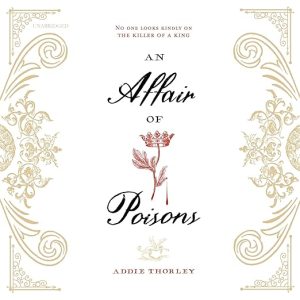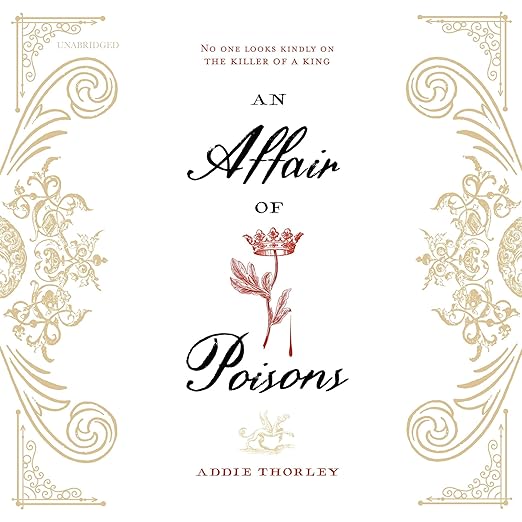
I started An Affair of Poisons on a Tuesday evening expecting a light YA fantasy and found myself still listening past midnight because Addie Thorley had constructed a moral problem I could not stop turning over. Mirabelle Monvoisin is not a passive heroine who stumbles into catastrophe. She actively participates in the assassination of Louis XIV, believing her mother's Shadow Society is working for the people, and then has to live with what she has done when the consequences reveal themselves to be something she cannot justify. That is a harder starting position than most YA fantasy attempts, and Thorley handles it without letting Mirabelle off the hook easily.
The historical grounding is real. The Affair of the Poisons was an actual scandal in 17th-century France, involving a network of poisoners, alchemists, and fortune-tellers who operated at the edges of the royal court. Thorley takes this history, adds a magical dimension in which the potions and curatives actually work, and constructs an alternate France in which the Sun King's assassination sets off a power struggle between the criminal Shadow Society and the remnants of the royal court. One reviewer noted that the book made them want to research the real scandal after finishing, which is the best possible endorsement of historical fiction doing its job.
The dual POV structure, alternating between Mirabelle and the bastard prince Josse de Bourbon, is one of the novel's genuine strengths. Josse is explicitly more kitchen boy than fils de France at the story's opening, and his transformation into a prince who can actually lead is earned rather than assumed. Reviewers have specifically praised the banter between the two leads, and Thorley uses their antagonism productively. They do not trust each other, they have every reason not to, and their alliance is built on necessity rather than attraction. That pragmatic foundation makes the eventual emotional development feel grounded rather than convenient.
Emily Woo Zeller is one of the more experienced narrators in the YA fantasy space, and her reading of this novel demonstrates why. The tonal calibration between Mirabelle's guilt-ridden interiority and Josse's increasingly pressured pragmatism is precise. She does not let either character slide into archetype, which is particularly important for a dual-POV structure where the risk of two-dimensional characterization is doubled. The Paris setting, rendered as dangerous and atmospheric as multiple reviewers describe, comes through clearly in Zeller's pacing choices.
Why An Affair of Poisons Works as an Audiobook
The historical detail is unusually dense for a YA novel, and Thorley wears it well. The Shadow Society is drawn from real figures in the historical record, and the author's note at the end of the audiobook explains what she changed and why. Several reviewers mentioned turning to research after finishing, which suggests the historical texture functions as an invitation rather than decoration. The magical system, in which alchemical potions have genuine power but their effects are unpredictable and morally weighted, integrates with the historical setting rather than sitting on top of it.
The female relationships in the novel are given more complexity than the genre often provides. La Voisin, Mirabelle's mother, is a genuinely compelling antagonist rather than a simple villain, and the dynamic between them drives the moral core of the story more than the central romance does. Mirabelle's attempt to separate herself from her mother's worldview while still operating within the world her mother has built is the argument the novel is actually making, and it is a more interesting argument than the rebellion-against-authority framework that YA historical fantasy usually defaults to.
Weak Spots in An Affair of Poisons
The novel is a standalone, which means it has to resolve its considerable plot in a single volume. Some readers may find the conclusion moves faster than the setup warranted, and the rebellion against the Shadow Society has a momentum in the final act that compresses what could have been a longer unfolding. This is a structural choice rather than a failure, but listeners who have been drawn into the historical texture of the first two thirds may find the climax slightly more generic in its action-sequence energy.
The romance between Mirabelle and Josse is secondary to the political and moral plot, which some readers will appreciate and others will find frustrating. Their relationship develops slowly and the emotional declarations, when they come, are understated rather than sweeping. For readers expecting a romance-forward YA experience, the pacing will feel restrained.
The Right Listener for An Affair of Poisons
YA listeners who want historical fiction with genuine period texture and a moral framework that does not simplify will find this among the more ambitious entries in the genre. It is particularly strong for those with an interest in 17th-century France or in how alternate history can illuminate real events. Emily Woo Zeller's narration is an added reason to choose the audio format. Skip it if you prefer your YA romance at the center rather than the edges, or if standalone narratives with high stakes and compressed resolutions are not your preference.
- Read by: Emily Woo Zeller handles the dual POV between Mirabelle and Josse with distinct vocal registers, maintaining the tonal difference between the alchemist's guilt-driven interiority and the bastard prince's forced pragmatism.
- At its heart: complicity and moral reckoning, unlikely alliance against a common threat, the weight of inherited identity
- Vibe: Atmospheric and urgent, with genuine historical texture beneath the fantasy overlay
- Short version: A dual-POV YA historical fantasy that takes its moral questions seriously and earns its romance through antagonism rather than convenience.