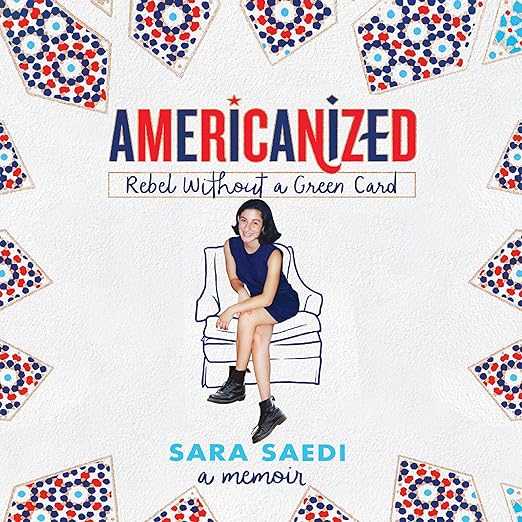
I finished Americanized on a Saturday morning when I had planned to do other things. That is the best endorsement I can give a memoir: I had it on in the background and then stopped pretending I was doing anything else. Sara Saedi's account of growing up undocumented in the United States is one of those books that refuses to behave the way you expect it to.
The premise alone is arresting. Saedi was two years old when her family fled Iran. She grew up in a California suburb, a straight-A student with a normal teenage life, until she discovered at thirteen that she didn't have a Social Security number and that her entire legal existence in the country she called home was uncertain. What happens next is not a trauma narrative, not exactly. It is something more complicated and more honest than that.
Our Take on Americanized
Saedi's great skill is her refusal to let the weight of the immigration story crush the ordinariness of her teenage experience. The book pivots constantly between the terrifying and the mundane: the prospect of deportation sits next to her desperation to get a date to prom, her parents' secret divorce to facilitate her mother's green card sits next to learning to tame her unibrow. One reviewer described it as "the right amount of teenage angst, awkward photos, and cast of warm characters that are screaming for a Netflix series," and that captures Saedi's tonal range exactly. She is funny in the way that people who have been genuinely frightened learn to be funny: as a survival mechanism that never fully obscures the fear underneath.
The revelation about her parents' immigration-motivated divorce is one of the memoir's most striking moments. Saedi treats it with the same mixture of bewilderment and retrospective understanding that characterizes the whole book. Her parents made extraordinary sacrifices in a system designed to make ordinary lives impossible, and she renders that clearly without resorting to either idealization or grievance.
Lameece Issaq's narration is what makes this audiobook specifically worth seeking out over the printed page. She inhabits Saedi's voice with a precision that feels less like performance and more like direct transmission. The comedic timing is sharp, the shifts into more vulnerable territory land cleanly, and she handles the bilingual and cultural texture of the material with evident fluency. Reviewer honeykrysp noted that the book "really penetrates the author's experience" and that quality comes through the narration as much as through the writing itself.
At just under six hours, the runtime moves quickly. This is a memoir that respects your time and does not pad itself. The interview at the end of the audiobook, mentioned approvingly by at least one reviewer, adds a useful coda that contextualizes how Saedi's situation eventually resolved and what she makes of it now.
What to Watch For in Americanized
One reviewer with a classroom context raised a fair caution: the book's representation of Iranian and Muslim experience is personal and specific to Saedi's secular, middle-class family, and teachers using it as a unit text should supplement it with other perspectives. That observation does not diminish the memoir's value, but it is worth naming for anyone expecting comprehensive cultural representation rather than a single person's story.
The book's light touch occasionally means it moves past moments that deserve more time. The emotional weight of Saedi's parents' manufactured divorce is acknowledged but not fully excavated. Readers who want depth over breadth on any single topic may feel the book skims. But Saedi is writing a coming-of-age memoir, not a policy document or a comprehensive portrait of the immigration system, and on those terms the balance is right.
Who Should Listen to Americanized
This audiobook belongs on the list for any teenager who has felt like a stranger in a place they have always called home, and for any adult who wants to understand what that experience actually looks like from the inside. It works in classroom settings for grades eight and up, though as noted above, supplementary reading is useful for fuller context. It will also land well for listeners who find immigration debates abstract and want something that makes the human specifics concrete and immediate. If your appetite runs to heavier, more analytical treatments of these subjects, Saedi is not writing in that register. What she offers instead is harder to find: a book that is genuinely warm about a genuinely frightening subject.
Before You Listen
How does Lameece Issaq's narration handle the Iranian cultural and linguistic elements in Americanized?
Issaq navigates the Persian words and cultural references with confidence and without exoticizing them. She brings a natural ease to the bilingual moments that adds authenticity to the teenage voice Saedi has written.
Does the audiobook include the interview mentioned in some reviews?
Yes. The Audible version includes an interview after the main narrative, which gives Saedi a chance to reflect on the events described in the book and update listeners on how her situation resolved.
Is Sara Saedi's family story representative of Iranian-American immigration experiences broadly?
No, and Saedi herself does not claim that. Her family is secular and middle-class, and her story is one specific slice of a much larger and more varied experience. The memoir works as a personal account, not as a representative survey.