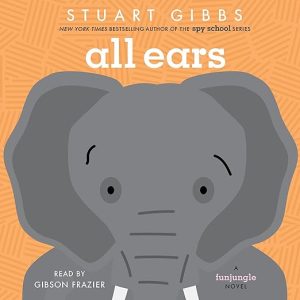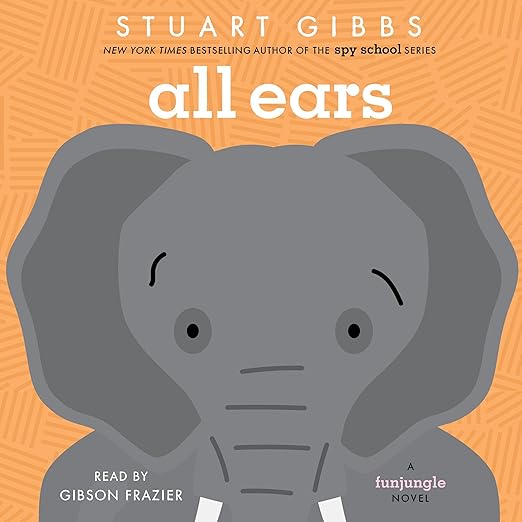
Can a missing elephant and a vandalism accusation share space in one middle-grade mystery audiobook without either plot feeling shortchanged? All Ears, the ninth FunJungle novel, makes the case that the answer is yes, and Gibson Frazier's narration is a large part of why. Stuart Gibbs has been building Teddy Fitzroy's world across nine installments now, and the formula, zoo-adjacent mysteries, animal stakes, and the particular social pressures of being thirteen and responsible for things that are not technically your problem, has not worn thin. It has gotten more confident and more emotionally specific as the series has progressed.
The setup this time involves a herd of elephants wandering onto a high school football field on a Friday night, which is exactly the kind of chaos the FunJungle series does best. When the herd is returned to the elephant sanctuary where they belong, a count reveals that Tanzy, a lone African elephant, is missing. Simultaneously, Teddy's best friend Xavier is accused of vandalizing a bulldozer at a construction site threatening a piece of beloved land the kids call TurtleTown. Teddy has to work both cases, which means the audiobook has twice the moving parts of a typical FunJungle entry and handles them both without losing momentum in either direction.
Frazier Keeps the Urgency High, Never Rushed
Gibbs has always been good at giving his animal-focused mysteries genuine environmental stakes without making them feel like lectures. The TurtleTown subplot is not subtle in its concerns about development and habitat destruction, but it earns its environmental argument through narrative rather than assertion. Xavier's predicament as the accused vandal gives Teddy a personal reason to solve this case that goes beyond his general appetite for problem-solving, and that personal dimension keeps the stakes human even as the elephant disappearance is providing the novel's most dramatic physical set pieces.
Frazier's narration handles the dual-mystery pacing with skill. Mystery audiobooks for middle-grade listeners have a specific requirement: the narrator must convey urgency without making the listener feel rushed, and must maintain the comic register that keeps the tone from becoming oppressively serious. Frazier does both. His version of Teddy is engaged and slightly exasperated in equal measure, which is the right characterization for a kid who keeps finding himself responsible for situations that no thirteen-year-old should be managing. He also handles the animal-related sequences with genuine enthusiasm, which matters for a series where the animals are as important as the human characters.
One Reviewer's Child Read It Four Times
Parents whose kids have been working through the FunJungle series will find this ninth entry one of the stronger recent volumes. Reviewers with children who have loved this series since they were ten or eleven note that it is the kind of series that creates habitual readers: kids who finish one book immediately want the next. The audio format works particularly well for this age group because the episodic structure and the clean chapter breaks make it natural to listen in sections without losing the thread.
At just over eight hours, All Ears is an appropriate length for middle-grade listeners, neither so short that it feels like a snack nor so long that it tests a young listener's patience. Gibbs writes at a pace that respects his audience's intelligence without overwhelming them with plot complexity, and the dual-mystery structure this time around actually adds momentum rather than confusion: the two cases generate their own urgency and create natural opportunities for the story to shift focus when one strand needs to breathe. One reviewer's child read it four times, which says something about how easily it sustains re-listening.
Full Pleasure Requires Time in Teddy's World
This is book nine in a series, and while Gibbs provides enough context that a new listener can orient themselves, the full pleasure of All Ears is available mainly to listeners who have spent time in Teddy's world already. The relationships with Xavier, with Teddy's parents, and with the wider FunJungle community all carry weight that is accumulated rather than established within this volume. New listeners may want to start at the beginning, or at least somewhere earlier in the series, before arriving here.
The elephant disappearance plot has a resolution that adult listeners may find relatively predictable, though middle-grade readers are less likely to see it coming. Gibbs is writing for his actual audience rather than performing difficulty for the adults who might be listening alongside them, which is the right instinct. The environmental messaging around TurtleTown is clear and a little insistent, but it is grounded in a real dynamic that kids who have watched development change landscapes around them will recognize immediately. Gibbs is not preaching so much as accurately describing how that conflict looks to a twelve-year-old who loves a piece of land.
Conservation-Aware Kids Find Extra Satisfaction Here
Middle-grade listeners ages nine to thirteen who enjoy animal-adjacent mysteries with humor and genuine stakes will find this audiobook exactly in their zone. Kids who love animals and have some awareness of conservation issues will get additional satisfaction from the TurtleTown strand. Series fans who have been with Teddy since the first FunJungle book will find this one of the more emotionally connected and structurally ambitious recent entries, with the dual-case format giving each thread room to develop. Adults looking for a family road-trip listen that holds adult attention while genuinely entertaining younger listeners will find that Gibbs has enough craft in his construction that it works across the age gap. New listeners should ideally start earlier in the series before arriving at this ninth volume.
At a Glance
- Performance: Gibson Frazier brings the right kind of energy to Teddy Fitzroy's voice: engaged, dry when the jokes land, and capable of the pacing shifts a mystery with multiple moving parts requires.
- What it covers: Animal conservation and development conflict, friendship and loyalty, middle-grade detective work
- Feel: Fun and fast-moving, with genuine stakes behind the comedy
- Our call: FunJungle's ninth entry gives Teddy two cases at once, and the dual-mystery structure is the most satisfying the series has offered in several volumes.
A Few Questions About All Ears
Does the All Ears audiobook work for listeners new to the FunJungle series, or should they start from the beginning?
Gibbs provides enough context to follow the plot, but the emotional relationships central to this ninth volume are built across prior entries. New listeners can start here, but the experience is richer with prior FunJungle context. Book one is the ideal starting point.
Is All Ears appropriate as an audiobook for younger children, or is it aimed specifically at the middle-grade range?
The FunJungle series is typically marketed at ages nine through twelve or thirteen. Younger listeners who are strong readers may enjoy it too, but the humor and mystery complexity are calibrated for the middle-grade range. There is no inappropriate content.
How does Gibson Frazier's narration hold up across a nine-book series?
Frazier is a consistent and well-matched narrator for Teddy's voice throughout the series. His performance here maintains the energy and comic timing that makes these mysteries work in audio format.
Does All Ears stand alone as a mystery, or do both plot threads from the audiobook require prior series knowledge to pay off?
Both plots are largely self-contained within this volume. The missing elephant case and the vandalism accusation are resolved here. What prior series knowledge adds is emotional depth around the characters, not resolution of ongoing storylines.