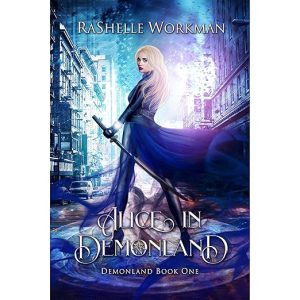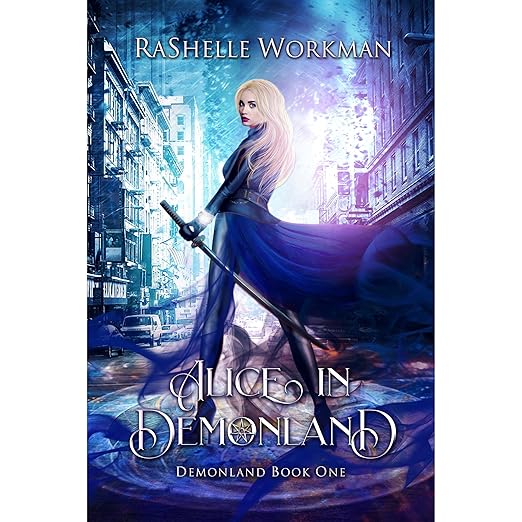
Alice Blackburn hunts demons instead of falling down a rabbit hole, and RaShelle Workman rebuilds Lewis Carroll's premise from the ground up across a tight two hours and forty-six minutes of audiobook time. Alice is half-demon herself, raised entirely inside a place called Demonland, and her single defining goal going into this story is defeating the demon sire she has spent her whole life training to fight.
The premise takes Carroll's Wonderland cast and reworks it through a specific, clever mechanic: Alice's sire is one of the seven deadly sins made literal, and she does not know which one until a warrior named Kade Everett fights his way into her orbit and complicates everything. Wrythe, king of the Dark Moths, orders her to investigate exactly who Kade is, a task that stops being simple the moment she starts developing feelings for the person she is supposed to be interrogating.
Is Alice in Demonland Worth Your Time?
Virtual Voice, Amazon's AI narration, reads this one, and character-driven fantasy is consistently one of the toughest tests for synthetic narration to pass convincingly, since it demands more vocal range than flat expository delivery alone. Three distinct voices need real differentiation here: Alice's guarded, mission-focused first-person perspective, Kade's warrior charisma, and Wrythe's authority as a demon king giving orders, and AI narration's flatness tends to show most clearly exactly where emotional stakes and character voice matter most, which is most of this book.
List-driven nonfiction or straightforward exposition tends to survive AI narration better than this kind of dialogue-heavy, romance-inflected fantasy does, since the format depends on vocal warmth and differentiated character delivery to land its emotional beats. Listeners who care primarily about plot mechanics may find the story comes through regardless; listeners who want a fully performed Kade-and-Alice romance dynamic should sample before committing.
A sub-three-hour runtime actually works slightly in Virtual Voice's favor here, in one specific sense: less total time exists for a flat delivery to wear on a listener's patience compared to a multi-book series marathon, even though the fundamental character-differentiation weakness remains present throughout. Listeners drawn primarily by curiosity about the premise, rather than a specific attachment to performed narration, may find the short commitment lowers the stakes of that tradeoff.
The seven-deadly-sins mechanic is the cleverest thing about this retelling: instead of a single demon sire, Alice faces the possibility that her enemy could be any one of seven distinct archetypes, giving Workman a built-in structure for mystery and suspicion that a straight Wonderland retelling would not have. Reviewer menab calls the result 'very original,' with a plot that is entertaining and new despite working from such familiar source material.
Laura Drake's review highlights the same seven-sins concept as interesting while praising how Workman builds a world within the world readers already know, using Carroll's familiar shape as scaffolding rather than simply borrowing his character names. G Harvey's short, enthusiastic review calling it a cute short story worth returning to signals this works well as a low-commitment entry point into Workman's much larger interconnected universe of series.
Wrythe's title, king of the Dark Moths, is a small but telling worldbuilding choice: moths specifically, drawn to light yet associated with night and decay, gives Workman's demon hierarchy a specific visual identity distinct from the generic demon-king shorthand a lazier retelling might reach for. Small naming choices like this one are where a short book like this earns real credit for internal consistency despite its brief runtime.
Kade Everett's introduction, described as fighting his way into Alice's life rather than simply meeting her, sets a specific tone for the romance from its first appearance: conflict and combat function as the meet-cute mechanism here rather than a more conventional first encounter, consistent with the book's action-forward, plot-first approach to pacing throughout.
The book's title itself does real work worth noting: Demonland replaces Carroll's Wonderland with a single deliberate swap that signals exactly how literally Workman intends her inversion, danger and moral peril standing in for whimsy and nonsense, while keeping the original's sense of a strange, rule-bound alternate world fully intact underneath the darker premise.
Before You Commit to Alice in Demonland
At under three hours, this reads as a fast, plot-forward introduction rather than a fully developed slow-burn romance, and Laura Drake's honest critique that the characters fell in love too quickly is worth taking at face value. Listeners who want a gradually earned romantic arc, rather than an efficient one, should adjust expectations for a series opener built to move fast toward its next installment.
This is book one of the Demonland series, which itself sits inside Workman's much larger Seven Magics Academy World, a sprawling web of interconnected retellings, Cinderella, Rapunzel, Sleeping Beauty, and more, that share a universe without requiring each other as prerequisites. Listeners do not need to have encountered any of those other series to follow Alice's story, but anyone who enjoys this one has a genuinely large catalog of related spinoffs waiting afterward.
The sheer size of Workman's connected catalog, listed in full within this book's own synopsis, functions almost like a menu for listeners who finish Alice in Demonland wanting more: retellings of Cinderella, Rapunzel, Sleeping Beauty, and Beauty and the Beast all exist within the same Seven Magics Academy World, giving genre fans a large backlist to explore without needing to track a single, strictly linear reading order.
Listeners should also know this operates as a genuine series opener rather than a complete, standalone story; three more entries, Alice Fights Demonland, Alice Takes Demonland, and Alice Ignites Demonland, continue Alice's central conflict directly, so listeners who enjoy this introduction should plan on continuing rather than expecting full closure by the end of book one.
Should You Listen to Alice in Demonland?
Teen and young adult listeners who enjoy fast-paced paranormal romance with a fairy-tale retelling hook are the clearest audience, and the 4.2-star average across 654 ratings suggests the formula works reliably for readers already primed for this kind of series fiction. Anyone curious about Workman's wider catalog could reasonably start here, since Demonland functions as a self-contained entry point rather than requiring prior knowledge of her other interconnected series.
Listeners who specifically enjoy fairy-tale retellings that commit hard to a new mechanic, rather than simply relocating familiar characters into a new setting, should find the seven-deadly-sins framework here more inventive than the genre's average entry, even within a short and fast-moving runtime.
Short-runtime YA fantasy like this one often gets compared unfavorably to longer, more detailed epic fantasy, but the format serves a real, distinct purpose: a fast, low-commitment way to sample an author's voice and central concept before investing in a much longer connected universe, exactly the role Alice in Demonland plays within Workman's wider catalog of series.
Listeners who prioritize narration quality and performed character voices above plot mechanics should sample the Virtual Voice narration before committing, since AI narration remains a real limitation for dialogue-heavy fantasy romance specifically. Readers who prefer a fully self-contained single title, rather than an entry point into a sprawling multi-series universe with dozens of connected spinoffs, may find Workman's wider catalog more commitment than they actually want.
A Few Questions About Alice in Demonland
Is this audiobook a faithful retelling of Alice in Wonderland, or a loose inspiration?
A loose inspiration. Workman borrows Carroll's basic framework, the name Alice, a strange alternate world, but rebuilds the plot entirely around demon hunting and a seven-deadly-sins mechanic rather than following the original story's events.
Do I need to read Workman's other series before starting this audiobook?
No. Demonland functions as a self-contained entry point into Workman's larger Seven Magics Academy World, and this specific series can be enjoyed without prior knowledge of her other interconnected titles.
Is this audiobook long enough to feel like a complete story, or does it end mid-plot?
At under three hours, it reads as a fast, complete introduction to the central conflict and romance setup, though as book one of an ongoing series, larger questions clearly carry forward into the next installment.