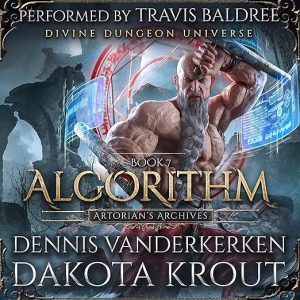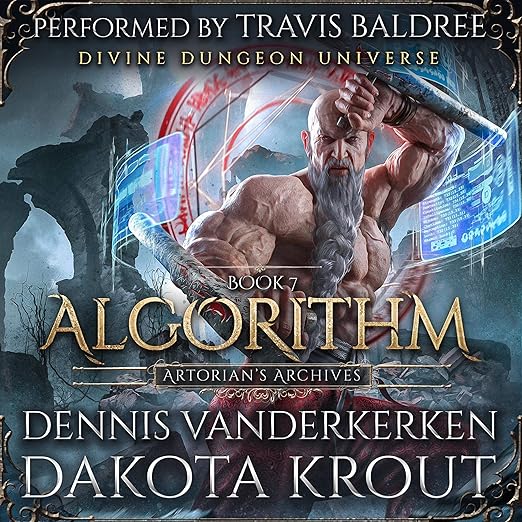
I came to Algorithm in the middle of a work trip, earbuds in, walking between gates at an airport, and the absurdist energy of a senior citizen navigating a broken game world while causing administrative chaos for a dungeon overlord felt exactly right for that context. Dennis Vanderkerken's Artorian's Archives series operates in a very specific register: comic LitRPG with genuine heart, anchored by a protagonist whose core characteristic is the willingness to find and exploit every gap in whatever system he has been dropped into. By book seven, that formula is well established, and Algorithm commits to it fully.
For new listeners: Artorian is an elderly scholar-turned-essence-user who has a history of surviving impossible situations through a combination of optimism, lateral thinking, and what the synopsis calls parkour through the rafters when a direct route is unavailable. In this installment, he has surrendered his administrator privileges and been thrust into Eternia, a game world that is essentially a work-in-progress held together with glue and moody pylons. The book is structured around his attempt to speed-run this broken environment while simultaneously fixing its more egregious construction flaws, all while giving the Paragon of Order increasingly severe conniptions.
Eternia's Wireframe Becomes Artorian's Playground
Vanderkerken uses the LitRPG format differently from most authors in the genre. Where LitRPG often treats its numerical systems with earnestness, the Artorian's Archives series treats them as obstacles that a sufficiently clever and cheerful protagonist can dismantle from the inside. Eternia's wireframe structure, riddled with more holes than a wheel of dire cheese, is less a challenge to overcome than a playground to exploit. The comedy comes from the gap between what the system expects and what Artorian actually does.
This creates a particular kind of pacing that reviewers consistently describe as sassy, fun, and action-packed. One reader noted that it was filled to the brim with pop-culture references, which is accurate. The references are thick on the ground and delivered with a lightness that makes them feel like bonuses rather than intrusions. If you have been with the series since the beginning, they will often land as callbacks to earlier material rather than purely external references, which adds another layer of reward for long-term listeners. The book is self-aware without being self-indulgent, which is a fine line in comedy fantasy and one Vanderkerken generally manages well.
Baldree's Comic Timing Carries the Dragon's Chapters
Travis Baldree is the correct narrator for this series in the way that certain actors are simply correct for certain roles. His delivery of Artorian is warm without being saccharine, energetic without being exhausting, and precise in its comic timing in ways that make the difference between a joke landing and a joke merely existing. The dragon's point-of-view sections, which one reviewer specifically cited as particularly entertaining, require a narrator who can hold the internal logic of a character who believes every problem can be eaten, and Baldree delivers that with apparent delight.
At twelve hours, the book is generous without being padded. The various mission threads, rescuing a princess from one of the most powerful crime lords in the world, managing a goblin horde threatening the dwarf kingdom, and navigating Eternia's construction flaws, are woven together with enough momentum that the runtime does not drag. One reviewer noted that the book felt short despite the runtime, which is the highest praise this kind of entertainment writing can receive.
Found Family Stakes and Eternia's Deeper Lore
By this point in the series, the emotional investments have accumulated enough that smaller character moments carry genuine weight. The relationship between Artorian and his extended found family, the young dragon, the vampire who gets impaled repeatedly, the elf with a property damage fixation, the bureaucrat who has mastered the frying pan as a weapon, is well enough established that new threats to that family have real stakes. The war on the horizon in this installment is not merely a plot device; it is a threat to people the listener has spent six previous books caring about.
Vanderkerken also deepens the game-world lore in ways that reward attentive listeners. The relationship between Eternia and Eternium, the dungeon overlord who keeps getting headaches from Artorian's maneuvers, gets more complex texture here than in earlier books. The lesson Timmy delivers to the goblin horde, never get into a war of attrition with a necromancer, applies equally to the reader who underestimates how much work this series is doing beneath its comic surface.
Newcomers to LitRPG Should Start at Book One
If you are at book seven, you do not need a recommendation; you are already committed. If you are new to the Artorian's Archives series, start with book one. The comedy is funnier, the found family more moving, and the LitRPG mechanics more interesting when they are accumulated across the full run. For fans of comic LitRPG more broadly, this series is one of the cleaner examples of what the genre can do when it has genuine wit rather than just systems and numbers.
Newcomers to the LitRPG space who are looking for an entry point into the genre via comedy rather than straight progression mechanics will find the Artorian's Archives series a welcoming introduction. It treats the numbers and systems as tools for the character rather than as the point of the exercise, which is the mode that tends to sustain long series rather than burning out after the initial novelty of the mechanics wears off. By book seven, the series has clearly found its sustainable form.
Key Details
- Narration: Travis Baldree is essentially the voice of LitRPG comedy at this point, and his performance in this series installment is as energetic and precise as the material demands.
- Themes: rules and how to break them, identity outside established systems, found family under pressure
- Mood: Playful and fast, with genuine warmth underneath the chaos
- Verdict: Exactly what the series has trained you to expect: an old man in improbable circumstances, scheming enthusiastically, narrated by someone who clearly enjoys every moment.
Can Algorithm be listened to as a standalone entry, or is the full series context necessary?
The series context is important. By book seven, the emotional weight of character relationships and the humor of the LitRPG systems both depend on accumulated knowledge from earlier volumes. New listeners will follow the plot but will miss most of what makes the comedy and the stakes work.
How does Algorithm compare to earlier Artorian's Archives books in terms of tone and content?
Reviewers describe it as very much in the established series mode: sassy, fun, and action-packed. One reviewer noted it flowed better than the previous book. The main shift is the move into the Eternia game world setting, which allows more classic LitRPG mechanical humor while maintaining the core Artorian personality.
Are the pop-culture references in Algorithm disruptive or do they fit the tone?
They fit the tone. The series has always used pop-culture references as punctuation rather than as the primary source of humor, and by book seven they often work as series callbacks as much as external references. Listeners who enjoy this series' particular brand of self-aware comedy will find them rewarding.
Is Travis Baldree the narrator for the full Artorian's Archives series?
Yes, Baldree has been the consistent narrator throughout the series. His performance is frequently cited as central to the series' appeal in audio form, and by book seven his familiarity with the characters and their voices is evident in the precision of his comic timing.