- Performance: Mark Westfield handles a large ensemble of distinct male voices throughout the THIRDS series, and book five stretches that skill as Ash and Cael move from supporting players to protagonists.
- What it covers: Loyalty under pressure, identity and the closet, the tension between professional duty and personal desire in a world of hybrid species and paramilitary politics
- Feel: Action-charged and emotionally urgent, with longer character sequences than the earlier entries in the series
- Our call: The strongest emotional payoff in the THIRDS series so far, though listeners who have not read books one through four will have very little idea what is happening.
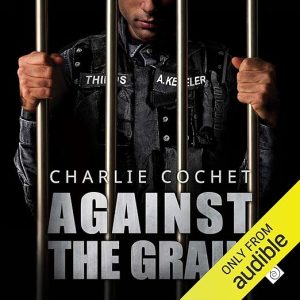
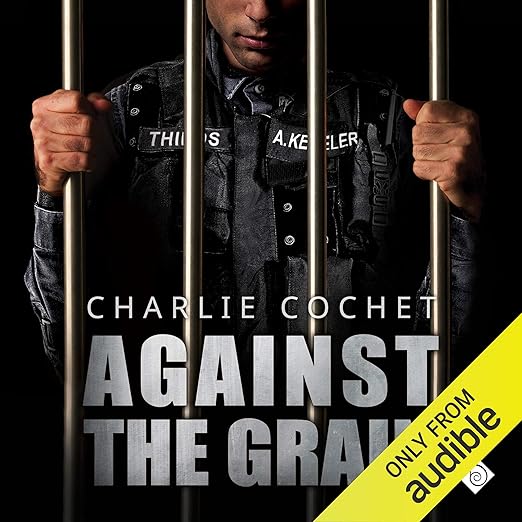
I will say upfront that Against the Grain is the fifth book in Charlie Cochet's THIRDS series, and there is no useful way to discuss it without that context. The THIRDS is a world where humans and Therians, people with the ability to shift into animal forms, coexist in a New York City policed by a joint paramilitary organization. The Destructive Delta team within that organization has been the focus of the series, and the earlier books have built a detailed social and emotional landscape that this installment assumes you know intimately.
That said, what Cochet has done with book five is structurally different from what came before, and the difference is significant enough to warrant attention. Where the earlier entries maintained a balance between case-driven plot and character development, Against the Grain leans heavily into the character story. The case here, which involves the aftermath of the Coalition's dismantling and a murder investigation tangled up with conspiracy within the THIRDS itself, is present but not dominant. What dominates is the relationship between Ash Keeler and Cael Maddock, two characters who have been circling each other across four books while both insisted the circling was not happening.
How Against the Grain Holds Up
Ash Keeler has been one of the series' most reliably abrasive presences: foul-mouthed, short-tempered, and deployed by Cochet as both comic relief and unexploded emotional ordnance. The setup of this book, in which Ash takes a bullet to save Cael and the near-death experience accelerates a reckoning with what he has been refusing to admit, is both the obvious destination for this arc and satisfying precisely because of how long and carefully Cochet has delayed it.
Cael Maddock brings the other side of the equation: he has known what he felt, survived heartache on the subject, and now has to navigate a situation where the person he loves is finally moving toward him but carrying considerable baggage about his own identity. One reviewer described the character story as genuine and wonderful, noting that the sex scenes serve the narrative rather than interrupting it. That is a meaningful distinction in this genre and one worth flagging for prospective listeners: this is emotionally motivated rather than gratuitously explicit, and the physical intimacy is positioned as character revelation.
Why Against the Grain Works as an Audiobook
Mark Westfield has narrated the entire THIRDS series and built a substantial set of distinct voices across a large ensemble. The complication that one reviewer identified is real and worth acknowledging: voices that worked as secondary characters do not always scale up to protagonist status without friction. Ash and Cael, who were vivid supporting presences in earlier books, now carry the narration for extended sequences, and there are moments where Westfield's choices for them as supporting players feel slightly incongruous when they become the primary focus of the listening experience.
This is not a fatal problem, and most listeners who have been with the series since book one will have acclimated to those voices sufficiently that the transition reads as continuity rather than dissonance. But it is worth knowing going in that the performance occasionally shows the seams of an oral history built cumulatively rather than designed from the start with these two characters as leads. Westfield's overall command of the ensemble remains impressive, and the action sequences benefit from his ability to maintain clarity across a cast that grows in nearly every installment.
What to Watch For in Against the Grain
The mystery at the center of Against the Grain, involving a murder with links to a conspiracy within the THIRDS organization, functions less as a standalone puzzle and more as pressure applied to the personal story. This is a legitimate choice. Series readers who have reached book five are not primarily there for procedural resolution; they are there for emotional payoff accumulated across four books of investment. The mystery delivers on its responsibility to create stakes and to force the characters into situations where their feelings about each other cannot be deferred any further.
Where the balance occasionally wobbles is in the middle section, where the character work is sustained at length and the mystery recedes almost entirely. One reviewer who loved the book still noted long stretches without suspense or mystery. For listeners who came to the series for its action-thriller dimensions, those stretches require patience. For listeners primarily invested in Ash and Cael as people, those same stretches are the payoff they have been waiting for.
Who Should Listen to Against the Grain
Against the Grain is not an entry point. The THIRDS series requires sequential reading from book one, and the emotional weight of the Ash and Cael resolution in this installment is entirely dependent on the four books of context that precede it. Listeners who attempt to begin here will find themselves in a world of established relationships, ongoing conspiracies, and references to events they have not witnessed, and the experience will be confusing rather than engaging.
For readers who have been with Destructive Delta since the beginning, this is the book the series has been promising. The team dynamics remain one of Cochet's most distinctive achievements: a found family that functions like a professional unit until the professional and personal dimensions become impossible to keep separate, which is exactly what happens here. The series as a whole continues to reward listener investment, and Against the Grain delivers on the specific promise it made at the end of book four in a way that should satisfy dedicated followers of the THIRDS world.
Good to Know
Does Mark Westfield's narration work as well for Ash and Cael as protagonists as it did for them as supporting characters?
Mostly yes, with some minor friction. Voices built for supporting roles do not always scale perfectly to extended protagonist status, and some reviewers noticed the seams. Most series listeners who have spent four books with those voices will adapt quickly, but it is worth knowing the transition exists.
How explicit is the romantic content in Against the Grain compared to earlier THIRDS books?
The physical content is present and meaningful to the character arc rather than gratuitous. Reviewers have specifically noted that the intimacy serves the narrative, revealing character rather than interrupting the story. The content is consistent with the series' established approach across prior installments.