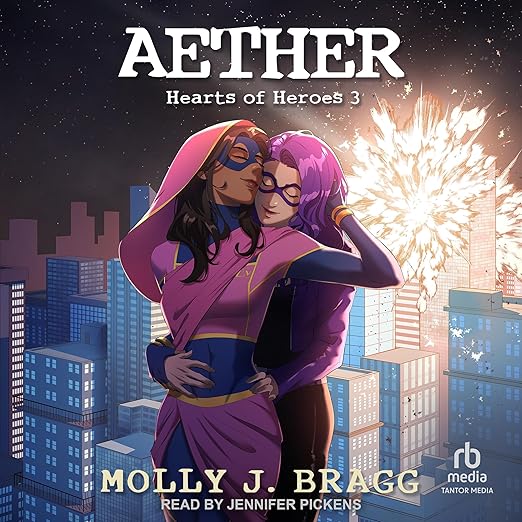
A lab accident next door, set off by her best friend's ex-boyfriend, is all it takes to give Maggie Bennett superpowers she never asked for. Did she want to spend her research sabbatical fighting crime instead of running her own experiments? Not particularly, but this audiobook, the third entry in Molly J. Bragg's Heart of Heroes series, does not really give her a choice once Sierra's lab explosion leaves her gifted and in the custody of the High Guard, Sun City's marquee superhero team. Between learning to control her new abilities and dodging blame for the explosion, Maggie also has to contend with Varsha, a speedster who keeps turning up with homemade ice cream and an invitation to lesbian movie marathons, and with Garrett, the supposedly dead ex-boyfriend who turns out to be very much alive and after dangerous alien technology tied to Maggie's own past.
Training Finally Gets Taken Seriously Here
What sets this entry apart from earlier Heart of Heroes books, according to the people who have read the whole series, is how seriously it takes the actual mechanics of becoming a superhero rather than treating powers as an instant plug-and-play upgrade. One longtime reader put it directly: "none of the other books got quite so into the training of a superhero aspect of things," calling that shift "really interesting and fun." Another reviewer, clearly invested in the series as a whole, wrote that they were "certainly not disappointed" by this latest entry, having been "always excited when another entry to the Hearts of Heroes series drops." That kind of standing enthusiasm, built up across multiple prior installments, is a strong signal that Bragg has kept her world and cast consistent enough to reward continued investment.
Maggie Investigates Instead of Waiting to Be Rescued
The central romance gets real room to breathe alongside the superhero plot, and Bragg lets Maggie's scientist instincts stay front and center even after she is pulled into a world of capes and secret identities; she is investigating Garrett's plot to steal alien technology using her own research background, not just waiting to be rescued, and the synopsis itself frames her arc precisely: she is "pushed into the role of a reluctant Superhero," not someone who ever dreamed of capes and secret identities. That balance between competence and vulnerability is where the book's emotional core actually lives, and it gives Maggie a distinct identity within the High Guard roster rather than making her just another set of powers waiting to be trained.
Bragg also keeps the High Guard itself from feeling like generic superhero furniture. The team is actively helping keep Maggie and Sierra from getting blamed for the explosion even while training Maggie to use her new powers, and that layered, not-fully-trusting dynamic keeps the found-family arc from feeling too easy or pre-ordained. It also gives Aether a slightly different flavor of reluctant-hero story than most superhero fiction offers: Maggie is not just unsure she wants these powers, she is not even fully trusted by the team meant to be training her, and that double bind is what keeps her partnership with Varsha feeling earned rather than incidental to the plot around it. Sun City itself functions as more than backdrop, a place with its own superhero infrastructure and history that Maggie has to learn on the fly, alongside her powers and her feelings for Varsha, in the same compressed timeframe, all while a superhero team that is supposed to be protecting her keeps her formally under investigation.
Pickens Brings a Quieter Register to Capes
Jennifer Pickens' most directly comparable prior narration work sits in restrained literary and women's fiction, where her controlled, unhurried register lets a guarded protagonist's competence read as armor rather than quirk. That is a genuine, if not perfectly matched, asset here, since Maggie herself spends much of the book processing real trauma underneath the superhero plot, and a narrator who resists over-performing emotional beats should serve that undercurrent well even in a book with more overt banter and action than Pickens' prior credited work. The ice-cream deliveries and movie-marathon courtship with Varsha need warmth without whimsy tipping into parody, while Garrett's return needs real menace, and both registers ask something a little different of a narrator whose strongest confirmed work leans quieter.
What ties those two demands together is Maggie herself, a scientist first who keeps approaching her own transformation the way she would approach a research problem, methodically, skeptically, and a little reluctantly. A narrator who can let that clinical curiosity coexist with real fear and real romantic interest, without flattening any one of the three, gives the book's central voice the same layered quality the synopsis itself promises.
A 4.8 rating across 290 ratings is a genuinely strong number for the third entry in an ongoing series, and the specificity of the fan reaction, readers naming the series by title, tracking a particular character's arc across multiple books, suggests genuine investment rather than casual, one-off praise.
Spice Runs Lighter Than Series Regulars Expect
At least one longtime reader flagged a lighter spice level than they expected from this entry, writing plainly that "my only real complaint about the book is the lack of spicy scenes." Readers coming in expecting the same heat level as other entries in the series, or as other superhero romance generally, should recalibrate expectations toward a book that leans more on emotional and relational tension than on graphic content.
This is also the third book in an ongoing series, and while Maggie's own story is reasonably self-contained, the shorthand around the High Guard's existing dynamics and Sierra's history with the team will land more fully for listeners who have already spent time with the earlier two books.
Maggie's Choices Do Not Sit Well With Everyone
Superhero-romance readers already invested in the Heart of Heroes series will get exactly what they are looking for here, a new protagonist with a distinct voice, a genuine romance, and, for the first time in the series according to longtime fans, real attention paid to what learning superpowers actually involves. LGBTQ+ readers looking for a queer romance with capes-and-secret-identities stakes rather than contemporary realism will find plenty to enjoy even without prior series knowledge.
One reviewer's own review title said it succinctly, "loved the book but not Maggie's choices," a reminder that Maggie's decisions throughout the story do not sit equally well with every reader; listeners who prefer protagonists whose choices go largely unquestioned by the fan base should know at least one dedicated reader came away with real reservations about how Maggie handles her own relationships.