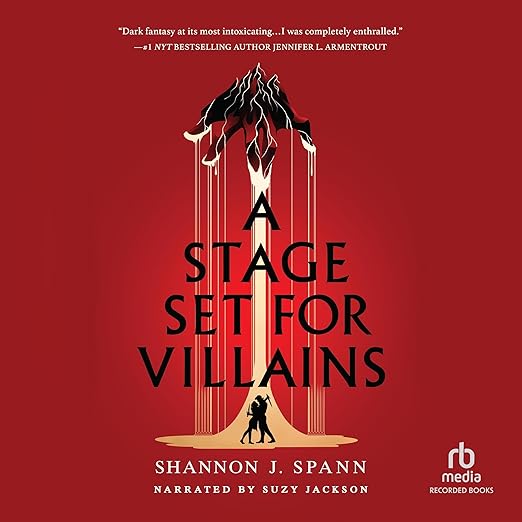
In Brief
- Voice: Suzy Jackson's performance matches the theatrical setting precisely, capturing both Riven's desperation and the Playhouse's menacing glamour.
- Big ideas: Identity and self-deception, the line between hero and villain, immortality's cost
- Atmosphere: Dark, lush, and increasingly unsettling
- Worth it?: Shannon Spann's debut earns its sixteen-hour runtime through sustained craft and a twist that makes you reconsider the entire narrative.
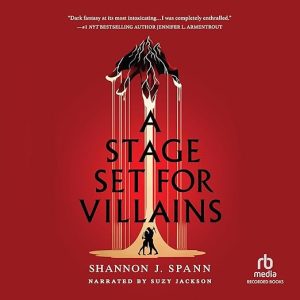
Shannon J. Spann's debut audiobook A Stage Set for Villains announces itself with a premise that is immediately distinctive: in a world where the gods have died, their replacements are the Players, a troupe of performers whose shows bend hearts, minds, and reality itself. The craft of this novel lies in how fully Spann commits to the theatrical metaphor. When Riven Hesper, our eighteen-year-old protagonist, infiltrates a competition that promises one mortal the chance to steal a Player's immortality, she is not just entering a contest. She is entering a story, and the Playhouse controls how stories end.
Spann structures the novel so that the theatrical frame is never merely decorative. Reviewers note the moments when dialogue shifts into literal script format, a creative choice that signals shifts in who is performing and who is being performed. For listeners, Suzy Jackson's narration makes this work; she handles the register changes with enough theatrical awareness to prevent them from feeling like typography tricks that do not translate to audio. The Playhouse itself is constructed as an institution with its own internal logic, its own hierarchy of Players and mortals, its own history of manipulation. Spann does not shortchange the worldbuilding.
The Review
The book has been compared to Caraval and One Dark Window, and both comparisons are apt for positioning purposes without being fully adequate to what Spann is actually doing. Like Caraval, the narrative takes place inside a competition with rules that shift and performers whose motives are opaque. Like One Dark Window, it has a female protagonist who discovers that her own nature is more complicated than she believed. But A Stage Set for Villains is darker than either of those comparisons might suggest, and its central revelation, that Riven may not be the hero of her own story, is handled with more conceptual rigor than the twist-in-dark-fantasy genre usually manages.
One reviewer who self-identifies as a theater kid describes finding the premise immediately resonant, noting that Spann builds on the "all the world's a stage" tradition in ways that feel fresh rather than derivative. Another calls it a "fantastic dark fantasy standalone," which is worth emphasizing: despite the richness of the world and the complexity of the Playhouse's backstory, Spann delivers a complete story without relying on sequel promises. That discipline in a debut is genuinely notable.
Why A Stage Set for Villains Works as an Audiobook
Suzy Jackson's narration is one of the audiobook's significant assets. Dark fantasy requires a narrator who can sustain an atmosphere of menace without making it exhausting, and Jackson finds that balance. Jude, the Lead Player whose charm is explicitly described as dangerous, requires particular care in performance; a narrator who oversells his charisma makes him cartoonish, while one who undersells it loses the reader's understanding of why Riven makes the bargain she does. Jackson calibrates Jude's register precisely, which is a small but consequential achievement across sixteen hours.
The runtime of sixteen hours and thirty-three minutes is one of the longer entries in the YA dark fantasy space. One reviewer flags this honestly, noting the writing is impressive but the book is "just too long," awarding three and a half stars rounded to four. That is fair criticism of the pacing in the middle section, where the competition's stakes can feel repetitive before the narrative acceleration of the third act. Listeners who engage with long fantasy immersions will not find this problematic; those who prefer their dark fantasy compact may want to know the pace is deliberate rather than efficient.
The Caveats
The book's central question, whether Riven is the hero or the villain of her own story, is not a gimmick appended to the climax. Spann plants the evidence across the entire novel, and one of the specific pleasures of a second encounter with the text, or of close listening during the audiobook, is noticing how many of the earlier scenes have a different valence once the ending reframes them. The magic system, which Spann calls Craft, is distinct from standard fantasy power frameworks; it is specifically theatrical, tied to performance and audience and the power that flows between them. Understanding how Craft works early in the narrative pays dividends in the final act.
The curse that is killing Riven at the opening of the novel is not explained quickly, and Spann is deliberate about parceling out information about its origins and implications. Listeners who need early exposition may find the setup pacing frustrating. Listeners who enjoy narratives that trust them to hold uncertainty while the picture develops will find the withholding well-managed. The Playhouse's secrets, which unravel into what the synopsis describes as "a disturbing picture," are revealed in an order that maximizes their impact rather than their clarity, which is a choice with both rewards and costs.
Who Should Pick Up A Stage Set for Villains
This audiobook is most directly suited for readers in the dark fantasy and YA spaces who have appetite for lush atmosphere, theatrical settings, and narratives that complicate the hero/villain binary. The theater-adjacent magic system gives it a strong niche appeal for listeners who are drawn to the performing arts as a metaphor. Those who want straightforward quest fantasy with clear moral categories will find Spann's narrative more morally ambiguous than they prefer.
As a debut standalone, it demonstrates that Spann has both the worldbuilding discipline and the structural intelligence to sustain a complete narrative without a sequel crutch. That alone distinguishes it from a substantial portion of the dark fantasy market. If you are drawn to the Caraval and One Dark Window comparison and want something with a harder edge and more conceptual ambition, A Stage Set for Villains delivers.
Is A Stage Set for Villains a standalone audiobook or the start of a series?
It is a standalone. Despite the richness of the Playhouse world and the complexity of the backstory Spann builds, the novel delivers a complete narrative arc without leaving the reader on an unresolved cliffhanger or requiring a sequel to feel whole.
How explicit is the content in this YA audiobook?
The content is dark fantasy with violence and menace but not explicit sexual content. The book is shelved as YA and contains the dark themes appropriate to that designation, including a curse, lethal competition, and morally complex characters. It is not graphic in a way that would concern parents of older teens.
At over sixteen hours, does the audiobook sustain momentum across its full runtime?
Largely yes, with one honest caveat: the middle section of the competition has a slower pace than the opening and closing acts. One reviewer flags this as the book being 'just too long.' If you listen in sessions rather than marathons, the middle sections are easier to sustain. The final act acceleration and the central twist make the investment pay off.