Quick Take
- Narrator: Mark Deakins brings a measured, intelligent delivery that suits Will's essayistic tone, though listeners wanting rowdier baseball energy may find the pace stately.
- Subjects: Baseball mythology, the meaning of fandom, Chicago history, the nature of loyalty and loss
- Tone: Reflective and fond, with enough wit to keep the sentiment from becoming pure nostalgia
- Bottom line: George Will at his most personal makes for a richer listen than his political writing, and Deakins's narration keeps pace with the book's blend of history and philosophy.
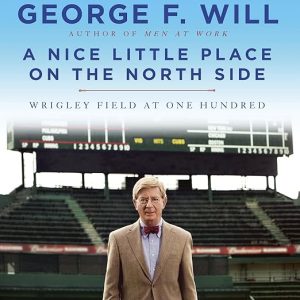
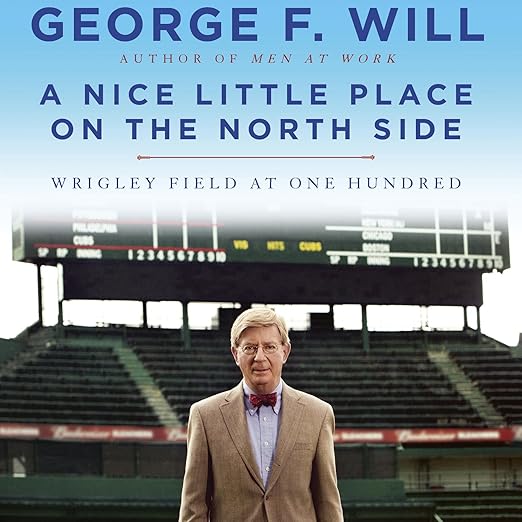
George Will's audiobook meditation on Wrigley Field is exactly as opinionated and as entertaining as you would expect from a man who has spent decades applying serious analytical frameworks to the game of baseball. A Nice Little Place on the North Side is not a conventional stadium history, and it announces that ambition early. Will wants to know what it means that people love a ballpark the way they love Wrigley, and he is willing to drag in the metaphysics of religion, the sociology of American civic life, and a good deal of personal memoir to find out. Mark Deakins narrates with a scholarly authority that fits Will's voice, and the five-hour running time moves without drag.
The book was written before the Cubs' 2016 World Series victory, and Will's meditation on perpetual futility reads somewhat differently now than it did at publication. That temporal shift does not damage the underlying argument; if anything, it adds a layer of interest to hear Will theorize about loyalty and loss in a context where the drought eventually ended. The broader claims about what Wrigley means in American life are durable regardless of what happened in Cleveland in October 2016.
Will is upfront about what he is doing: this is a meditation, not a documentary. He acknowledges Wrigley's myth and then tries to locate the truth underneath it, which involves some deflation of beloved stories alongside genuine celebration of the park's history. The reviewer Jack D notes that Will tries to portray his story from an elitist point of view, which is fair as a critique, but also describes something the book is self-aware about. Will knows he approaches the Cubs through a particular lens, and part of what makes this interesting is watching him acknowledge that and work through it anyway.
The historical material here is genuinely strong. Will traces the figures who shaped the park and the franchise, from William Wrigley himself through Bill Veeck, Leo Durocher, and Ernie Banks, with the kind of archival care that distinguishes real baseball writing from nostalgia-padding. The chapters on the park's early decades contain material that even longtime Cubs fans will find new, and the way Will situates Wrigley within Chicago's broader civic history gives the stadium a context that purely statistical or game-by-game accounts cannot provide.
The Best Parts of A Nice Little Place on the North Side
The audiobook format suits Will's discursive style particularly well. These are essays that build argument through accumulation, and listening to them read aloud by Deakins allows the rhetorical structure to land more clearly than skimming on the page sometimes permits. Deakins gives Will's periodic one-liners the appropriate beat before moving on, and handles the denser historical passages with enough pace to keep things from stalling.
Tom Erickson's review describes the book as engaging and chocked full of interesting history and anecdotes, while also noting it takes ample time to philosophize on the meaning of baseball and life. That dual nature is the book's actual subject: Will is not choosing between the historical and the philosophical registers but insisting that the two belong together. A baseball park is not just a place where games happen; it is an argument about what Americans care about and why. Deakins navigates between those registers smoothly, giving each its proper weight.
Before You Commit to A Nice Little Place on the North Side
Listeners expecting a purely celebratory account will need to adjust. Will is too honest a writer to let the mythology stand unchallenged, and some of the book's best passages involve him puncturing specific Wrigley legends that have been accepted as gospel for decades. That critical rigor is a strength, but it does mean the emotional register is more complex than the cover might suggest. This is not simply a fan's tribute to a beloved place.
At just over five hours, the audiobook is compact for the amount of ground it covers. Will does not linger, and listeners who prefer extensive quotation from primary sources and game-by-game recreation will find the treatment selective. The personal sections, particularly Will's account of his own childhood relationship with the team, are among the most affecting passages and provide the emotional anchor for everything that surrounds them. Those sections also serve as a reminder that the Cubs' long drought was not only a civic condition but a deeply personal one for the people who grew up with them.
Should You Listen to A Nice Little Place on the North Side?
Cubs fans are the obvious audience, but the book rewards any listener interested in the history of American baseball culture, the sociology of sports fandom, or Will's brand of essayistic argument. Jeff's review, describing taking a train from Michigan specifically to see a game at Wrigley and experiencing the park's particular atmosphere, speaks to the kind of reader who will find the most in these pages: people who understand that attending a game at Wrigley is not the same as attending a game at any other stadium and want someone to explain why that feeling is real rather than manufactured.
Non-Cubs fans who find the Wrigley mythology interesting without loving the team will get full value from the historical and philosophical sections. Listeners wanting pure statistics or a chronological game-by-game chronicle should look elsewhere; this is a thinking person's baseball book delivered without apology, and Deakins's narration serves that ambition well throughout the five hours.
Before You Listen
Does the audiobook work as a standalone listen, or do you need to know Cubs history going in?
Will provides enough context that the audiobook is accessible without deep Cubs knowledge. He explains who the key figures are and why they matter, making this suitable for general baseball fans or listeners interested in American sports culture without specific familiarity with the franchise.
How does Mark Deakins's narration handle the balance between Will's scholarly analysis and his more personal memoir passages?
Deakins manages the tonal range well. The analytical sections get a measured, confident delivery, while the personal material gets a slightly warmer register without becoming performative. It is a controlled performance that matches Will's prose style rather than trying to impose additional personality on top of it.
Is this audiobook primarily for Cubs fans, or does it have broader appeal for general baseball listeners?
Broader appeal than the premise suggests. Will uses Wrigley Field as a lens for examining what American stadiums mean in civic and cultural terms, and the historical material covers figures who matter to baseball history generally. Non-Cubs fans who are interested in baseball culture or in Will's essayistic method will find substantial content that is not franchise-specific.
How does this audiobook hold up for listeners who know the Cubs won the 2016 World Series, given it was written during the drought?
The core arguments about fandom, loyalty, and the meaning of Wrigley are durable enough to survive the championship. Some of the rhetoric around Cubs futility reads differently post-2016, but Will's historical and philosophical framing does not depend on the Cubs remaining losers. Most listeners report the book holds up regardless of when they come to it.