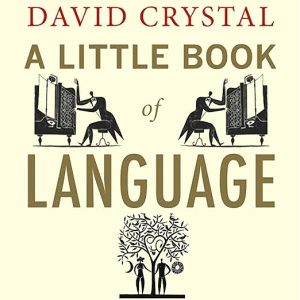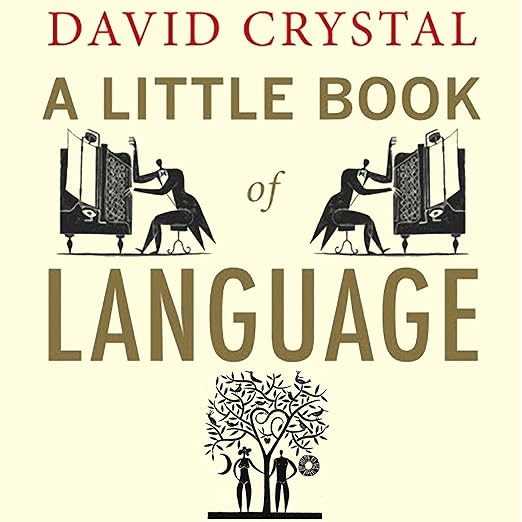
A Little Book of Language audiobook announces its ambition in its title's modest paradox. David Crystal, who is not a modest thinker, has produced something genuinely rare: a rigorous introduction to the history and current state of human language that a teenager could absorb, and that an adult linguist would not find condescending. Crystal is one of the world's most prolific and authoritative writers on the English language specifically, and language more broadly. His Cambridge Encyclopedia of Language remains a standard reference. That A Little Book of Language comes from the same author and aims at a young adult audience is not a demotion; it is a demonstration of the hardest skill in academic communication, making complexity accessible without making it false.
How A Little Book of Language Holds Up
Derek Perkins handles the narration, and his voice suits the material well. Crystal's prose has what reviewers have called an avuncular quality, the sense of someone who delights in sharing what they know and who assumes the listener is capable of following. Perkins captures that register without over-performing it. Across seven hours and twenty-two minutes, the listening experience maintains the feel of being in conversation with someone who knows an enormous amount and wants to give it to you without making you feel outpaced.
The scope is genuinely broad. Crystal moves from the first sounds an infant makes, through the development of writing, to the rise of unique dialects, regional accents, and the text-message shorthand that emerged as a new linguistic register in its own right. He addresses endangered languages, noting that a language disappears roughly every two weeks, with the same care he brings to successful revitalization efforts. Welsh is often cited as a case study in the latter, and Crystal, who is himself Welsh, brings a particular investment to those sections. He then turns to the future: how technology is reshaping reading, writing, and spoken communication in ways that are still mid-process rather than settled outcomes. The Little Histories series, of which this is a part, includes similarly accessible narrative histories across multiple disciplines, and Crystal's entry stands as one of the stronger representatives of the series format precisely because language, as a subject, is not optional the way other academic fields might be for a given reader.
Why A Little Book of Language Works as an Audiobook
Reviewer Gregory J. Casteel, who planned to read the book over two weeks and consumed it in two evenings, captures something essential about what makes this material work in audio: it does not sag. Crystal builds momentum through curiosity. Each chapter opens a door that makes the next door worth opening. The audiobook format benefits particularly here because Perkins maintains pacing across transitions between topics, keeping the listener inside the broader arc even when individual sections could function as standalone essays.
Reviewer Sharon Overcast flagged something that speaks directly to the audio experience: the book makes visible the communications ability we take entirely for granted until it is lost. Listening to this material while using your own language, following a narrator, processing meaning in real time, brings its subject matter unusually close. The listening act and the subject of the listening exist in interesting proximity. Reviewer William Orr, who noted Crystal's standing as one of the foremost experts on English and language development, points out that the introductory level here is a genuine access point rather than a compromise: for someone without a linguistics background, this is where that education begins.
Crystal's enthusiasm for his subject occasionally means that certain topics receive more time than others based on what he finds most compelling. His treatment of text messaging and digital language, which was cutting-edge when the book was written, has dated somewhat in its specifics, but the underlying linguistic principles he applies to those phenomena remain current and accurate. The framework he uses to analyze how new communication technologies change linguistic norms applies as well to the platforms that emerged after the book's publication as to the ones it directly addresses.
Weak Spots in A Little Book of Language
The book targets a young adult audience, which means listeners who already have significant background in linguistics or sociolinguistics may find the introductory sections slower than they want. Crystal does not assume prior knowledge, and he explains foundational concepts with care. For listeners coming in without that background, the pacing is ideal; for those with advanced training in the field, certain sections will feel foundational rather than illuminating. The material rewards listeners who are genuinely new to thinking carefully about how language works, and those with deeper backgrounds will still find value in Crystal's synthesis and his treatment of specific topics like language revitalization and the politics of linguistic identity.
The Right Listener for A Little Book of Language
Anyone who has ever been genuinely curious about why different accents exist, what happens when a language dies, how writing began, or how texting changed the way young people write will find Crystal's audiobook a satisfying and substantive companion for those questions. The young adult framing should not deter adult listeners; Crystal's level is more accurately described as accessible than simple, and the subject matter has no age limit. Educators and parents looking for audiobook material that opens up humanities and social science thinking for young listeners will find this an excellent choice. Skip it only if you already have significant formal training in linguistics and are looking for research-level analysis rather than a well-crafted narrative introduction. For everyone else, A Little Book of Language makes a strong case that linguistics is one of the more fascinating corners of the academic landscape.
Key Details
- Narration: Derek Perkins keeps Crystal's avuncular style intact, giving the material the feel of a knowledgeable guide walking alongside you rather than lecturing at you.
- Themes: Language history and evolution, endangered languages, the future of communication in a digital age
- Mood: Curious and warm, intellectually generous
- Verdict: David Crystal at his most accessible: a linguist who genuinely loves his subject and makes that love contagious across seven and a half hours.
Before You Listen
Is this audiobook suitable for adult listeners, or is the young adult framing limiting?
Adult listeners without a linguistics background report finding it fully engaging and substantive. The young adult label reflects the clarity of Crystal's explanations rather than any shallowness in the content.
Does this audiobook cover sign languages or languages beyond spoken English?
Crystal ranges well beyond English in this audiobook, addressing language diversity, endangered languages across multiple continents, and the nature of language as a human universal rather than specifically English linguistic history.
Does this audiobook address how social media and texting have changed language?
Yes. Crystal devotes attention to digital communication and text messaging as a new linguistic register. Some specific examples have dated since publication, but the linguistic principles he applies to those phenomena remain current and accurate.