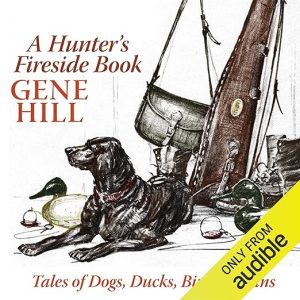
Before You Press Play
- Performance: Ray Childs is credited on a collection whose effects hang on restraint, since Hill's essays turn on one quiet closing line.
- What it covers: Hunting as memory, dogs, weather, male friendship, mid-century sporting life
- Feel: Warm, unhurried, nostalgic without apology
- Our call: A lovely short collection for anyone who already loves the outdoors, and a hard sell for anyone who does not.
What does an outdoor writer owe a listener who has never carried a shotgun at dawn? Gene Hill's answer, across the five hours and six minutes of this audiobook, is that he owes them the feeling rather than the instruction. A Hunter's Fireside Book collects short essays about duck blinds, dogs, weather and the company of friends, and almost none of it explains how to hunt anything.
Ray Childs is the credited narrator. The listing carries a 4.7 average across 328 ratings, a substantial pool for a sporting-essay collection, and the written notices stretch from 2010 all the way to 2025. Two of them were filed before this recording existed at all, which tells you the readership was firmly in place long before anyone thought to read Hill aloud.
Is A Hunter's Fireside Book Worth Your Time?
The publisher's description promises 'sunrises in the duck blind, an unforgettable hunter's moon, the camaraderie of men who know the pleasures of being wet and cold and a little bit lost', and that turns out to be an unusually accurate summary. Hill writes about the periphery of hunting: the drive out, the dog, the coffee, the failure, the friend who is not there this season. The bird, when it appears, is rarely the point.
A reader who followed Hill's column in Field and Stream supplies the best description of the effect, recalling that Hill's articles ranked as 'the first I would read each month'. That same reader credits him with putting words to feelings the outdoors produces in almost everyone and almost nobody can articulate. The claim holds up. Hill's sentences are plain, and the effects he pulls out of them are not.
Another notice, filed in 2010 by someone who had been reading Hill since the 1950s, lists exactly what the essays reactivate: 'the bite of a pre-dawn icy wind on a duck pond, the smells of oil and gun powder after a clean shot in a snow covered corn field'. That is the mechanism of the collection in one sentence. Hill supplies precise sensory detail and lets your own memory supply the emotion, which is why the book lands hardest on people carrying some of those memories already.
My reaction was closer to admiration than immersion, having never sat in a duck blind in my life, and several pieces still moved me. One five-star reader describes belly laughing and then finding a little moisture in the eyes over the same book, blaming allergies, and that swing is real. Hill is funnier than his reputation suggests and considerably more willing to sit with loss than most sporting writers of his generation.
The Best Parts of A Hunter's Fireside Book
Structurally this is close to ideal for stop-start listening. Each essay stands alone, none runs long, and nothing carries forward that you need to hold on to. A twenty-minute drive delivers a complete piece rather than a fragment, which is a rarer property in audio than it sounds and makes the collection unusually forgiving of interruption.
The running time also points toward a complete text rather than a trimmed one. A reviewer puts the print edition at 160 pages, and five hours and six minutes spread across that many pages works out near thirty-one pages an hour, comfortably inside the normal range for an unabridged reading. That is an inference rather than a guarantee, so confirm it on the product page if completeness matters, but the two figures line up neatly.
Prose quality is the reason this collection has stayed in print. Hill writes short declarative sentences and then, once or twice a page, permits himself a longer one that carries the weight, a technique borrowed from the best magazine columnists of his era and considerably harder than it looks. He is also unusually good at endings. A five-hour collection lives or dies on how its individual pieces close, and a surprising number of these land on a single image rather than on a summary, which is exactly what you want when the reading is arriving in your ears rather than on a page.
Material like this also asks something particular of whoever records it. Hill's essays generally turn on a single quiet sentence near the end, and the whole effect depends on that sentence arriving without emphasis. Restraint is the entire craft demand of the form, which is why a book of short reflections can be harder to read aloud well than a thriller twice its length.
Before You Commit to A Hunter's Fireside Book
This is a period piece and should be bought as one. The description's own phrase about 'the camaraderie of men' is not incidental. Hill's world is mid-century, male and American, and its assumptions about who belongs in the field arrive fully intact. Nothing in it is hostile. It is simply the furniture of another decade, and a listener who is not braced for that will notice it early.
Weigh the written pool carefully before you buy. Two reviewers first encountered Hill in childhood and are partly reviewing their own memories, one bought four copies and plans on more as gifts, and another sums the whole thing up as a nice little read. That is warm, genuine testimony, and it is also nostalgia-weighted. A 4.7 average built that way says more about Hill's standing among sporting readers than about how the essays will strike a newcomer.
Length is the last thing to weigh. Five hours runs short by audiobook standards, and because this is a collection nothing accumulates across it. The pieces vary in strength, as essay collections always do, and a listener who wants one sustained narrative about the outdoors should look elsewhere rather than expecting this one to build toward anything.
Should You Listen to A Hunter's Fireside Book?
Hand this to hunters, anglers, gun-dog people and anyone who has spent a cold morning waiting for something that never showed up. It suits readers who like sporting magazines in their literary mode, listeners who want short-form nonfiction they can dip into, and anyone shopping for a parent or grandparent who reads very little else.
It fits poorly for listeners who want practical instruction, for anyone looking for a contemporary voice on conservation or on who the outdoors belongs to, and for people with no interest in field sports, who are unlikely to be converted by a writer who assumes the appeal is self-evident.
Give it a run if the phrase fireside book appeals to you literally: something taken in pieces, late, at low volume, by someone in no hurry at all. On those terms the five hours are well spent, and the reviewers behind that 4.7 include people who have been going back to Hill for half a century.
Is this audiobook a guide to hunting technique?
Not at all. Hill writes essays about the experience surrounding a hunt rather than instruction in how to conduct one. Expect weather, dogs, friendships, waiting and failure. Anyone wanting practical guidance on shooting, gear or field craft will find effectively none of it across the five hours.
Is the audiobook the complete collection or a selection from it?
The description calls it Hill's finest collection rather than a complete works, and a reviewer's 160-page figure for the print edition lines up closely with the five-hour running time, which points to an unabridged reading of the whole book. Confirm on the product page if that distinction matters to your purchase.