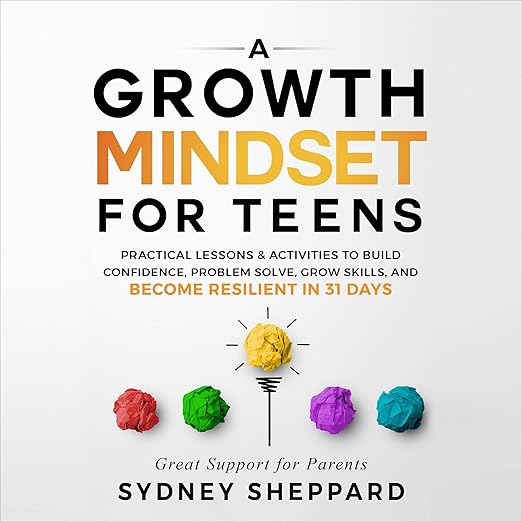
My niece turned seventeen last spring, and in the months since, the question of how she actually learns to be herself - rather than the version of herself shaped by other people's expectations - has been on my mind in a way I did not fully anticipate. When A Growth Mindset for Teens came across my review queue, I listened to it partly as an aunt and partly as a critic, which turned out to be a useful combination of perspectives.
Sydney Sheppard's book belongs to a category that can be very good or very empty depending entirely on execution. Growth mindset content for teenagers has been around long enough to calcify into cliche, and the risk of any audiobook in this space is that it delivers motivational vocabulary without genuine substance. Sheppard mostly avoids that trap, and the result is more practically useful than the genre average.
What We Made of It
The framing is honest about its audience's anxieties. The opening questions - what if I fail? What if I disappoint my parents? What if I choose wrong? - are not rhetorical warmups; they are the actual territory the book maps. Sheppard knows what keeps teenagers up at night, and she addresses those specific fears rather than offering generic encouragement. The distinction matters. Generic encouragement slides off worried teenagers like water off glass. Specific acknowledgment of specific fears tends to land differently.
The content covers emotion regulation, problem-solving frameworks, time management, and the mechanics of breaking through what the book calls limiting beliefs. The 31-day growth mindset challenge is a notable structural element - offered in two versions, one designed to do with family and one to do independently. That dual design reflects a practical intelligence about how teenagers actually exist in the world: sometimes the work is private, sometimes it is shared, and the challenge should accommodate both.
Why A Growth Mindset For Teens Works as an Audiobook
Jennifer Allton's narration is better than average for this type of content. She does not oversell the material with the performative enthusiasm that can make self-help audiobooks grating - she reads with genuine warmth and a measured pace that allows the listener to absorb rather than just receive. For a book designed for teenagers who may be listening while doing other things, that pacing discipline is a real asset.
Reviewer Marcus Tomblin's account of bringing this book to his seventeen-year-old son stuck in negativity and apathy - hoping to work through it together - struck me as the most illuminating use case. The book is structured well for that kind of shared engagement. It gives both parties something concrete to discuss without requiring the teenager to feel lectured. That is genuinely difficult to achieve in self-help writing, and Sheppard's practical, non-preachy approach makes it possible.
What Might Not Land
At 3 hours and 29 minutes, this is a brief audiobook. The brevity is mostly a feature - it stays focused and does not overstay its welcome - but it does mean that some topics receive lighter treatment than a listener might want. The emotional regulation section, in particular, covers real ground but moves quickly past concepts that could use more development. The accompanying PDF (available in Audible Library with purchase) apparently supplements the audio with additional materials, which helps compensate.
One reviewer who is no longer a teenager noted finding the book genuinely useful as an adult, which is worth acknowledging: the mindset principles here are not age-locked, and the concrete tools for managing fear, building persistence, and reframing failure translate well beyond the teen years. Parents listening alongside their children may find the content applicable to their own lives as well.
The Right Listener for A Growth Mindset For Teens
The core audience is teenagers aged 14 to 19 navigating the transition toward adult independence, particularly those prone to anxiety about failure or paralysis in the face of uncertain choices. It also works well as a shared listening project for parents and teens, especially given the dual-version 31-day challenge structure.
Adults who manage young people professionally - coaches, teachers, mentors - will find the frameworks useful. This is not a deep academic treatment of growth mindset theory; it is a practical guide with concrete activities. If you want the theoretical foundations, Jo Boaler's Mathematical Mindsets offers that rigor in a more specific context. But for accessible, actionable tools delivered in under four hours, Sheppard's work delivers.
The Short Version
- Performance: Jennifer Allton delivers a clear, accessible performance pitched correctly for the teenage audience - warm without being condescending, direct without feeling scripted.
- What it covers: resilience and emotional regulation, breaking through limiting beliefs, practical goal-setting
- Feel: Encouraging and structured, like a capable mentor who has done the reading
- Our call: A solid, practical self-help guide for teens and families navigating the transition to adult independence, with enough concrete tools to justify the 3.5-hour investment.
Questions Listeners Ask
What is the 31-day growth mindset challenge, and how does it work in audiobook format?
The challenge is a structured daily practice built into the book's framework, offered in two versions: one designed to complete independently and one to do with family. The accompanying PDF (included in the Audible Library with purchase) provides the written components that support the audio, making the challenge more functional than a purely audio format would allow on its own.
How does Jennifer Allton's narration handle the tone - does it feel like a lecture or a conversation?
Allton pitches the narration as a conversation rather than a lecture, which is important for the target audience. She avoids the performative enthusiasm common in self-help audio and delivers the material with warmth and a measured pace that makes it easier to absorb. It does not feel condescending, which can be a real failure mode in books written for teenagers.
At 3.5 hours, is this audiobook long enough to cover the material substantively?
The brevity is intentional and mostly works in the book's favor - it stays focused without padding. Some sections, particularly on emotional regulation, feel slightly compressed. The PDF companion fills in additional detail. For a concentrated, practical introduction to growth mindset principles, the length is appropriate; for deep theoretical coverage, you would need supplementary reading.