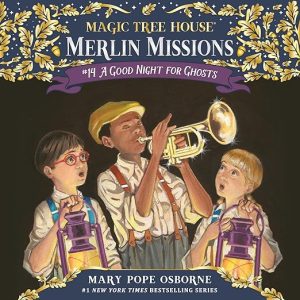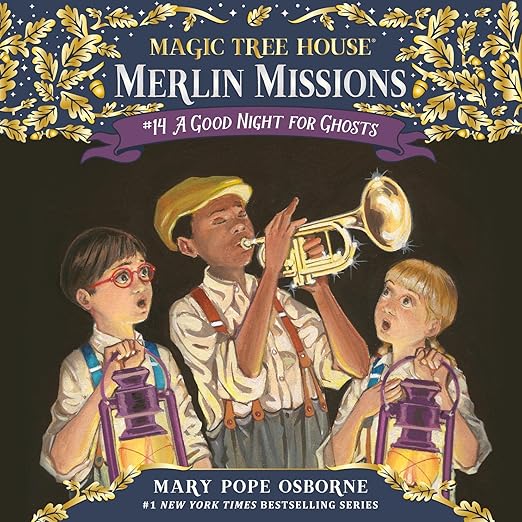
Louis Armstrong as a young man in New Orleans, a pair of children face-to-face with actual ghosts, and the origins of jazz crackling into life around them. That is the premise of this audiobook, the fourteenth in the Merlin Mission strand of the Magic Tree House series, and it is a sharper, more atmospherically rich premise than the series sometimes gets credit for. Mary Pope Osborne has been sending Jack and Annie through time for decades, but this volume lands on a setting that does real work: the supernatural element slots naturally into a city whose very soil seems haunted, and the historical hook is specific enough to give young listeners something genuinely to carry away.
At 1 hour and 25 minutes, this is a short audiobook by any measure, but Osborne packs the runtime densely. The mission is framed around finding a musician destined to bring joy to millions, and the story never underestimates its audience by making that search too easy. Jack and Annie navigate the streets of early-twentieth-century New Orleans, encounter the kind of ghosts that are more mournful than menacing, and ultimately witness a young Louis Armstrong playing in a way that reframes how listeners might think about music and its power to shape lives. That is a quietly ambitious emotional goal for a children's chapter book, and this audio version delivers it cleanly.
Osborne's Self-Narration Feels Like Second Nature
Osborne's self-narration is the essential feature of this audiobook. She has been reading Jack and Annie aloud for long enough that the characters feel second nature to her, and that ease translates into something warm and unhurried. She does not overdo the spooky elements, which is exactly the right call for the 6-to-9 age range. The ghosts register as genuinely eerie without tipping into material that would keep a child awake for the wrong reasons. Her New Orleans cadences are subtle but present, grounding the historical setting without becoming a performance that distracts from the story. One parent reviewer noted that an eight-year-old read through the entire thing in a single night - the pacing of the audio version achieves the same effect.
What sets this volume apart from many in the Merlin Mission line is that the historical content is not merely decorative. Armstrong's presence is handled carefully - Osborne is not inventing dialogue for him as a fully formed adult legend but catching him at the edge of becoming himself. That framing respects both the history and the listener. When Jack and Annie hear the music, the writing trusts that children can understand that some moments in history matter in ways that reach across time. Reviews consistently mention that the series teaches history in a way that sticks, and this entry is a clear example of why.
Osborne's Rhythm Mirrors the Birth of Jazz
The audio format rewards this particular story because music is central to it. Osborne's narration has a natural rhythm that mirrors what the book is about - listening to someone who knows how sound and story work together. For a book whose climax turns on what it means to hear live jazz for the first time, that is not a trivial benefit. Children who listen rather than read will absorb the pacing of those scenes differently, and there is something fitting about an audiobook centered on the birth of an American musical form.
The New Orleans setting also benefits from audio. Osborne reads the city's details, from the French Quarter architecture to the streets at night, with a descriptiveness that suits being heard rather than seen on a page. Parents who listen along will notice that Osborne's voice lends the ghost sequences an appropriate gravity - they feel like genuine danger without ever crossing into material unsuitable for the younger end of the target range. The series has been a classroom staple for over twenty-five years, and this is the version that works best for car rides, pre-sleep listening, or any context where a child needs a story that moves.
A Bedtime Story Rather Than a Journey
Two things are worth flagging. First, this is entry fourteen in the Merlin Mission strand and forty-two in the overall Magic Tree House numbering, so the series mythology - the missions, Morgan le Fay, the nature of the tree house - is assumed knowledge. Children new to the series will not be lost in terms of the plot of this specific story, but they will be missing contextual warmth that longtime readers feel. The audio drops in without much setup, trusting the listener to already care about these characters. Second, because this is a very short audiobook, families who invest in it expecting a full afternoon of listening will move through it faster than expected. At 85 minutes, it is genuinely a bedtime story rather than a journey.
Neither of these is a flaw, exactly - they are simply the parameters of the format and the series. For the right listener at the right age, those 85 minutes are well-constructed and carry a historical punch that extends beyond the runtime. The Louis Armstrong material will send some curious children to look up early jazz recordings, which is a worthwhile outcome for any children's audiobook.
Spooky but Safe for Ages Six to Ten
Children aged 6 to 10 who are ready for chapter books with genuine supernatural atmosphere will get the most from this. Families already invested in the Magic Tree House or Merlin Mission series will find this a strong entry, and it works especially well as a bedtime listen given the spooky-but-safe tone and the short runtime. Parents looking for children's audiobooks that weave music history into adventure without being didactic will appreciate what Osborne accomplishes in under 90 minutes.
Children who need a lot of series context before they can engage, or listeners under age 6 who might find the ghost sequences unsettling, will do better starting earlier in the series. Adults looking for a children's audiobook to share with older kids who have aged past the target range will likely find this too brief and too tied to the established characters to work as a standalone.
Before You Press Play
- Narration: Mary Pope Osborne reads her own work with warmth and genuine fondness for these characters, giving Jack and Annie distinct voices that feel lived-in after decades of writing them.
- Themes: Music as legacy, historical discovery, courage in the face of the supernatural
- Mood: Lively and spooky in equal measure, pitched perfectly for young listeners at bedtime
- Verdict: Osborne's narration and a rich New Orleans setting make this one of the Merlin Mission entries that genuinely earns the jazz-age subject matter.
Questions Listeners Ask
Is this audiobook suitable for children who haven't read the earlier Magic Tree House books?
The specific plot of this volume is followable on its own, but the series mythology and the relationship between Jack, Annie, and Merlin is assumed. New listeners won't be confused, but they won't have the accumulated investment that makes this series so effective for longtime readers.
How does the audiobook handle the Louis Armstrong and jazz history content?
With more care than you might expect from a children's book. Osborne doesn't put words in Armstrong's mouth as a finished legend but catches him at the beginning of his musical life. The history is woven into the adventure rather than delivered as a lesson, and the audio format suits the music-centric climax particularly well.
At 1 hour and 25 minutes, is this audiobook long enough to be worth buying?
That depends entirely on how you use it. As a single bedtime listen or a car-trip story, it is perfectly sized. As a substitute for longer audiobook investments, it is genuinely brief. Families who have found the Magic Tree House series to be a reliable listening staple will find the length appropriate for the format; families looking for extended listens should look at the longer Merlin Mission entries.