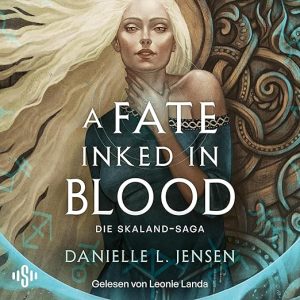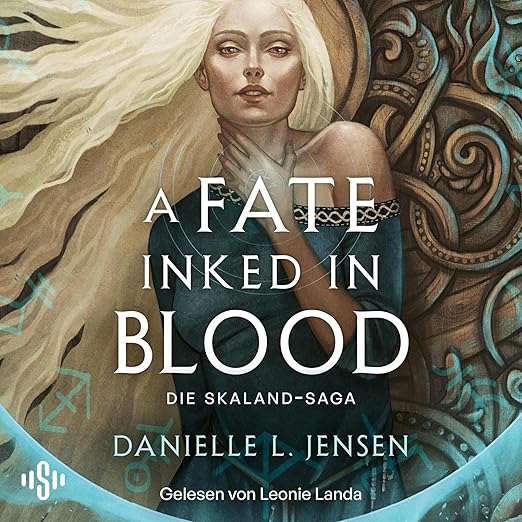
Viking-inspired fantasy romance has been a crowded corner of the audiobook market for several years now, which makes it harder, not easier, for a debut in the subgenre to stand out. A Fate Inked in Blood by Danielle L. Jensen manages it, and Leonie Landa's narration is a significant part of why. At sixteen hours and nine minutes, this is a long listen, and Jensen uses nearly all of that time to let the central relationship develop at a pace that feels earned rather than rushed.
The setup is classical in its bones: Freya has spent her life concealing a hidden magical power, and when she is betrayed, the lord of the Northlands wants to claim her as his wife because of what she represents, a shieldmaiden whose union will unite a kingdom. Jensen frames this as a story about a woman who has long been treated as a pawn refusing to let that dynamic continue. That refusal is the engine of the first act, and it gives the narrative something more interesting to work with than the usual rivals-to-lovers framing. Freya is not simply hostile to her situation out of stubbornness. She has specific, well-founded reasons not to trust the men around her, and Jensen takes those seriously throughout the book.
The character who complicates everything is the lord's son, and the dynamic between him and Freya is where the novel is at its sharpest. He is the only person in her world who sees her as an equal combatant rather than a political asset. That shift in how she is perceived, from object to peer, is what the slow burn is built on, and it works because Jensen does not resolve the tension cheaply. The romance tropes here are familiar: forced proximity, an engagement that creates impossible circumstances, a growing fire that neither character can easily act on. What distinguishes Jensen's execution is that the obstacles are structural rather than manufactured. The lord's son is engaged to someone else not out of pride or misunderstanding but because of a generational debt of honor. That specificity matters enormously to how the conflict reads.
The Best Parts of A Fate Inked in Blood
Leonie Landa's performance is the right casting choice for this material. Her voice carries both the physical authority a shieldmaiden requires and the emotional precision that the slower, more interior scenes demand. Reader reviews describe the narration as convincing, the story as smoothly written, viscerally imagined, and emotionally strong. One reviewer noted that the content won them over despite initial hesitation about the cover art, and the pattern of skeptic-turned-convert appears more than once in the response to this book, which suggests Jensen's world-building and character work do the persuading once a listener is inside the story.
The Norse-inspired setting is developed with enough specificity to feel textured without becoming a history lecture. Jensen integrates the mythology and the magic system into the conflict without pausing the narrative to explain itself at length. For listeners who enjoy progression in the sense of watching a character build power alongside emotional stakes, the story delivers on that count as well. Freya's arc is not simply romantic: it is also about her coming into her own abilities on her own terms, which gives the book a dimension beyond the romance genre alone.
The magic system embedded in the Norse world is another element worth noting. Jensen does not rely on vague supernatural atmosphere to create stakes. Freya's powers have rules, limitations, and costs that matter to the plot, and the way those costs intersect with the political and romantic pressures of the story adds a layer of tension that goes beyond the romance framework. Readers who appreciate fantasy that integrates its magic system meaningfully rather than using magic as a convenience will find Jensen's choices here satisfying and consistent.
Before You Commit to A Fate Inked in Blood
This is the first book of a duology, which means the story ends without full resolution. Listeners who prefer self-contained narratives should be prepared for an open ending. The central romantic arc does not complete here, and some of the broader political threads regarding the warring factions and the kingdom's unification are left deliberately open. That is a structural choice, not a flaw, but it is worth knowing before you commit to sixteen hours of listening.
The pacing in the middle section of the book is deliberate. Jensen is building toward a climax that requires a lot of groundwork, covering alliances, rivalries, and escalating stakes, and listeners accustomed to a faster-burning romance may find the middle third tests their patience. Those who stay with it generally report that the payoff justifies the investment, but the slow build is real and worth acknowledging upfront.
Should You Listen to A Fate Inked in Blood?
Ideal for fans of Norse mythology romance who want character-driven tension over pure action, and for listeners who appreciate a slow burn that actually earns its resolution. Those who enjoy Jennifer L. Armentrout or Sarah J. Maas in audio form will likely find Jensen's voice familiar in the best sense. Skip it if you need a self-contained story or if series openers of this length test your commitment. Listeners new to the enemies-to-allies romance format will find this a strong introduction to the trope done with genuine craft. The sixteen-hour runtime is long for a series opener, but Jensen earns every hour of it by refusing to shortcut the emotional work that makes the payoff land.
Common Questions
Does the audiobook end on a cliffhanger, or is there enough resolution to satisfy?
The romantic arc reaches a meaningful turning point but not a complete resolution, as this is the first of two books. The ending is not an abrupt cliffhanger so much as a natural pause in an ongoing story. Most listeners report satisfaction with where book one ends while still wanting to continue immediately.
Is the spice level in the audiobook appropriate for listeners who prefer clean or low-steam romance?
A Fate Inked in Blood leans toward a higher heat level than a clean romance but is primarily driven by emotional and plot tension rather than explicit content. The slow-burn framework means the romantic escalation is gradual. Listeners sensitive to steam should note that the romance does intensify as the story progresses.