At a Glance
- Voice: Dave Droxler is the named reader, and since every written review predates this recording, the performance sits entirely unassessed by anything attached to the listing.
- Big ideas: Middle school anxiety, secret identity, unofficial Minecraft comedy, reluctant-reader adventure
- Atmosphere: Loud, silly, over in an hour
- Worth it?: A genuine reluctant-reader hook for Minecraft-obsessed six to ten year olds, provided you accept sixty-five minutes and no illustrations.
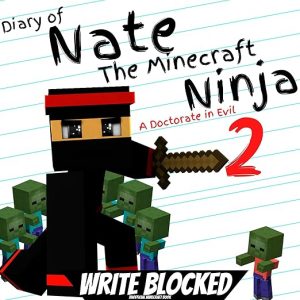
Can a children's adventure land properly in barely an hour? That is the honest question hanging over this audiobook, which runs one hour and five minutes and asks a young listener to follow a middle schooler juggling homework, a school dance and a secret ninja identity. A Doctorate in Evil is the second entry in Write Blocked's Diary of Nate the Minecraft Ninja, it holds a 4.8 average across 310 ratings, and it comes with a caveat printed in capitals on its own product page: this is not an official Minecraft product and carries no approval from the game's makers.
Fall Ball Panic Meets Dr. Herobrine's Latest Plot
The plot is exactly as advertised, which for this readership is a feature. Nate Noonan is trying to find someone to take to the Fall Ball while simultaneously working out what Dr. Herobrine is up to, and the description frames those two problems as equally urgent. That is the correct comic instinct for the age group. A villain plotting doom and a boy dreading an invitation belong on the same shelf of catastrophe when you are nine. Write Blocked pitches the series at readers aged six and up, and the fast-cut structure suggests a writer who knows precisely how long a young attention span holds.
The reviews are the charming part, and they are unmistakably written by kids. One notice consists almost entirely of the word hooray, deployed after ninjas, wooden swords, Nate, a chicken and a girl in turn. Another declares it "the goat" and thanks the author by name mid-sentence. Danevicius speculates about a character's identity, admits to doubting the theory in the same breath, and concludes it "might be my favorite write blocked series so far". Dale Kotchka-Alanes wants more of the same, writing that the book "was really adventurous and cool" and hoping the series keeps going. Nobody is performing criticism. Everyone is reporting enjoyment.
Every Review Predates Dave Droxler's December Recording
Here the pool has a hard limit that a buyer should know about up front. Every single one of the five written reviews was posted before this recording was published in December 2025, the oldest by more than three years and the most recent by three months. Not one of them could have heard a word of the audio edition. They are responses to the book, and useful as such, but on the question of whether the recording works they are silent by chronology rather than by omission. The narration credit here goes to Dave Droxler, and the assessment of that reading remains genuinely open.
What the material demands of a reader is easy to describe. This is diary-format comedy for early independent readers, which means short paragraphs, exclamation marks, sound effects and jokes that need to land within a sentence or two. The register has to stay bright without turning saccharine, and Nate's first-person voice has to sound like a real kid rather than an adult impersonating one. Those are the two failure modes for this format. The runtime helps: at sixty-five minutes nobody has to sustain anything for long, and the book fits neatly inside a school run or a bath and bedtime. I want to be fair about what the format offers a child here: an hour means a whole book finished, and finishing is precisely the point for the reader this series chases.
Pictures Are the Real Cost of Going Audio
The illustrations are the format's real cost. Write Blocked's description promises the book is filled with them and treats them as a selling point, which they are for reluctant readers who need pictures to break up the text. Audio removes them entirely. A PDF of the artwork does ship with the recording, so the pictures are technically available, but a child listening in a car will not be looking at a PDF. If the pictures are a meaningful part of why a specific kid engages with these books, the audio edition is a partial product rather than a complete one.
Two further cautions worth stating plainly. The Minecraft connection is unofficial, and the product page says so in capital letters; the game's owners have no involvement, which matters if you are buying for a child who expects official canon and will notice the difference. And an hour and five minutes is genuinely short. At standard series pricing this can feel thin next to a full-length children's novel, so treat it as one episode rather than one book, closer in scale to a comic issue than to a chapter book. Both facts appear on the listing, though the runtime is far easier to miss than the disclaimer.
The 4.8 average deserves a moment too. It sits on 310 ratings, a substantial figure for a children's listing of this size, and it plainly reflects genuine enthusiasm from the intended readership. What it does not reflect is any judgment about pacing, structure or literary quality, because the reviewers are not attempting that kind of judgment and should not be expected to. I would take a 4.8 from this population as meaningful in exactly one direction and uninformative in every other. Read the score as a reliable measure of whether kids enjoy these books, which they demonstrably do, and not as a measure of anything else at all.
Skip It If Minecraft Means Nothing to Your Child
This is squarely for children roughly six to ten who already play Minecraft or who have watched other people play it, and above all for the reluctant reader the publisher keeps naming. That pitch is not marketing invention. The evidence in the reviews supports it: these are enthusiastic notices from young readers who finished the book and wanted more. Parents hunting for something a resistant child will finish without negotiation have a real candidate here, and the short runtime removes the intimidation factor that a thick spine creates.
Skip it if your child has no interest in Minecraft, since the references carry a good deal of the comedy and land flat without the context. Skip it too if you want something to stretch a strong reader, because the vocabulary and structure aim deliberately low to keep the pages turning. Starting with book two is workable given how self-contained each entry appears, though beginning at the first would cost nothing. And if the artwork is part of the appeal for your household, buy the pictures rather than the audio, or make sure you can put the supplied PDF in front of the child while the recording plays.