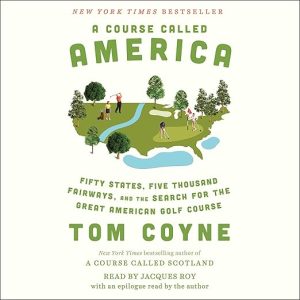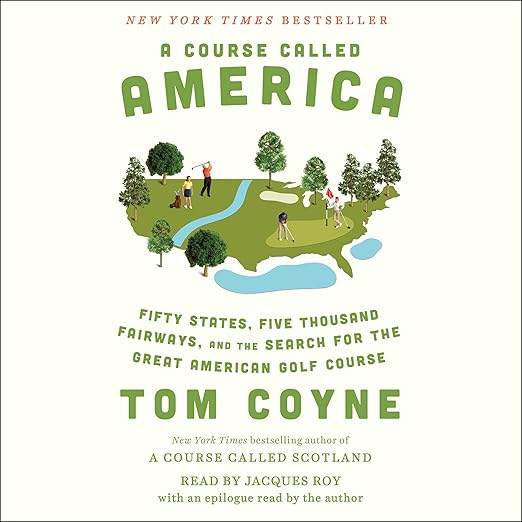
I am not a golfer. I want to establish that clearly because it matters for what I have to say about A Course Called America. I have read Tom Coyne's two previous books in this series, A Course Called Ireland and A Course Called Scotland, and found both of them more interesting to me as travel and cultural writing than as golf journalism. The sport is the vehicle; the country is the subject. That ratio is, if anything, even more pronounced in this third volume, which may explain why Kirkus Reviews concluded that non-golfers can enjoy it. It is not quite right to call this a golf book any more than it is right to call Steinbeck's Travels with Charley a driving book.
Coyne's project here is ambitious in a specifically American way: in the span of a single year, he plays golf in all fifty states, visits every course that has ever hosted a US Open, and on top of all that attempts to identify the single greatest American golf course. That last element is a classic Coyne move, a judgment so grandiose it can only be made in the spirit of genuine fun, and the book's energy comes partly from watching him take it seriously while clearly laughing at himself for doing so. Jacques Roy's narration captures that self-aware enthusiasm from the opening chapter.
Where This One Lands
The remarkable thing about the scale of Coyne's project, 295 courses, 5,182 holes, 1.7 million total yards as The Wall Street Journal catalogued it, is that it does not produce a book that feels scattered or exhausting. Roy's narration helps here significantly: he reads Coyne's voice with a familiar ease, as if recounting the stories of a well-traveled friend rather than presenting a catalog of experiences, and that conversational register keeps the episodic structure from feeling like a listicle of course descriptions.
The human encounters are what make the book work at every level. Coyne plays ranch golf in Eastern Oregon. He plays a midnight game under bright summer sun on the solstice in Fairbanks, Alaska. He discovers what he calls a golf miracle hidden in the sand hills of Nebraska. He plays a homemade course in the Navajo Nation. He finagles his way onto Shinnecock, Oakmont, and Chicago Golf Club between rounds at courses no one outside the local community has heard of. Each of these episodes produces a different kind of golf story, and the cumulative effect is something closer to a portrait of a country than a ranking of its courses. The best courses are the ones you play with the best people, as one of his Minnesota hosts tells him, and Coyne structures the book around that conviction.
Why Listen to A Course Called America
The most astute critique of A Course Called America comes from reviewer Doug, who argues that it is thousands of miles wide and a few inches deep. Coyne covers so much ground that he sometimes gives a course or a community only the briefest description before moving on. The previous books in the series, Ireland and Scotland especially, had a slower rhythm that allowed deeper engagement with individual places and the people who tend them. America is simply too large for the same approach, and Coyne's solution to keep moving and trust the accumulation of small moments works for many readers and frustrates others who came wanting the intimacy of the earlier books.
Reviewer Valuable Book, a self-described fan who has followed Coyne across all three books, calls this one a mild letdown compared to Ireland and Scotland while still giving it five stars, which is about the most honest assessment the series has received. The star rating reflects genuine enjoyment; the caveat reflects a calibration that all Coyne readers should carry into this volume. If you have read the earlier books and come with appropriate expectations, this is a worthy third entry that extends and completes the series. If you come to it as a first Coyne, Scotland or Ireland might be a more rewarding introduction to his particular gifts as a writer.
What Gives Us Pause
The resolution of Coyne's quest for the Great American Golf Course lands in an unexpected place, and the criteria he settles on, bold and idealistic, welcoming yet imperfect, with a little revolutionary spirit and a damn good hot dog at the turn, are recognizably American in a way that transcends the sport entirely. That summary reads like a joke, and it partly is, but Coyne arrives at it through 295 courses of accumulated evidence, through hundreds of conversations with golfers from backgrounds he could not have predicted when he started. By the time he names his choice, it feels genuinely correct in the way that only choices arrived at through actual experience tend to feel.
For listeners who want a companion for a long drive, a series of morning commutes, or a slow weekend afternoon, this audiobook at 13 hours and 35 minutes is well-calibrated for exactly that purpose. Roy's narration keeps it moving without rushing, the anecdotes are consistently entertaining, and the underlying question of what American excellence looks like, in something as seemingly minor as a golf course, has enough genuine resonance to make the journey feel worthwhile even for those of us who have never swung a club.
The Right Listener for A Course Called America
It is worth placing A Course Called America in the tradition it belongs to, which is the American road trip narrative as a vehicle for thinking about national identity. Coyne is doing what Steinbeck did in Travels with Charley and what Blue Highways did for the back roads: using a journey across the country as a way of asking what Americans share and what divides them, with a sport as the organizing principle rather than simply the vehicle. The golf serves the same function that the dog does in Steinbeck: it gives Coyne a reason to stop, a reason to talk to strangers, and a reason to be let into places and communities that would not otherwise open to a writer with a notebook.
Reviewer Jonathan's minimalist review, worth every page, is the kind of endorsement that only means something from a reader who has thought about what they are endorsing. The book earns that response by taking its premise seriously without pretending that a list of courses could ever amount to a portrait of a country. Coyne knows that the courses are not the point. The people who play them are.
Does A Course Called America work as a standalone, or do I need to have listened to Ireland and Scotland first?
It works as a standalone. Coyne's structure is self-contained and he provides enough context about his previous journeys for new listeners to orient themselves. That said, readers familiar with Ireland and Scotland will find additional pleasure in seeing how his criteria and sensibility have evolved across the three books.
How does Jacques Roy's narration handle the balance between golf-specific content and broader travel observation?
Roy reads both with equal facility. He does not shift into a different register for the golf history versus the personal reflections, which is the right choice for a book whose strength is that it blends those elements without clear separation. The warmth he brings to Coyne's encounters with local golfers is a consistent asset.
Does Coyne actually name a specific course as the Great American Golf Course?
Yes. The reveal is specific and argued rather than vague, and Coyne presents it with enough self-aware humor that listeners understand it is his own conclusion rather than an objective ranking. The choice lands in an unexpected place that feels earned by the journey preceding it.