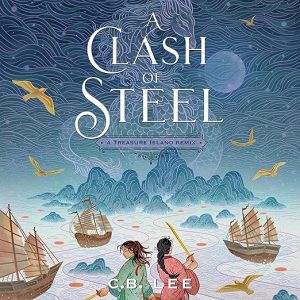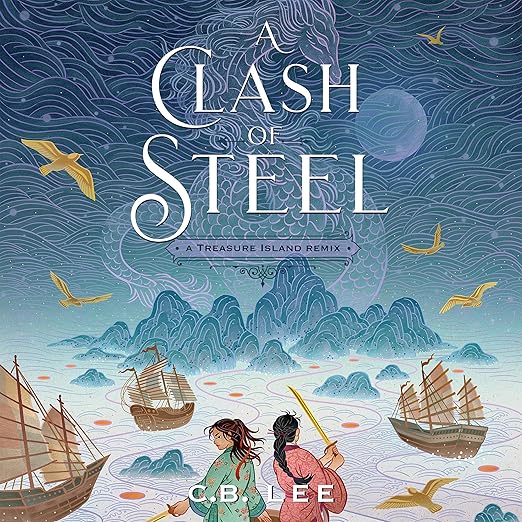
Piracy's golden age was already ending in 1826, and that is exactly where C. B. Lee sets this audiobook down. The Dragon Fleet, once the scourge of the South China Sea, has passed into story; its ruthless commander, known only as the Head of the Dragon, has become the kind of tale a girl grows up hearing. Xiang has grown up hearing it, and has no idea yet that the plain gold pendant she never takes off is part of it.
The Verdict, Briefly
Plot machinery starts with a theft that turns into a partnership. A girl named Anh takes the pendant, then returns it, wanting help with the tiny map scroll hidden inside. What that scroll reveals is that Xiang's father, dead at sea before she was born and until now only a story himself, sailed with the fleet. A daughter who has spent her life trying to matter to a mother with no time for her suddenly has a second parent, and a route.
The remix logic is stated most bluntly by a reader writing in 2022, who describes a story that has historically been about a teenage white dude becoming a story about a young woman and her sapphic adventure at sea. That is the operation, and it is not merely a swap of protagonists. The same account credits the infusion of Asian history and cultural detail with adding real substance, and notes that the characters are not exact copies of their originals, so plenty stays genuinely unsolved.
What survives from the source is the machinery: a map, a legendary hoard described as the plunder of a thousand ports, and the problem that everyone who wants it is prepared to be dangerous about it. What changes is who gets to want it. Treasure Island was always a book about a young person deciding which adults deserve loyalty, and moving that decision to a girl with a mother who does not look up is a smarter piece of adaptation than the pitch suggests. The mother matters more than a summary has room for: a shrewd businesswoman with no time for her daughter is not an obstacle to the voyage, she is the reason the voyage is worth making.
Why Listen to A Clash of Steel: A Treasure Island Remix
The character work is where the written praise concentrates. A reader who came to this having read the original several times as a child reports that Lee develops both Xiang and Anh properly, and the relationship between them, rather than letting the romance arrive as a reward at the end. That same account is fair about the limits: the secondary cast gets less room, though it stops short of stereotype or cardboard, and Lee is described as going against the grain with many of them.
One oddity in that response is worth flagging, because it will matter to anyone who cares about period. The reader remembers the book as set in ancient China, while the description dates the action precisely to 1826, at the close of the golden age of piracy. The two are centuries apart. Trust the description on this one, and expect a nineteenth-century world rather than an antique one, since the fleet's collapse is what the plot hangs on.
One of the four written accounts here consists of a title and nothing else, and the title happens to be the best summary of the book's appeal anyone has offered: that the adventure is really about the found family and the romance experienced along the way. It is thin evidence, and I am citing a headline rather than an argument, but it names the two things every other response also circles.
Points to Consider
The credits on this page do not add up, and it is worth being precise about how. The listing names C. B. Lee as narrator. The description carries a quoted line from Audiofile Magazine praising the exciting narration by Emily Woo Zeller, and then states separately that the program features an author's note read by the author. Read together, those three facts suggest a performer reads the novel and the author reads the note, while the credit line records only the second of them.
That matters commercially as much as editorially. A listener choosing between editions cannot tell from this page whose voice will carry eleven hours of pirate adventure, and a performer whose work is praised in the marketing copy goes unnamed in the one line that exists for that purpose. Whichever way the recording is actually structured, the page as it stands misdescribes it, and no written response clears the question up.
Smaller gaps run through the rest of the metadata. The series entry reads Remixed Classics with no volume number, so nothing tells you where this sits among its companions or whether the run has an order at all. And for a title carrying 142 ratings, four written responses is a thin harvest, made thinner by the empty one. Three usable accounts is not much on which to stake a long evening, and the ones that exist are enthusiastic rather than analytical. Anyone hoping to research this properly before buying will run out of material within a couple of minutes.
Who Should Pick Up A Clash of Steel: A Treasure Island Remix
The natural audience is a teenage reader who wants adventure with a romance built into the rigging rather than bolted on, and adults who like their retellings argued rather than decorative will do just as well. Knowledge of the original is optional in both directions: the description gives you everything the plot needs, and the pleasures on offer belong to Xiang rather than to the boy who held the map first. Two girls, a deadly sea and a hoard nobody has found is a premise that requires no homework of anybody.
Look elsewhere if you want the source text honored beat by beat, because a remix is precisely what is being advertised and the characters have been rebuilt rather than recast. Anyone allergic to a slow-burn romance inside an adventure plot should also take the found-family framing seriously; it is not a subplot here, it is the reason the voyage matters.
One reservation, and it concerns the listing rather than the writing. This is a confident, well-liked adaptation with a clear idea of what it is doing to its source, and the readers who have written about it are noticeably specific in their praise. What is wrong sits in the credits, and until the page is corrected, buyers deserve to know that the voice they hear may not be the name printed above the runtime.
A Few Questions About A Clash of Steel: A Treasure Island Remix
Does the A Clash of Steel audiobook include the author's note?
Yes. The description says the recording carries an author's note read by C. B. Lee, which is also the likeliest reason that name turns up in the narration credit. Notes of this kind on a retelling are usually where the research and the intent get explained, so it is worth staying for.
Is this audiobook part of a series I should start elsewhere?
The page files it under Remixed Classics without a volume number attached, and the description connects it to no other title. Nothing implies a reading order or a shared continuity between the books that carry that name. Treat it as a standalone that happens to share a shelf label.
What period and setting should I expect?
The year is 1826, with the golden age of piracy in its final decline and the Dragon Fleet of the South China Sea already reduced to legend. Expect a nineteenth-century maritime world rather than an ancient one, since the fall of that fleet is what sets the whole treasure hunt in motion.