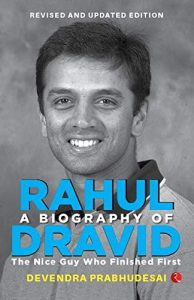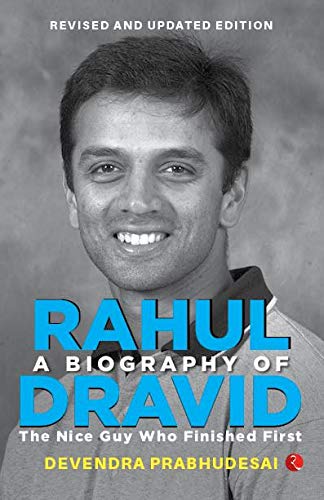
Rahul Dravid's place in Indian cricket history is secure and particular. Devendra Prabhudesai's audiobook A Biography of Rahul Dravid opens with the endorsement of Richie Benaud, who named Dravid as one of three truly great Indian batsmen alongside Sunil Gavaskar and Sachin Tendulkar - a framing that positions this biography inside the grandest possible context for Indian batting. Homer Todiwala narrates across six hours and forty minutes, and the combination of his reading and Prabhudesai's record-focused text produces something with genuine documentary value even where it falls short as biography in the fuller sense.
The subtitle of Prabhudesai's account is really about accumulation: Dravid was the first Indian batsman to score five double centuries in Test cricket, each higher than the last; the first to score four centuries in four consecutive Test innings; the only contemporary Indian cricketer to take 100 catches in Test cricket; the first batsman in Test history to score a century in every Test-playing nation. These are not statistics for their own sake - they represent a career built on relentless technical discipline and situational awareness that is harder to dramatize than a single famous innings but more impressive across a full reading of the record. Prabhudesai's instinct is to let the match record speak, and that instinct is both the book's strength and its limitation.
The limitation is clearly acknowledged in the reviews available for this title. Multiple readers have noted that the book functions more as a comprehensive match summary than as a biography in the psychological or personal sense. There is very little direct access to Dravid's own voice - short statements rather than sustained interviews - and the book does not venture significantly into the backstory, family, or inner life that makes biography as a form distinct from sports history. The coverage also ends around 2005, which means the later stages of Dravid's career, including his captaincy of the Indian national side and his eventual transition to coaching, are not part of this account. Listeners should know that going in.
Highlights
For cricket listeners, the audio format handles match description reasonably well. Todiwala's narration maintains pace through the statistical passages without losing the thread of individual match narratives, and the structure of the book - moving through Dravid's career in roughly chronological order - provides its own momentum. A listener who watched Dravid play and wants to revisit specific series or innings will find the detail here reliable and thorough.
Prabhudesai, as an Indian cricket writer, brings insider familiarity with the context in which Dravid operated - the conditions he faced in different countries, the specific opposition bowlers he mastered, the moments where the team needed someone to stay and he was the one who stayed. That contextual knowledge gives the match descriptions more weight than a generalist sports writer would manage. The Benaud endorsement in the opening is not decorative - Benaud was one of the sharpest analytical minds in cricket broadcasting and his view of Dravid as a genuine great is worth encountering as a framing device even if listeners come with their own assessment already formed.
The comparison Prabhudesai builds through Richie Benaud's endorsement is worth sitting with. Benaud placed Dravid alongside Gavaskar and Tendulkar as the three truly great Indian batsmen, a hierarchy that many Indian cricket followers would contest and that some would expand. But Benaud's specific framing of what made all three great is useful as an analytical lens: courage, clear thinking, and the ability to carry the attack by staying a step ahead of the bowler. Applied to Dravid, these qualities explain the statistics rather than the statistics explaining the qualities. A Test batting average sustained above 44 across more than one hundred and sixty Tests, against the best bowling attacks of his era across every playing surface in world cricket, is the record of someone who made very few decisions that fell outside that framework.
Prabhudesai's position as an Indian cricket writer also means that the social and cultural context of Dravid's career is present even when it is not foregrounded: the extraordinary pressure on Indian batsmen from a cricket-obsessed public, the relationship between individual reputation and national identity in a country where the sport functions as collective therapy. Where Sachin Tendulkar was worshipped as a prodigy and Ganguly was celebrated as a regional figurehead, Dravid built his reputation on being the batsman other batsmen needed him to be, which earned deep respect but a different quality of public relationship than his more charismatic contemporaries received.
What to Watch For in A Biography of Rahul Dravid
The 2005 cutoff is a genuine gap for anyone whose primary memory of Dravid involves his captaincy period from 2005 to 2007, which included a Test series win in the West Indies - the first for India in thirty-five years - and a World Cup campaign. Those years are not covered, and Dravid's evolution as a leader, which many observers consider the most interesting chapter of his cricket story, falls entirely outside the scope of this account. Listeners wanting that portion of the record will need to go elsewhere.
The biographical depth is also thinner than the title implies. This is a book that documents what Dravid did at the crease with considerable care but does not explain much about how he thought about the game or what drove him personally. Interviews with teammates, coaches, or opponents are sparse. For the fullest picture of who Dravid was as a cricketer and person, this audiobook works best as one source among several rather than a definitive account.
Is This One for You?
Cricket enthusiasts who followed Dravid's career through 2005 and want a comprehensive record of his major innings and series achievements will find this detailed and reliable. Listeners primarily interested in Dravid as a figure - his personality, his approach to batting, his relationship with the team and public pressure - will find the book thinner than they want on those questions. New listeners to cricket biography who want to understand why Dravid is spoken of with such reverence in Indian cricket will get the statistical case clearly but may want to pair this with more personal accounts, interviews, or documentary material to fill in the rest of the picture. At six hours and forty minutes, it is a worthwhile investment for anyone already invested in the subject.
Quick Take
- Performance: Homer Todiwala brings familiarity with the cricket context to the reading, which matters when navigating the statistical record and match descriptions that form a significant portion of the text.
- What it covers: Technical mastery and quiet excellence, the weight of expectation in Indian cricket, consistency as a form of artistry
- Feel: Respectful and detailed, with the patience of a long innings
- Our call: A valuable statistical and match-record account of Dravid's career through 2005, though listeners wanting significant personal insight or first-person access will need to supplement this with other sources.
Does this audiobook cover Rahul Dravid's captaincy and later career after 2005?
No - the biography covers Dravid's career up to approximately 2005, which means his captaincy of the Indian national side from 2005 to 2007, the historic Test series win in the West Indies, and his later contributions to Indian cricket are not included. Listeners wanting coverage of his full career will need additional sources.
How much of this audiobook is statistical match records versus personal biography?
The balance leans heavily toward match records and series summaries. There is relatively little first-person access to Dravid himself or extended interviews with teammates and coaches. Think of it as a comprehensive cricket record with biographical framing rather than a character portrait in the traditional biographic sense.