In Brief
- Performance: Sarah Gage navigates Rishe's accumulated competence and performative nonchalance with consistent precision, giving the protagonist's layered knowledge a wry authority that makes the fish-out-of-water comedy land.
- What it covers: isekai reincarnation loops, competence fantasy, enemies-to-lovers romance
- Feel: Breezy and confident with genuine romantic tension
- Our call: Fans of the villainess isekai genre who want a protagonist with accumulated real skills rather than only meta-knowledge will find Rishe a more satisfying heroine than most.
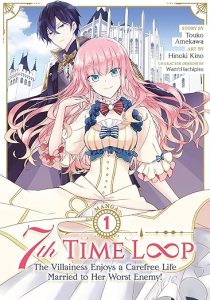
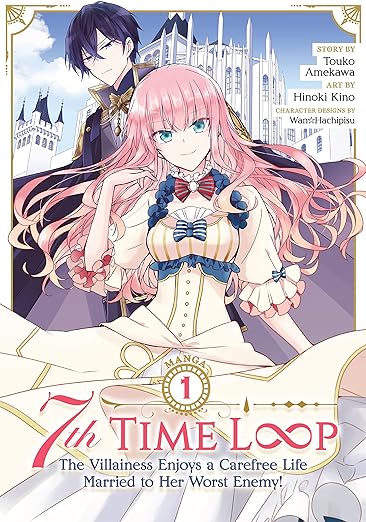
Rishe Irmgard Weitzner has died six times already, and she has the skillset to prove it. The seventh iteration of the time loop begins the same way it always does - being publicly dumped on the day of her engagement party - but by now Rishe has lived complete lives as a merchant, an apothecary, a maid, and a knight, among others. In this audiobook, 7th Time Loop: The Villainess Enjoys a Carefree Life Married to Her Worst Enemy!, Vol. 1, narrated by Sarah Gage and based on Touko Amekawa's manga adaptation, that accumulated competence is the central pleasure rather than a background detail. It is what makes this entry in the isekai villainess genre feel distinct from the dozen similar premises currently crowding the same shelf.
How 7th Time Loop Holds Up
The genre this volume belongs to - the isekai villainess reincarnation narrative - has specific conventions that Amekawa's story both honors and deliberately complicates. The standard template positions a modern-consciousness protagonist discovering she has been reincarnated as the villain of an otome game, using her foreknowledge of the plot to avoid her doom ending. Rishe's situation is different in an important way: she is not using meta-knowledge of a game script. She is using skills she actually learned in six previous lifetimes - real trading acumen, real medical knowledge, real combat training - and her seventh-life goal of simply living long and quietly is immediately complicated by Arnold Hein, the Crown Prince who killed her in her most recent life as a knight. The marriage proposal he makes at the start of this volume is not a misunderstanding. He knows something about who she is. She knows exactly who he is.
That asymmetry - Rishe knowing far more than Arnold suspects while Arnold clearly knowing more about Rishe than he should - is the story's primary dramatic engine, and it is handled with more craft than reviewers of the anime adaptation sometimes acknowledge. The female protagonist whose competence is genuine rather than primarily reactive, who chooses her strategic position deliberately rather than stumbling into it, is a meaningful variation on genre convention and is the main reason this series generated an anime adaptation in the first place.
Why 7th Time Loop Works as an Audiobook
Gage's narration is well-suited to Rishe's particular character register. The protagonist's defining quality is a kind of deeply informed nonchalance - she has seen enough of life and death across seven lifetimes that very little genuinely surprises her, which makes her responses to Arnold's provocations more amused than distressed. Gage captures that wry composure without flattening it into emotional vacancy; Rishe's amusement registers differently from her genuine alarm or her carefully concealed grief about previous lives. The supporting cast differentiation is also solid: Arnold reads as dangerous and watchful rather than generically threatening, which the romance's eventual trajectory requires.
At six hours and twenty-eight minutes, this is a brisk listen for the amount of world-building and character establishment it achieves. The story does not over-explain the time loop mechanics in the way some entries in this genre do - it trusts listeners to follow the implications of Rishe's situation without extensive internal monologue detailing every piece of accumulated knowledge. That efficiency of exposition is one of the volume's craft strengths and one reason reviewers who have seen the anime adaptation find the manga-based text fills in character interiority that the animation could not include at its pace.
Weak Spots in 7th Time Loop
The scene where Rishe demonstrates her medical knowledge to impress Arnold's court is cited by reviewers as a particular highlight - it is the moment where the series' competence-fantasy dimension becomes most explicit and most satisfying. Rishe is not simply clever or self-aware in the way most villainess protagonists are. She has actual trained knowledge that she can deploy in contexts where it is not expected, and watching Arnold recalibrate his assessment of her in real time is the kind of character-dynamic work that sustains a multi-volume romance across its slower chapters.
The enemies-to-something-more trajectory is handled at a realistic pace for the genre. This is a first volume, and Amekawa does not resolve the central tension - Rishe knows Arnold killed her in a previous life, Arnold is not yet aware of the full extent of what Rishe knows - in a way that would deflate the subsequent volumes. Listeners who need immediate romance payoff may find the first volume more slow-burn than satisfying. Listeners who understand that this genre rewards patience will find the setup here unusually well-constructed for what comes after, with the 4.7 rating across nearly eight hundred reviews reflecting that the audience this series is built for responds to it exactly as intended.
The Right Listener for 7th Time Loop
Isekai and villainess reincarnation fans are the natural audience, and they will find this audiobook a well-executed entry in a crowded genre. Anime viewers who encountered the story through the Crunchyroll adaptation will find the source material has more interiority and character nuance than the animation could accommodate. Listeners new to the villainess isekai genre should know that this volume is a beginning, not a complete story - the arc continues in subsequent volumes, and the emotional payoff of the central relationship requires that longer investment. Listeners who prefer self-contained narratives will find this volume frustrating. Those happy to begin what is clearly a well-structured multi-volume series will find Rishe an unusually capable and genuinely appealing protagonist in a genre that can feel formulaic when the heroine's only asset is foreknowledge.
Frequently Asked Questions
Do I need to have seen the anime adaptation before listening to this audiobook?
No prior knowledge of the anime is required. The audiobook begins the story from the beginning and builds its own context. Anime viewers will find additional interiority and character detail that the visual medium could not include, making it a worthwhile listen even for viewers already familiar with the story.
Is this audiobook a complete story, or does it end on a cliffhanger requiring the next volume?
Volume 1 establishes the premise and central character dynamic but does not resolve the series' primary tension. It is the opening of a multi-volume story. Listeners who want a complete standalone narrative should be aware that subsequent volumes continue the arc.
How does Sarah Gage handle Rishe's unique characterization as someone who has lived six previous lifetimes?
Gage captures Rishe's accumulated composure and wry awareness without making her emotionally flat. The character's nonchalance in situations that would distress an ordinary protagonist comes through as informed confidence rather than blankness, and Gage distinguishes this register from moments when Rishe is genuinely moved or alarmed.
Is this audiobook appropriate for listeners new to the isekai villainess genre?
Yes, though the story assumes general familiarity with isekai reincarnation conventions without explaining them at length. The core premise - protagonist reliving her engagement day after repeated deaths - is clear from context. The manga adaptation format gives the text a slightly different texture than a light novel, with more visual scene construction.