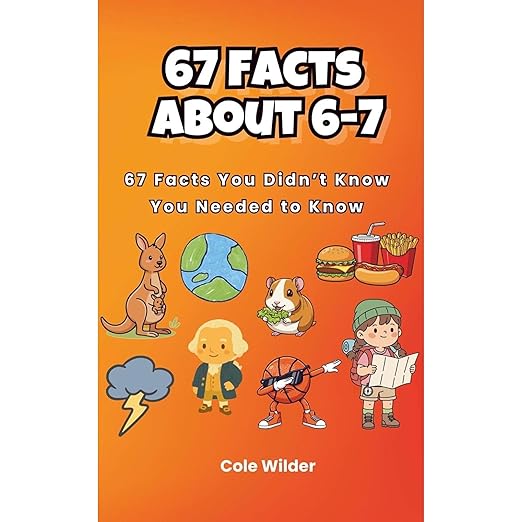
Somebody turned a playground meme into a fact book, and then somebody turned the fact book into an audiobook read by a text-to-speech system. My verdict up front: this works if you know precisely what you are buying, which is fifty-three minutes of trivia organized around a two-digit number that a certain age group currently finds hilarious. Cole Wilder released it on Christmas Day of 2025. Two hundred and seventy-six people have graded it since, and the average has settled at 3.8, a long way below the five stars sitting on every written notice the page displays.
Virtual Voice Reads All Sixty-Seven Facts
Exactly as advertised, and no more complicated than it sounds. Sixty-seven items, each connected in some way to the number 67, drawn from sports, science, history and pop culture, aimed at readers eight and up and openly pitched at the teacher or parent who secretly likes trivia. Run the arithmetic and the shape of the thing appears: sixty-seven facts inside fifty-three minutes leaves under fifty seconds apiece, including the setup. This is a book of beats, not of chapters, and it moves at the speed of a scroll. Every item has to tie back to the number in some way, which is a constraint rather than a theme, and constraints of that kind either produce ingenuity or produce padding.
Virtual Voice appears in the credit line, naming a synthetic reading system in place of a person, and that is worth knowing in advance because of what this material asks for. A trivia book of this kind lives on the pause before the reveal. The fact itself is usually one clause long; the comedy sits in the half-second of silence that lets a nine-year-old get there first. A list is also, in fairness, the structure a synthetic reader handles most evenly, since nothing here needs a character or an accent. Play a minute while your child is within earshot and let the child decide, because that is the only test that counts here.
Classrooms Call It Perfect for Third Graders
Classrooms are where the enthusiasm on this page is concentrated, and the detail is more specific than a rating. One notice reports handing a copy to every child in a class at Christmas and getting a loud reaction back. Another, from a teacher, calls it perfect for third graders. A third calls it an excellent choice for fun at a party. These are not literary judgments and they are not pretending to be; they are people telling you the setting where the material worked, which is more useful than a star.
Length is the second argument, and for a family audience it may be the decisive one. Fifty-three minutes is a drive to a relative's house, a wet afternoon, the stretch between dinner and bedtime when nobody wants to start anything real. Very little written for eight-year-olds fits inside that window without either patronizing them or asking for a commitment. This asks for none.
One more reason is less obvious, and it applies to adults rather than to children. If a number has been arriving in your house as a punchline for months and you have no idea why, an hour spent inside the joke buys you something. Wilder's frame is that the meme is a door and the facts are the room behind it, which is a generous way to treat a piece of internet nonsense. Whether the sports statistics and historical coincidences justify that frame is a matter of taste, and taste at this age is not negotiable.
276 Grades Include Voters Who Said Nothing
Between the average and the written responses lies the widest gap on any page I have looked at this week, and it deserves a plain reading. Every visible notice awards five stars. The overall average across two hundred and seventy-six grades is 3.8. Those two numbers can only be reconciled by a large body of people who marked it down and said nothing, so the five enthusiastic accounts you can actually read are not representative of what buyers as a group concluded. Weigh the score, not the testimonials.
Consider next what those responses are actually describing. Three of the five present the book as a present: a Christmas gift for two nieces, a copy for every child in a class, and a third headed simply as a great gift. The other two describe settings rather than transactions, a room of third graders and a party. One of the gift notices sets the book against two girls' phones and puts the word real in quotation marks, praising a physical thing precisely because it is not a screen, promising them "a break from their phones". None of that survives the conversion to audio, and if the appeal for you is handing over a small solid object, this edition is the wrong format for the job.
A smaller flag worth naming: two of the five notices carry dates that fall before the December 25 release recorded on this listing, one in mid-November and one two days before. Nothing improper follows from that, and the likely explanation is simply that the book existed in another form before this recording did. It does mean the responses you are reading were not written by anyone reacting to the audio.
Buy the Audio for the Long Car Journey
Buy it for the eight-to-twelve-year-old who already knows the joke and wants ammunition, or for the adult who has to survive a long car journey with that child. It is also, genuinely, a classroom filler: a teacher with fifteen minutes left before the bell could run three or four of these and get a room back.
Skip it if your child has never encountered the meme, because the material assumes the joke rather than building it, and a fact about the number 67 is only funny to someone already primed to find 67 funny. Look elsewhere for durable nonfiction for a young reader, since this is a novelty tied to a specific moment in internet culture and will date faster than almost anything else on the shelf.
And think twice if what you had in mind was a present. Most of the written notices here describe handing over something wrappable, at Christmas or in a classroom, and a download does not do that job however good the jokes are. Buy the audio for the journey and the paperback for the stocking, or accept that you are buying a different product from the one those readers enjoyed.