The Short Version
- Narrator: Victoria Villarreal brings real urgency to the desert survival sequences and maintains distinct, credible voices for the dual-protagonist dynamic between Katie and Aster.
- Subjects: Survival and trust, healing fractured friendships, danger hiding in plain sight
- Tone: Taut and claustrophobic despite the open landscape, with mounting dread
- Bottom line: A tightly constructed YA survival thriller that uses the Utah backcountry as both setting and antagonist, with a central friendship mystery that compounds the physical danger beautifully.
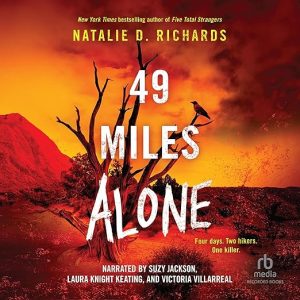
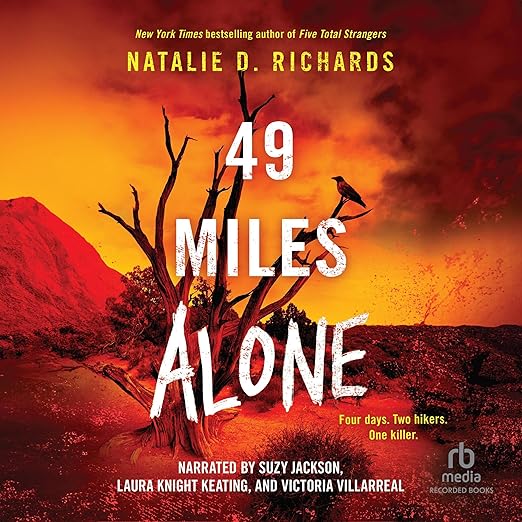
Katie and Aster's four-day hike through the Utah backcountry was supposed to be a reset , a way to heal the fracture in their friendship and leave behind whatever happened between them the previous year. That backstory is parceled out in fragments across the audiobook of 49 Miles Alone, and Natalie D. Richards uses it with real precision, letting readers feel the weight of the unresolved history before revealing its specifics. The survival thriller plot arrives on top of that emotional setup: an illness, an injury, a freak storm, and then a young couple at their campsite with extra supplies, one of whom seems warm and friendly and one of whom spells trouble from the moment he appears.
When Riley vanishes in the night and Finn goes after her, Katie and Aster are left with a terrible calculation: help is a two-day hike away, their supplies are already strained, and they are potentially the only witnesses to something that may have gone very wrong. Richards does not let the thriller mechanics swallow the emotional core. This is always also a story about two cousins trying to remember how to trust each other, and the pressure of the crisis accelerates rather than replaces that work.
The Verdict, Briefly
Richards is a practitioner of what I would call maximally efficient YA thriller construction. Nothing in this book is wasted. The desert environment is used as both setting and antagonist: heat, dehydration, the psychological disorientation of vast empty space, the way distances that look short on a map become enormous when you are already exhausted and scared. Richards knows her terrain, and the Utah backcountry feels genuinely specific rather than generically rugged. When the storm arrives and the couple's camp turns up empty, the landscape itself feels like it is conspiring against any resolution.
The choice to center the story on two protagonists rather than one is smart. Katie and Aster do not process the same situation identically, and their differing responses to what they witnessed create productive friction. When Katie pushes to find Riley and Aster wants to focus on getting out alive, the disagreement is not manufactured drama , it is two people with different risk tolerances and different emotional investments making genuinely reasonable arguments under terrible pressure. That moral complexity keeps the thriller mechanics honest.
Why Listen to 49 Miles Alone
Victoria Villarreal's narration serves the material with the seriousness it deserves. YA thrillers can be difficult to narrate well because the genre requires sustained urgency without tipping into melodrama, and the dual-protagonist structure demands that two distinct voices remain consistently differentiated across nearly eight hours. Villarreal handles both challenges. Her Katie and Aster sound like specific people rather than generic teenage voices, and the physical tension of the desert survival sequences , the desperation, the fatigue, the difficult calculation of what risks can and cannot be taken , comes through clearly in her performance.
The blurb from Kit Frick comparing the book's feel to crackles of tension and desert heat is accurate without being sufficient. The heat and tension are present from early on, but what makes this audiobook stay with you is the secondary mystery: what happened between Katie and Aster a year ago, and how does that unresolved history affect what they are able to do for Riley now? Richards does not answer that question cleanly until she is ready, and Villarreal's performance keeps the emotional register appropriately complex throughout the wait.
Points to Consider
The middle section of the audiobook requires patience. After the initial encounter with Riley and Finn and Riley's disappearance, the story enters a sustained stretch where Katie and Aster are moving through the desert with limited information and deteriorating resources. Some listeners may find this section slower than the bookending sequences, though Richards is doing necessary work building the physical and psychological exhaustion that makes the climax feel earned rather than convenient.
The backstory between Katie and Aster, when it is finally fully revealed, recontextualizes several earlier scenes in satisfying ways , but it arrives relatively late in the runtime. Listeners who have been waiting for that explanation may find themselves impatient before it materializes. The delay is purposeful and ultimately justified, but it is worth knowing the book holds that card for a substantial portion of the runtime before playing it.
Richards' decision to keep the backstory between Katie and Aster deliberately vague for much of the audiobook serves the survival thriller mechanics well. Not knowing exactly what broke the friendship keeps both characters slightly opaque to each other and to the listener, which mirrors the way real fractured relationships work: you know something happened, you feel the gap, but the full shape of it only becomes clear when someone finally says the thing that has been unsaid. The Utah desert is an unforgiving setting for that kind of delayed revelation, and the timing of when Richards chooses to deliver it , with the clock running and options shrinking , is one of the book's better structural decisions.
Who Should Pick Up 49 Miles Alone
This audiobook is for YA thriller listeners who enjoy survival narratives with genuine emotional stakes rather than pure action mechanics. Natalie D. Richards fans will find her characteristic blend of twists, character work, and propulsive pacing fully operational here. The content is appropriate for older teens and adults, with the wilderness danger and threat of violence present but never graphically depicted. Readers who have enjoyed Kit Frick's work or Natalie D. Richards's earlier novels will find this among her strongest, most tightly constructed efforts.