At a Glance
- Read by: Holter Graham handles Meb Keflezighi's first-person reflections with warmth and measured authority, matching the book's balance between technical running detail and personal honesty.
- At its heart: Resilience built mile by mile, faith and identity as athletic fuel, the gap between elite achievement and universal lessons
- Vibe: Grounded and reflective, with bursts of race-day urgency
- Short version: A chapter-per-marathon structure that gives every listener, runner or not, something concrete to take away from one of the sport's most distinctive careers.
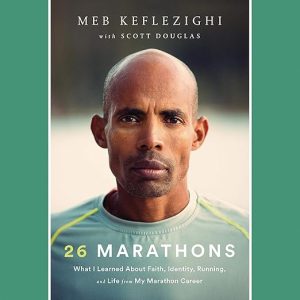
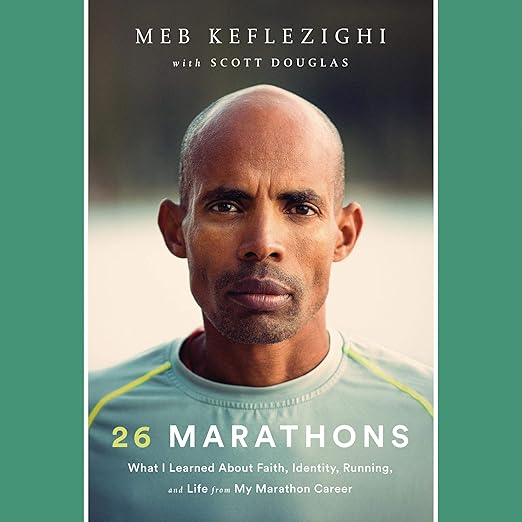
Meb Keflezighi's career numbers are genuinely unusual: the only person to win both the Boston and New York City marathons and claim an Olympic marathon medal, across 26 professional races spanning roughly two decades. The audiobook 26 Marathons, narrated by Holter Graham, organizes that career not as a conventional biography but as a chapter-by-chapter reckoning with each of those 26 races, treating every finish line as a lens for a different life lesson. The structure is unusual in sports memoir, and it works better than it has any right to, precisely because Keflezighi treats no race as too ordinary to contain something worth examining.
The Review
What distinguishes Keflezighi's voice throughout is specificity. He does not trade in the generalized motivational language that fills most sports memoirs. When he describes the 2014 Boston Marathon, the first held after the bombings, the reflection is about the particular weight of representing something larger than yourself on a specific day with specific people watching. When he covers races that went badly, including injuries and off-days that any marathoner would recognize, he names what he was thinking and feeling without dressing it up in retrospective heroism. Reviewer Duane Schneider noted that the book is highly structured in a way that suited a professional runner accustomed to following a training program for years, and that observation is accurate: this is a disciplined, organized book, not a loose conversation.
The dual value of the book is laid out clearly in the synopsis: it is simultaneously a behind-the-scenes account of elite racing and a guide for recreational runners and anyone interested in translating athletic discipline into daily life. Eliud Kipchoge's endorsement, that Meb shows how marathon experiences help us become better in our lives, is not a throw-away quote from a famous name. The connection between how you handle mile 20 when everything hurts and how you handle professional setbacks or family strain is made explicit throughout and, more importantly, made convincing. Keflezighi earns that parallel by grounding it in concrete moments rather than asserting it through aphorism. Shalane Flanagan's observation that the advice on overcoming injuries and adversity is for everyone captures why the book travels beyond its running-specific audience.
Holter Graham is a reliable narrator for this kind of material. He reads with consistent energy that never tips into performance, which suits Keflezighi's own voice: thoughtful, proud of the work, clear-eyed about the cost. The 6-hour-and-49-minute runtime moves efficiently because the chapter structure creates natural pacing. Each marathon chapter has a self-contained arc, so the listen accommodates interruption and resumption without losing momentum. Reviewer Julie Eastlick observed that Keflezighi's reflections are something people can use in their daily lives and goals whether or not they aspire to be a runner or athlete, and Graham's narration carries that accessibility well.
The running-specific sections covering training philosophy, nutrition strategy, and pacing decisions are handled clearly enough that non-runners will follow them without feeling excluded. Graham reads these passages with the same measured tone as the personal reflection sections, which helps: nothing is flagged as too technical or too emotional. The result is a listen that is genuinely useful for competitive athletes while remaining engaging for anyone interested in sustained excellence across a long career. The Booklist starred review called it a swift listen guaranteed to be popular with student athletes and hard-core and recreational runners alike, noting that Keflezighi is an American treasure and running ambassador who never fails to inspire. Graham's pacing contributes to that swiftness, maintaining forward momentum without sacrificing the space each chapter's central lesson needs to register properly.
Before You Commit to 26 Marathons
The chapter structure, while effective, creates some unevenness in emotional weight. Not all 26 marathons were equally significant in Keflezighi's career, and a few chapters are thinner than others, dealing with races where the primary lesson is relatively straightforward. These are honest accounts of workmanlike performances, and they belong in a complete career record, but listeners should know that the book's high points are genuinely high and the connective chapters are more modest in scope. The Washington Post's assessment that Meb's wisdom is not just for runners holds especially for the Boston 2014 and Olympic chapters, where the personal and historical stakes are at their highest.
The book also operates firmly within a framework of faith that is genuine rather than decorative. Keflezighi's Christianity is woven into how he explains perseverance and identity, and while this never becomes prescriptive, it is consistent enough that listeners who prefer their sports memoir without a religious dimension should know it is present throughout. This is not a book that separates the athlete from the faith that animated him, because Keflezighi does not experience himself that way.
Who It's For
Marathoners and serious runners will extract the most from the technical sections and race-day detail. But the book has been deliberately structured for a wider audience, and the appeal to recreational athletes and general readers is real rather than marketing language. The 26-chapter format functions particularly well for non-runners who want the life-philosophy dimension without having to extract it from purely athletic content: each chapter arrives at its broader lesson explicitly rather than leaving the reader to infer it. Listeners who connect to sports memoir as a form of life philosophy rather than simply athletic record-keeping will find the approach consistently rewarding across the full runtime. The book's balance of technical detail and personal reflection makes it genuinely useful to both audiences simultaneously.
A Few Questions About 26 Marathons
Does this audiobook cover Meb Keflezighi's 2014 Boston Marathon win in detail?
Yes. The 2014 Boston race, the first held after the bombing, is one of the most emotionally resonant chapters. Keflezighi discusses the specific weight of that finish line and what it meant to represent something larger than his own performance on that day.
How does Holter Graham's narration handle the balance between running-technical content and personal memoir in this audiobook?
Graham reads both with consistent tone and measured energy. He does not over-dramatize the personal moments or flatten the technical ones, which keeps the audiobook moving without making the training-and-nutrition content feel like a detour from the memoir.
Is the 26 Marathons audiobook well-structured for listening during runs or workouts?
The chapter-per-marathon format, each around 15 to 20 minutes, makes it practical for run-listening. At 6 hours and 49 minutes total, the book works well broken into daily training sessions rather than requiring long uninterrupted listening blocks.