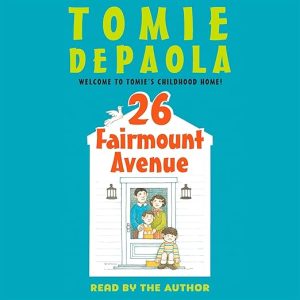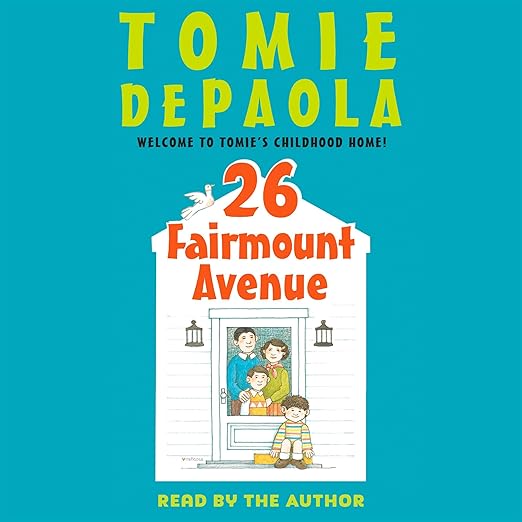
This audiobook collection bundles the first four books in Tomie dePaola's beloved 26 Fairmount Avenue series into a single 47-minute listen, making it an ideal starting point for young readers being introduced to memoir as a form. DePaola narrates his own childhood recollections, and the result has a quality that professional voice actors rarely capture: the sound of someone who actually remembers the events in question and still finds them funny.
The Narration Transports a Parent to the Fair
The 26 Fairmount Avenue series occupies a specific and valuable niche in children's literature. DePaola writes about his own childhood in the first person, recounting experiences from home and school with the unvarnished perspective of a child rather than the retrospective tidiness of adult memoir. Kids reading these books at the target age of roughly six to nine encounter something rare: a grown-up author who is genuinely honest about what being a child actually felt like, including the small frustrations, the confusions about adult rules, and the outsized importance of particular events that adults might find trivial.
The four books in this bundle span dePaola's early childhood, covering everything from a visit to the World's Fair to making a prize-winning Valentine's Day box. These may sound like modest subjects, and in one sense they are. But dePaola's gift, both in the writing and in the narration, is to restore the specific weight that such events carry for a child. When something mattered to young Tomie, the reader feels exactly why it mattered, without any adult irony distancing us from the experience.
One parent reviewer described listening with a child during a family drive and noting how the narration transports her into a visit to the World Fair. Another described the books as packed with "drama, excitement, joy, and humor." At 47 minutes for four books, the runtime reflects dePaola's approach: spare, direct prose that never condescends and never wastes words.
Rhythms of a Family's Oral Storytelling Tradition
The decision to have dePaola narrate his own work is the single most important production choice here, and it pays off comprehensively. His voice carries the natural rhythms of a storyteller who grew up in a tradition of oral family narrative, and young listeners respond to that authenticity in ways that are difficult to explain but easy to observe. When a child laughs at dePaola's delivery of a particular moment, part of what they are responding to is the feeling that the person telling the story was actually there.
The 47-minute total runtime is also worth noting as a practical feature rather than a limitation. For the six-to-nine audience this is aimed at, shorter listening sessions are often more effective than longer ones. A single book in the series might run ten to twelve minutes. The bundle format means a family can work through all four books across several car trips or bedtime sessions, using each natural break point as an opportunity to discuss what happened.
This box set is listed as beginning with book 1 in the series, which means it works as an introduction. Listeners who respond well to these four books will find that the series continues, giving them a ready-made next step. DePaola's consistent first-person perspective and his attention to mid-twentieth-century American domestic detail give the series a cumulative texture that deepens across volumes.
Told the Way an Engaging Grandfather Would Tell It
The extremely short runtime, 47 minutes for four books, means this collection is best understood as an introduction to the series rather than a comprehensive listen. Parents and educators who purchase this expecting a long-form audiobook experience will be surprised. The brevity is a function of dePaola's prose style, which is genuinely concise, and of the audience's reading level, but it is worth managing expectations around.
The mid-century American setting provides some historical texture, including references to the World's Fair and to wartime domestic life in the early books, which gives the series a social studies dimension that some educators find useful. But these references are contextual rather than explanatory; dePaola does not pause to annotate historical events for young readers. Parents listening alongside younger children may want to use those moments as conversation starters.
DePaola's narration is warm and natural but not theatrical. He does not voice distinct characters with separate accents or perform dramatic scene-setting. He tells his stories the way an engaging grandfather would tell them: directly, with good timing, and with a clear sense of what the funniest parts are. Listeners accustomed to full-cast productions will find this approach very different, but the simplicity suits the material perfectly.
A Children's Book Narrated by Its Own Author
The primary audience is children aged six to nine who are ready for their first chapter-length memoirs, particularly those transitioning beyond picture books toward longer narrative forms. Parents looking for a family listen that holds a child's attention without adult condescension will find this collection effective. Teachers introducing memoir writing to early elementary students may find the dePaola books particularly useful as examples of first-person child perspective done with genuine craft.
Adults listening purely for their own pleasure will likely find the material too brief and too squarely aimed at young readers. This is not a crossover title in the way some children's audiobooks manage to be. It is a children's book, narrated by its author, doing exactly what it set out to do for its intended audience.