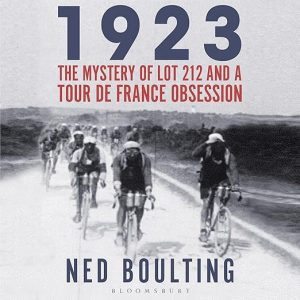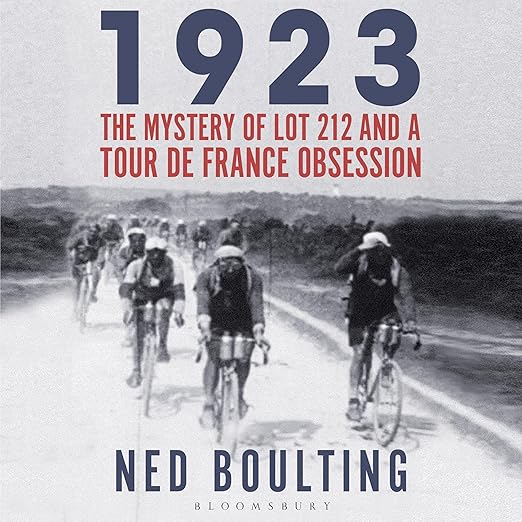
Ned Boulting's 1923 audiobook begins with something genuinely unusual in sports writing: not a race, not a champion, not a career retrospective, but a piece of Pathe news film, 2.5 minutes long, purchased blind at a London auction in the autumn of 2020. Lot 212. Stage 4 of the 1923 Tour de France. Half a dozen sequences, including a lone rider crossing a bridge. What Boulting does with that footage, the forensic patience he brings to each frame, the directions it sends him, is the subject of this Sports Book Awards 2024 Cycling Book of the Year, and it's a reminder that the best sports books often aren't about sport at all.
The ITV cycling commentator's reputation is built on the Tour de France, and that affiliation grounds the investigation in professional credibility. Boulting knows this race's history, its landscape, its personalities. What makes the book unusual is that he deliberately limits himself to a single, narrow question: what is this footage, who is in it, what was France like when it was shot, and why does it matter? The discipline of that constraint generates a kind of detective story that gradually expands outward from the film into travelogue, post-WWI French history, and a meditation on what it means to find meaning in almost-nothing. The constraint becomes the method, and the method turns out to be the book.
How 1923 Holds Up
The Telegraph called this an absorbing mix of historical sleuthing and travel writing. That's an accurate description, though it undersells the emotional register. Boulting is working in the five-years-after-the-war France, a country still marked by the absence of an entire male generation. The 1923 Tour de France wound through that landscape, through towns that had been front lines, past people who had survived what the riders before them hadn't. That context transforms the footage. A lone rider crossing a bridge isn't just a sporting image. It's a document of a specific historical moment, and Boulting's determination to understand it is a way of honoring what the film incidentally recorded.
The self-narration is essential here. Boulting's voice is the voice of a committed amateur, in the original sense of the word: someone who loves the thing itself. He sounds genuinely uncertain at points, genuinely excited at others, and that variation is what keeps the 10-hour-and-16-minute listen alive. A professional narrator reading this text would produce a cleaner performance and a flatter book. Boulting's slight hesitations, his evident pleasure in particular discoveries, his commentator's instinct for the telling detail, all of it makes the obsession legible rather than just described. You feel the years he spent with this footage.
One reviewer admitted they're not a cyclist but watch the Tour de France every year for the countryside and the spectacle of endurance. That reader profile, the non-specialist drawn to the race by its peripheral pleasures, is exactly who will get the most from this audiobook. Boulting never assumes deep cycling knowledge. The 1923 Tour is reconstructed for general listeners, not catalogued for enthusiasts. The French history that surrounds the race is given enough context that WWI's shadow falls clearly without requiring a prior knowledge of the period or its military detail.
The Waterstones Best Book of 2023 in Sport designation and the William Hill nomination confirm what the individual reviews suggest: this transcended its niche. The Times calling it wonderful and The Telegraph's absorbing mix framing are the right notes. It's a book about obsession that makes obsession feel like a reasonable and even admirable way to spend your time. For audio specifically, that feeling is amplified by Boulting narrating his own investigation, live and in his own voice, rather than having it ventriloquized by someone else. The self-narration is not a compromise; it's the correct format for this particular book.
Weak Spots in 1923
Listeners expecting a conventional sports history of the 1923 Tour de France will find this a sideways approach. The race itself is not reconstructed in detail. What Boulting traces is the story visible in one short piece of footage, and the associative method he uses, following each discovery to its next question, is more essayistic than narrative. Some chapters digress considerably from the cycling before returning. For listeners who prefer linear historical reconstruction, these tangents occasionally test patience. For listeners comfortable with the associative logic of good long-form journalism, they're the best parts of the book.
The book also operates as a quiet argument for the value of physical objects as historical evidence. The film Boulting bought is not unique in what it recorded, but it is unique in existing at all. Its survival is accidental. His decision to take it seriously, to spend years extracting meaning from 2.5 minutes, is a kind of argument that attention itself is a form of historical practice. That theme runs quietly underneath the detective story and surfaces explicitly near the end of the 10-hour listen.
The Right Listener for 1923
Listen if: you enjoy sports writing that uses its subject as an entry point into history and culture rather than an end in itself, you appreciate self-narrated audiobooks where the author's own uncertainty and enthusiasm are audible, or you have any interest in the Tour de France, France between the wars, or the archaeology of archival research.
Skip if: you want a detailed race history of the 1923 Tour de France or a straightforward cycling biography. Also worth noting that the associative, essayistic structure is not for every listener; those who prefer chronological narrative will find the method occasionally frustrating, however rewarding the final destination proves to be.