At a Glance
- Performance: James Fouhey reads dense young-adult nonfiction where clarity beats character, and a quantity spoken too fast is a quantity a young listener loses.
- What it covers: The Columbian exchange, globalization as ecology, unintended consequences, empire financed by silver
- Feel: Curious and systematic
- Our call: A rigorous adaptation that trusts young listeners with real complexity, and needs its maps more than the format allows.
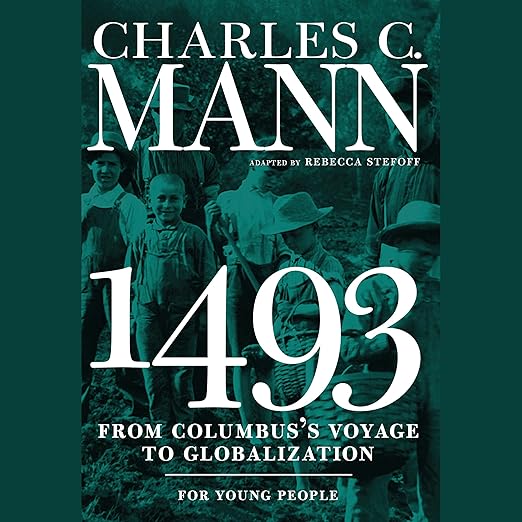
Globalization is usually taught as an economics topic, which is why this audiobook works: it teaches the same thing as a story about plants, metals and parasites moving around a planet that had kept them separate. A potato feeds the European poor and then kills millions of them. A rubber plant makes industry possible. Silver from a mountain in Bolivia funds flood control in rural China and wars for the Spanish Empire. James Fouhey reads it across six hours and thirty-two minutes for a young audience.
This adaptation keeps the original's central provocation intact, which is that the greatest leaps in human capacity repeatedly arrived bundled with the greatest threats to it. Malaria, slavery and the outcome of the American Revolution get connected in a single argument. That is a demanding claim to make for readers who have mostly been handed history as a sequence of national events, and the book spends its length showing the mechanism rather than asserting the conclusion.
April 2016 produced the most useful point about the audience, five stars, noting that a book written for young people is also an excellent route in for adults who want to learn more about MesoAmerica, and crediting Mann with expertise delivered in a comfortable style. That matches my own experience of the adaptation: the vocabulary has been calibrated for younger listeners without the ideas being thinned out to match.
What the format costs is the apparatus. The original is a book of maps, tables and photographs, and the adaptation for younger readers leans on visual explanation as well. Heard rather than read, the ecological chains have to be held in memory, and a listener who loses the thread between the silver mine and the Chinese floodplain cannot glance back at a diagram to recover it.
The Best Parts of 1493 for Young People
Structure is the reason, and one response explains why it matters. Writing in July 2019, a homeschooling parent describes assigning this over the course of a year to a third grader and finding it a challenge at first precisely because it approaches history differently from most children's books, which present the past as a series of narrative events, short stories with a beginning and an end. This one presents systems instead.
That difficulty is the educational value. Learning to follow a causal chain across continents and centuries is a skill, and few books for this age band ask for it. The audio version helps in one specific way: hearing the connections stated aloud in sequence keeps the chain in working memory better than a page of prose does for a reluctant reader who tends to skim.
Fouhey is handling a text full of place names, dates, quantities and unfamiliar terms, aimed at listeners who may be encountering all of them for the first time. The demand is clarity over character, and pace over color: a number spoken too quickly is simply lost, while a well-placed pause does the work a paragraph break does on the page. Nonfiction for young listeners lives or dies on that discipline.
Before You Commit to 1493 for Young People
Credit lines on this record do not match its own description. The byline reads Rebecca Stefoff, while the copy opens by naming the book as the work of Charles C. Mann, and no field anywhere says adapted by, which is what actually happened. Both names belong on this listing and each is doing a different job, but a buyer scanning the page has no way to work out the relationship between the two.
That lone one-star grade in the pool is not about the book at all. Filed in October 2020, it describes text squashed together on the screen, pages that stop loading at a fixed position, and a return window that had closed, before adding that the actual writing encountered so far is very interesting. That is a complaint about the typesetting of an electronic edition, sitting inside the average for every format of this title.
Which produces a small arithmetic curiosity worth knowing. The five written grades here are four fives and that single one, and they average exactly 4.2, the same figure the listing displays across ninety-one ratings. The visible sample happens to land on the overall number, and it does so only because a formatting complaint about a different edition is pulling four full stars out of it.
Should You Listen to 1493 for Young People?
Households where history is already a shared interest, and classrooms covering the early modern period. A March 2026 response describes buying it for a husband who loves history and already owned the earlier companion volume, then reports the consequence: the book was finished in a few days and the conversation at home is now full of facts from it, particularly about the origins of the potato and why we should all be eating more of them.
That is a fair picture of how this book behaves. It produces talking points, which is exactly what you want from history for a young audience, and the six and a half hours are structured in self-contained chains that survive being discussed at dinner. Adults who bounced off the full-length original will also find this a legitimate way in rather than a compromise.
Readers who want narrative history with characters to follow should look elsewhere, since this is argument and mechanism throughout, and so should anyone whose young listener needs maps to stay oriented. Take it if you want a book that treats a twelve-year-old as capable of holding a global system in mind at once. On that ambition, the adaptation succeeds well enough that adults keep borrowing it.
Before You Listen
What age range does this audiobook suit?
Upper elementary through high school, with adults reading alongside. One response describes assigning it to a third grader across a full school year, which suggests the lower bound is ambitious but achievable with support. Independent listening is more realistic from roughly middle school onward.
Do I need to read 1491 before this audiobook?
No. This volume stands on its own, covering the world that took shape after 1492 rather than the Americas before it. Readers who own the earlier book will find the two complementary, and one response in the pool describes exactly that pairing in the same household.