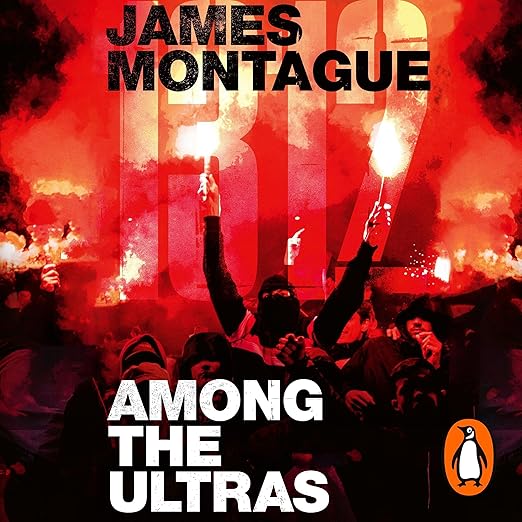
Key Details
- Narration: James Montague narrates his own reporting, and the reporter's voice carries directly into the performance without ever feeling like a separate reading of someone else's work.
- Themes: Football fandom as youth movement, radical politics on the left and right, authority and control on the terraces.
- Mood: Immersive and reportorial, occasionally confrontational.
- Verdict: A strong pick for anyone who wants football writing that treats fans as a real political phenomenon, less so for listeners who want the sport kept separate from politics entirely.
Ultras remain one of football's most visible mysteries, filling terraces with color and noise while staying almost entirely unknown as people, and that gap is exactly what this audiobook sets out to close. James Montague, a football journalist, narrates his own years of reporting on a subculture he positions as one of the largest youth movements in the world, built on access to stadium blocs from the Balkans to Buenos Aires. I worked through most of 1312: Among the Ultras on a string of long solo walks, the kind of stretch where dense, reported nonfiction holds up better than a plot-driven novel, and Montague's voice in my ear for nearly fourteen hours felt less like a narrator performing someone else's research and more like a colleague briefing me on where he had just been.
A Closer Look at 1312: Among the Ultras
What comes through first is how much Montague treats ultras as a political phenomenon rather than a hooligan curiosity. The book traces how the movement began and how its aesthetic spread into nearly every league on earth, then pushes past spectacle into the harder question of what these groups actually want. Reviewer Tobias D L Muse calls it 'a fascinating read, great writing and incredible access', and that access is the book's real spine: Montague is not reconstructing ultra culture from press-box distance, he has been inside the blocs, at the meetings, in the arguments about tactics and loyalty that never make it onto a match report.
Self-narration by a working journalist is often a gamble in audio, but here it pays off in a specific way: Montague's own reporting voice, measured, curious, willing to sit with contradiction, is the same register he uses to narrate, so the writing and the performance share the same voice instead of feeling like two separate jobs. Thomas G Manning III's review puts it simply: 'James does a fantastic job bringing you into the scene.' That is not a small compliment for a book that spends a lot of time inside crowded terraces and tense backroom meetings, where a flatter reading style would have let the scenes blur together instead of standing apart from each other.
The synopsis's opening line sets up the whole project in miniature: 'You can see them, but you don't know them.' That gap between visibility and comprehension is the actual subject of the book, more than any single match, riot, or banner display. Montague structures the reporting to close that gap methodically, tracing not just what ultras do on matchday but why the movement took the specific shape it did as it spread from its origins into nearly every stadium culture on the planet, absorbing local political tensions as it went rather than staying a fixed export.
The book's real ambition is showing how ultra culture became, in Montague's account, a genuine global political force reaching far beyond the terraces, then following that claim into genuinely uncomfortable territory: these groups embrace extremes on both the political left and right, fight the commercialization of football, and clash constantly with authorities who both fear and want to control them. That three-way tension, fans against clubs against the state, gives the book a throughline that a simpler inside-the-hooligan-gangs book would not have, and it is why long stretches of this read closer to political reporting than sports writing.
Geography does real work here too. Montague does not stop at Western Europe's most photographed ultra scenes; he follows the movement to the Balkans and to Buenos Aires, two settings where the stakes, and the violence, run higher than most casual football fans following weekend highlights would expect. Reviewer Marc Reichardt frames the book's core argument sharply: for him, 'politics and football are life,' and the book earns that claim by treating ultras as citizens with grievances and ideologies, not just noise machines standing in the stands for ninety minutes at a time.
The book also treats commercialization as a genuine throughline, not a side complaint. Ultras groups, in Montague's account, are fighting a similar battle in country after country: resisting the slow transformation of football clubs into pure commercial products, ticket prices climbing, atmosphere manufactured rather than organic, working-class fan bases priced out of the stadiums their own loyalty helped build for free. That economic argument sits underneath the more visible political fights over left-wing and right-wing radicalization, and Montague never lets listeners forget the two are connected rather than separate stories running in parallel.
Things to Know Before Starting 1312: Among the Ultras
This is not a book that keeps its head down and sticks to tactics and transfer news. If you came here hoping for a light survey of colorful fan traditions, chants, tifos, smoke and pyro displays, you will get some of that, but it is consistently in service of the harder argument about power and control, not the point of the book on its own. The politics is not seasoning here, it is the main course, and Montague never apologizes for that choice or softens it for listeners who might prefer the game kept separate from everything surrounding it.
At nearly fourteen hours, this is also a real time commitment, and the density of names, factions, and country-specific political context, particularly in the Balkans chapters, rewards focused listening more than background noise during chores. Nothing about the structure signals abridgment or filler; it is a fully reported book that simply asks listeners to keep track of a lot of moving parts across a lot of countries at once. Anyone hoping for a breezier, highlight-reel treatment of stadium culture should recalibrate expectations before pressing play on this one.
Worth knowing too: this is not a book confined to famous ultra scenes already covered heavily in English-language sports media. Montague's reporting draws specifically on the Balkans and Buenos Aires, regions where ultra culture intersects with recent history, organized power struggles, and entrenched political tension in ways that Western European fan culture usually does not. That choice of geography is deliberate and gives the book real reporting value beyond what a highlight-reel documentary about stadium culture could offer in ninety minutes.
Who James Montague Is Writing For
Football fans who care about the politics behind the terraces, not just match-day atmosphere, will get the most out of Montague's reporting. It also rewards readers of political nonfiction generally, since the throughline here, fringe movements testing the limits of state control, extends well past sports and into how power actually gets contested in public spaces.
Reichardt's own five-star review draws a hard line worth repeating here: anyone who does not like 'politics in their football' should expect to be uncomfortable, since, as he puts it, avoiding politics is itself a political statement. Go in knowing that upfront.
Does the 1312: Among the Ultras audiobook cover ultras culture beyond Europe?
Yes. Montague follows the movement specifically into the Balkans and to Buenos Aires, alongside the more familiar Western European scenes, treating ultra culture as a global phenomenon rather than a regional one.
Is James Montague narrating his own reporting in this audiobook?
Yes, Montague reads his own book, and reviewer Thomas G Manning III specifically credits the delivery with bringing listeners into the scene rather than just summarizing it.
Does 1312: Among the Ultras lean heavily into politics, or stay mostly on match-day atmosphere?
It leans heavily into politics. The book treats ultras as a political movement embracing both left and right extremes, and reviewer Marc Reichardt notes directly that listeners uncomfortable with politics in football should look elsewhere.
How long is the 1312: Among the Ultras audiobook?
It runs 13 hours and 58 minutes, and the density of names and country-specific context makes it better suited to focused listening than background noise.