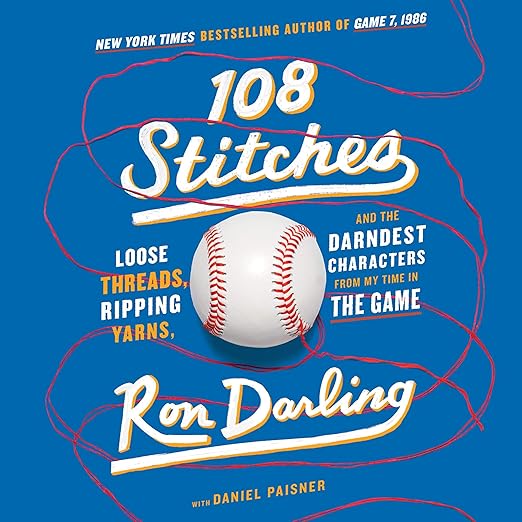
Key Details
- Read by: Malcolm Hillgartner is the credited performer rather than the Emmy-nominated broadcaster who wrote the book, an unusual call for a memoir built on a famous voice.
- At its heart: Baseball's oral tradition, six degrees of separation, clubhouse candor, Mets history
- Vibe: Chatty, opinionated and easy to dip into
- Short version: Excellent fragmented listening for a baseball fan, and not the career memoir some buyers expect.
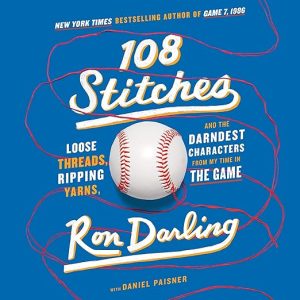
Ron Darling talks for a living, which makes the credit on this audiobook oddly conspicuous. The publisher's copy introduces him as a New York Times bestselling author and an Emmy-nominated broadcaster, a man whose voice has carried baseball for decades. The performer credited on 108 Stitches is Malcolm Hillgartner. Seven hours and twelve minutes of stories from a career spent behind a microphone, and somebody other than the microphone's owner is reading them.
What We Made of It
Neat is the word for the conceit, and I did the arithmetic behind it before writing anything else. A baseball carries 108 stitches; Darling offers 108 anecdotes. Spread across seven hours and twelve minutes that averages near four minutes apiece, which describes the listening experience more precisely than any blurb could. This is not a memoir with an arc. It is a sequence of short self-contained pieces, and it can be paused anywhere without costing you your place.
Six degrees of separation is the organizing idea, applied to a sport that suits it. Darling has played with or reported on nearly everyone in uniform since 1983, and those people in turn played with or reported on the generation before, so the chains run back through Yale coach Smoky Joe Wood, Willie Mays, Bart Giamatti, Tom Seaver and Mickey Mantle as far as Babe Ruth. One reviewer captures the effect exactly: Darling "spent enough time in baseball to see/hear/live a lot of things, and he strings them together here in clever ways." Stringing is the right verb. The book is stitched rather than built.
Darling's vantage point is unusual, and it is what makes the chains work at all. He played, and then he moved into broadcasting, which hands him clubhouse access and a professional obligation to hold opinions out loud. The copy leans on exactly that dual standing when it builds its chains, which is how somebody who started in 1983 ends up two handshakes from Babe Ruth by way of a Yale coach. Books by players tend to protect the fraternity. Books by broadcasters tend to lack the inside seat. This one solves both problems at once and, as its reviews demonstrate, promptly creates a third.
Why 108 Stitches Works as an Audiobook
All five written responses on this listing describe reading rather than listening, and what they agree on transfers cleanly anyway: speed. One calls it a fast beach read. Another says "very fast read." A third settles on "Good, easy, and enjoyable." That consensus about pace belongs to the prose and the chapter length rather than to paper, which means it survives the move to audio intact. Seven hours of four-minute stories disappears across a week of commutes without ever demanding a bookmark.
Allegiance is the second draw, and reviewers are candid about it. Two identify themselves as Mets fans before saying anything else, one admitting the bias outright: "biased because I'm a Mets fan." That candor is genuinely useful to a buyer. If you follow the Mets, this book concerns people you already hold opinions about. If you do not, trust the reviewer who calls it "great for a Mets fan but also for a baseball fan," and note that the reach back to Ruth is what makes the second half of that sentence true rather than polite.
What Might Not Land
The sharpest reservation in the pool concerns tone, and it deserves weight. A four-star reviewer reports surprise at "the amount of profanity, insults, and vulgarity" given Darling's good-guy image on television, then warns plainly that the book "is not as family friendly as a trip to the ballpark with the kids." The same notice raises disputes about the accuracy of certain stories and mentions a lawsuit brought by Lenny Dykstra. That response breaks off mid-sentence on the listing, so where it finally lands is unknowable, but the warning it opens with could not be clearer.
A five-star reviewer pushes back directly, calling the sensitive responses "way off base," insisting Darling "doesn't say anything that's horrible" and that he "definitely holds back in many situations," including on the Bob Murphy material that had already drawn attention. Two readers, one book, opposite verdicts on how far it goes. That disagreement is the most informative thing on the page, because it establishes the book is provocative enough to divide people who otherwise agree about baseball entirely.
Structure is the last thing to weigh. 108 discrete anecdotes with no through-line means nothing accumulates, and a three-star reviewer gets at that gently, allowing it is worth the read for anyone after interesting stories from a career in baseball and broadcasting. That is a recommendation with a ceiling built in.
The headline number, meanwhile, is 4.3 from 319 ratings, while the five readable notices average 4.4, ranging from three stars up to five. Both figures describe a book people liked without loving. One more practical note: the earliest readable response here dates from May 2019, forty days after release, and the most recent from November 2025. Six and a half years of reaction on a book of anecdotes is a decent durability test, and the newest response still calls the stories worth the read.
Who Should Pick Up 108 Stitches
Baseball fans who love the sport's oral tradition are the constituency, and Mets fans twice over. Anyone who enjoys clubhouse stories, broadcast-booth gossip and the particular pleasure of learning what one player really thought of another gets seven hours of precisely that. The four-minute chapter length makes it close to ideal for fragmented listening: a dog walk, a train platform, the quarter hour before the rest of the house wakes up. It also makes an unusually easy gift, because the conceit explains itself in one sentence: 108 stitches hold a baseball together and 108 stories hold a life in the game together, an image the copy runs out to its end by describing experiences interwoven with every athlete who ever played and every fan who ever skipped work for a day game.
It is the wrong pick for a listener who wants Darling's own life told properly. This is a scatter of encounters rather than a career narrative, and anyone after a player's interior account of his own seasons will find him mostly reflected off other people. Parents planning a shared listen with a young fan should heed the language warning. And anyone who prizes discretion in a memoir over candor should note that one reviewer reports both accuracy disputes and a lawsuit, while another insists Darling held back.