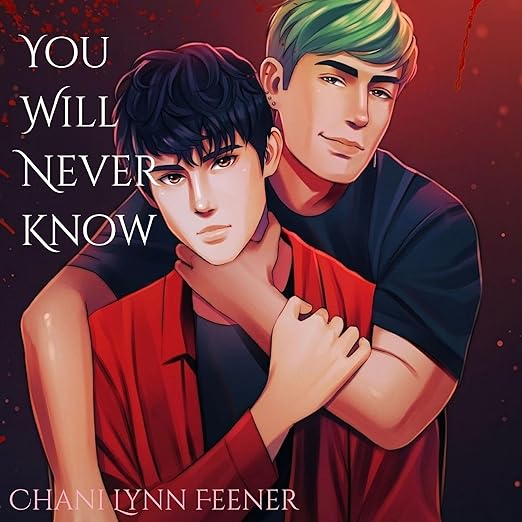
Quick Take
- Narration: Dan Levy brings controlled authority to Odin’s perspective and genuine vulnerability to Hunter’s, navigating the enemies-to-lovers tension without tipping into melodrama.
- Themes: Betrayal and its aftermath, power imbalance within desire, identity under criminal coercion
- Mood: Tense and charged, with a slow-burning romantic core
- Verdict: A confident debut for this sci-fi mafia romance series, best read as the opener to a completed trilogy rather than in isolation given the cliffhanger ending.
Chani Lynn Feener has built a following on the strength of her banter, and this is the first thing you notice about You Will Never Know within the opening chapters. The back-and-forth between Hunter and Odin has the quality that makes or breaks enemies-to-lovers fiction: it feels like two people who actually know each other rather than two characters delivering scripted friction. I was listening on a Sunday morning with the windows open, and I found myself grinning at lines I normally would have found too arch. That is a sign of craft, not coincidence.
The setting here is genuinely unusual for this genre. Sanctum is a planet ruled by criminal families who can control the elements, politically organized around a corrupt Emperor who has essentially abdicated meaningful governance to concentrate on personal enrichment. Hunter once worked for the Snow family, chose the wrong side in a family conflict, and has been running ever since. Odin Snow, the Dominus of the Snow family, finds him after ten years and has a plan that involves using their old connection as a weapon against his stepbrother Isa. The premise is more layered than the typical mafia romance setup, and Feener earns credit for not flattening it into a simple pursuit dynamic.
Our Take on You Will Never Know
Dan Levy handles the dual perspectives well. Hunter’s fear is a constant underneath his surface competence, and Levy keeps that tension audible without making him seem passive. Odin is harder to render sympathetically at first, because his initial intentions toward Hunter are genuinely manipulative. Levy’s approach is to let Odin’s rationalization be transparent without making the character contemptible, which is exactly the right call. You need to understand why Odin tells himself his plan is justified while the reader can see clearly that it is not.
The element system in this world, where members of the Brumal families control different elements, is introduced economically. Odin’s fire control is the most prominent in the narrative, functioning both as a literal power and as an obvious metaphor for the kind of consuming attention he turns on Hunter. One reader noted wanting more worldbuilding around the political structure and character positions. That is a fair critique. The Brumal hierarchy and the Emperor’s role are gestured at more than explained in this first volume, and readers who want to understand the full landscape before investing in the romance may find the pacing slightly frustrating in the first half.
Why Listen to You Will Never Know
The chemistry is the thing. Multiple reviewers converged on this without being able to fully explain it, which is usually a sign that the author has achieved something technically difficult: the sense that these two specific people, with their specific history and specific wounds, could not believably be drawn to anyone else. Feener gives Odin a ten-year absence to account for, a period during which he has had to rebuild everything he lost because of what Hunter did. That context means his anger toward Hunter is not simply possessive jealousy. It is earned grievance, which complicates the eventual softening considerably.
At six hours and fifty-one minutes, the runtime is on the shorter side for a romance audiobook, which contributes to one of the book’s real structural issues: the first fifty percent does feel like extended setup, and the cliffhanger lands before the central conflict has fully resolved. One reader said she spent the first half frustrated with the back-and-forth and then lost to the book entirely once it accelerated. That curve is real. If you push through the setup, the payoff is there.
What to Watch For in You Will Never Know
The stepbrother Isa Frost is introduced as the background antagonist who orchestrated everything unfortunate that has ever happened to Odin, and he is a more threatening presence than the page time he receives in this volume would suggest. He is the reason for the ten years of damage between Odin and Hunter, and the narrative makes clear that dealing with him is the actual long-game objective. Readers who want that story resolved will need to continue the series.
The cliffhanger is real and it is pointed. One reviewer said she would have screamed at the ending if the rest of the series had not already been available. The series is complete, which is relevant information for anyone considering starting it. You are not signing up for an indefinite wait.
Who Should Listen to You Will Never Know
This is for MM romance readers who want their love interest’s manipulation to have emotional roots rather than being simply possessive, for sci-fi romance listeners who like worldbuilding layered into romantic tension rather than delivered as exposition, and for readers who have followed Chani Lynn Feener’s other work and want to see her working in a new register. Read the full series before starting rather than picking this up in isolation. The ending will frustrate you without immediate access to the next book. Skip it if you need clean worldbuilding or resolved endings at the volume level.
Frequently Asked Questions
Is this MM romance, and how explicit is the content?
Yes, You Will Never Know is an MM romance. The content is moderately explicit. Multiple readers described it as less intense than other dark romance titles it is sometimes compared to, such as Haunting Adeline, so expectations should be calibrated accordingly.
Does the sci-fi setting feel integrated into the romance, or is it just backdrop?
More integrated than many genre hybrids. The element-control powers are central to both the plot mechanics and the metaphorical texture of the romance. Odin’s fire control in particular is woven into the dynamic between him and Hunter throughout.
How well does Dan Levy distinguish between Hunter and Odin’s perspectives during point-of-view shifts?
Clearly enough that you are never confused about whose interiority you are in. Hunter’s fear and constant vigilance read differently from Odin’s calculated confidence, and Levy maintains those tonal distinctions consistently across dual POV chapters.
Is the cliffhanger at the end resolvable without reading the next book, or does it leave things genuinely unfinished?
Genuinely unfinished. The central conflict between Odin, Hunter, and Isa Frost is not resolved in this volume. The series is complete, so the resolution exists, but this is not a standalone listen with a tidy conclusion.