Quick Take
- Narration: B.J. Harrison brings energy and comedic timing to Fiona Roarke’s alien small-town romance, handling the tongue-in-cheek humor and sci-fi worldbuilding with enough warmth to keep the premise from feeling silly.
- Themes: Hidden identity and secret-keeping, small-town community with an alien twist, investigative journalist vs. the truth she was not looking for
- Mood: Playful and light, built for escapism rather than emotional weight
- Verdict: A fun, undemanding series opener that earns its audience through consistent humor and a creative premise, though listeners expecting either heat or feminist character writing should adjust their expectations accordingly.
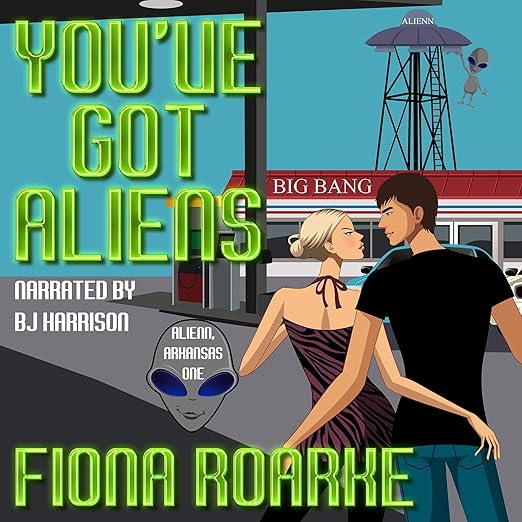
I came to You’ve Got Aliens on a quiet afternoon when what I wanted was something with a clearly defined sense of its own absurdity and no pretensions beyond delivering on its premise. Fiona Roarke’s first Alienn, Arkansas book delivers that contract. Librarian and aspiring journalist Juliana Masters is trying to figure out who she is. Her plan involves completing one lucrative writing assignment: proving that aliens operate out of a secret facility under the Big Bang Truck Stop in a small Arkansas town. The irony that the alien she falls for is the one she is trying to expose is the engine of the book, and Roarke keeps it running with consistent comedic energy and a genuine affection for the universe she has built.
Alienn, Arkansas is a town founded by aliens from Alpha-Prime who are hiding in plain sight, with a tourist-friendly alien theme that functions as the most practical cover possible. Diesel Grey is the fearless leader of this galactic way station, managing a family business that involves considerably more headaches than he anticipated, including the shockingly well-informed writer who has gotten closer to the truth than anyone should. His trigger-happy brother keeps erasing her memories. This is the comic infrastructure of the book, and it works because Roarke commits to its internal logic rather than treating the premise as an excuse for anything-goes plotting.
Our Take on You’ve Got Aliens
B.J. Harrison narrates with the energy the material requires. The humor here is tongue-in-cheek rather than dry, and the Alpha-Prime aliens’ superior attitude toward earthlings needs a narrator who can sell the joke without condescension. Harrison manages it, keeping the comedic beats landing consistently while maintaining enough warmth in the romantic scenes to make the relationship feel like something more than a delivery mechanism for humor.
One reviewer offered an honest assessment that lands as useful for prospective listeners: this is not a spicy read. If the heat level is a primary criterion, this series is not calibrated for it. The romance is evident and the attraction between Juliana and Diesel is real in the narrative, but Roarke is writing toward humor and adventure rather than toward physical intensity. A reviewer who reached the midpoint before realizing this felt genuinely disappointed about the discovery, which is a reasonable feeling and a fair warning to pass along.
Why Listen to You’ve Got Aliens
The particular appeal of this book is its departure from the standard romance formula at the structural level. Roarke is not writing the predictable small-town love story with sci-fi dressing. The Alienn, Arkansas universe has its own internal rules, its own community logic, and its own comedy of manners, and Juliana’s investigative journalist framing gives the book a plot momentum that is distinct from the romantic-beats-in-sequence structure of more conventional entries in the genre. One reviewer noted that the story was interesting with a few plot twists thrown in, and the investigative thread gives the romance somewhere more interesting to go than the usual obstacles.
This is the first book of what appears to be an ongoing series, and the worldbuilding is calibrated for the long game. Reviewers who came to this through the Nocturne Falls Universe, which Roarke has also contributed to, note that the Alpha-Prime aliens are consistent across fictional universes, which adds texture for readers with that context. New readers will find the opening book self-contained enough to function without it.
What to Watch For in You’ve Got Aliens
The female lead’s arc attracted a dissenting note from at least one reviewer, who found the speed with which Juliana falls for Diesel unrealistic and her subsequent behavior in pursuing relationship-level questions with someone she has just met irritating. This is a legitimate character critique. Roarke is writing in a genre where the love-at-first-sight convention is broadly accepted, but how quickly Juliana moves from investigative journalist to contemplating long-term compatibility is fast enough that readers who want their heroines to maintain professional skepticism for longer may find the romantic acceleration jarring.
The memory-erasing brother is a recurring comic device that also raises some ethical questions the book is not particularly interested in examining. Within the internal logic of the novel’s light register, it functions fine as a plot mechanism. Readers who want their fictional worlds to reckon with the moral implications of removing someone’s agency and memory will find the book cheerfully uninterested in that conversation.
Who Should Listen to You’ve Got Aliens
Readers looking for a series starter that promises a light, humorous alien romance with a small-town setting and enough plot momentum to distinguish it from pure will-they-won’t-they plotting will find this worth their seven hours. Fans of the Nocturne Falls Universe who want more Fiona Roarke will already know what they are getting. Those who need significant heat, morally complex heroines, or genre fiction that interrogates its own premises should look elsewhere. As escapism with a creative premise, it does its job.
Frequently Asked Questions
How much science fiction worldbuilding is in You’ve Got Aliens, and does it get in the way of the romance?
Roarke has built a coherent internal world for the Alpha-Prime aliens in Alienn, Arkansas, with their own community structure, cover stories, and internal politics. The worldbuilding is present enough to give the story texture and comedic material, but it is not dense enough to overshadow the romance. The sci-fi elements function as the setting and source of conflict rather than as subjects for detailed exploration.
Is B.J. Harrison’s narration suited to the comedic and romantic register of Fiona Roarke’s writing?
Yes. Harrison brings the energy and timing that Roarke’s particular brand of tongue-in-cheek humor requires, and maintains enough warmth in the romantic scenes to keep the relationship feeling genuine rather than purely comedic. The Alpha-Prime alien humor lands well under his delivery.
Does the memory-erasure plot device become a problem for the romantic storyline?
The book handles this with light comedy rather than examining the ethical implications. Within the novel’s playful register, Diesel’s brother erasing Juliana’s memories functions as a recurring comedic obstacle. Readers who would find such a device troubling in a romance should know it is present and played for laughs rather than moral weight.
Is You’ve Got Aliens the first book in the Alienn, Arkansas series, and is it necessary to read them in order?
Yes, it is the first book, and the series is designed to be read in order though each book follows a different couple. The worldbuilding and recurring community characters from Alienn, Arkansas reward reading in sequence, but each romantic storyline is self-contained with its own happily-ever-after.