Quick Take
- Narration: The ‘Various’ cast works well for this anthology format, lending the letter readings an intimacy that a single narrator might have flattened.
- Themes: fatherhood and legacy, gratitude and reconciliation, intergenerational memory
- Mood: Quietly emotional, reflective, and occasionally surprising in its humor.
- Verdict: A listening experience that is genuinely moving in the way only collected personal testimony can be, best encountered in short, deliberate sessions.
I came to Wisdom of Our Fathers on a Sunday afternoon in October, the kind of day when the light shifts early and you feel the pull of something quieter than your usual listening fare. Tim Russert had died in 2008, and there is something particular about encountering his voice and sensibility in a book that is itself a response to other people’s love for their fathers. It creates an unusual layering of grief and gratitude that runs underneath everything you hear.
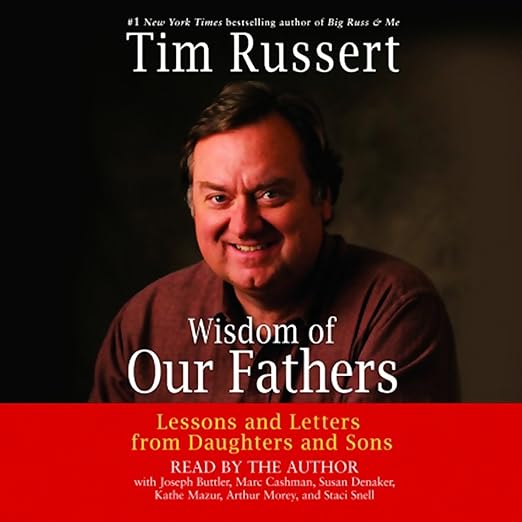
This audiobook is the follow-up to Russert’s bestselling memoir Big Russ and Me, and it was born from an avalanche of letters he received after that book’s publication. Tens of thousands of daughters and sons wrote to tell him about their own fathers, and Russert selected and curated the best of them into this collection, organizing the material into chapters built around specific life lessons: tenderness, discipline, humor, silence, reconciliation.
Our Take on Wisdom of Our Fathers
What distinguishes this from a sentimental anthology is Russert’s editorial eye. He was, by profession, someone who read people carefully and knew how to let a story do its own work. The letters he chose are not uniformly uplifting. Some document difficult fathers, estrangements that were only resolved at the last moment, the complicated math of love and disappointment. One contributor describes a fifteen-year estrangement with her father that ended just before his death. Another writes about learning to read the affection in a father’s silence. These are not the letters of people who had perfect parents; they are the letters of people who found meaning in imperfect ones, which is a far more honest and useful thing.
The format is unusual for an audiobook. Each chapter is short, and each letter within it is rarely more than a page. One reviewer described it as a book that requires care to read slowly and savor each letter, and that advice transfers directly to the audio experience. This is not something to put on as background listening. The cumulative emotional weight builds through accumulation, not through sustained narrative tension, and if you’re half-present you’ll miss the specific detail that makes a given letter resonate.
Why Listen to Wisdom of Our Fathers
The audio format actually suits the material particularly well. Hearing these letters read aloud gives them a quality that silent reading can’t quite replicate; they feel delivered, not just printed. The use of various narrators, rather than a single voice throughout, reinforces the sense that these are genuinely different people speaking. Russert’s own introductory and contextual material grounds each section, and his conversational warmth, so familiar to anyone who watched him on television for decades, comes through in what he chose to say and how he chose to say it.
At seven hours and thirty-nine minutes, this is a brisk listen compared to most audiobooks in this collection, but it asks for a different kind of attention than a novel. You don’t build momentum here in the conventional sense; you accumulate feeling. By the final sections, the emotional resonance is considerable, not because any single letter is extraordinary, but because dozens of ordinary letters have stacked up into something that starts to feel like a portrait of fatherhood itself.
What to Watch For in Wisdom of Our Fathers
This is an anthology with a specific emotional register, and it doesn’t modulate much. Listeners looking for narrative drive, sustained argument, or intellectual provocation will find this too soft for their purposes. It is deliberately and unapologetically sentimental, though never saccharine, because Russert was too good a journalist to mistake sentimentality for honesty. The letters occasionally repeat certain types; there are multiple variations on the coach-father who showed up for every game, and if you listen to the whole book in one sitting, the sameness of some entries may become visible.
It is also, inevitably, a book shaped by a particular cultural context: mostly American, mostly mid-century in its references, mostly middle-class in its circumstances. That is not a failing, but it is a limit, and listeners whose own experience of fatherhood looks very different may feel the gap.
Who Should Listen to Wisdom of Our Fathers
Anyone who has been thinking about their father, whether he is still living or not, will find something in these pages that feels recognizable. It works well as a gift audiobook for Father’s Day or as personal listening during any period of reflection. Avoid it if you need your audiobooks to do something other than make you feel; this one has no other ambition, and it fulfills that ambition with quiet conviction.
Frequently Asked Questions
Do I need to have read Tim Russert’s first book, Big Russ and Me, before listening to this?
No. Wisdom of Our Fathers stands entirely on its own. Russert provides enough context about his previous book that new listeners will understand the origin of this collection, but the letters themselves require no prior knowledge.
How does the various-narrator format work for this audiobook?
It serves the material well. The anthology format benefits from multiple voices because it reinforces the sense that these are genuinely different people telling their own stories. It would feel flatter with a single narrator performing all the letters.
Is this appropriate listening for someone who has recently lost their father?
Thoughtfully, yes, though with caution. The book does include letters about fathers who have died and about the regret of estrangement, so it will surface grief. Many listeners find that kind of honest engagement with loss helpful rather than harmful, but it is not a comfort listen in a light sense.
Are there any letters in the collection that deal with difficult or absent fathers, or is this uniformly celebratory?
Russert was deliberate about including complicated relationships. There are letters about estrangement, silence as a form of love, fathers who got things wrong but eventually got something right. It is not a book of uncomplicated hero worship.