Quick Take
- Narration: Cynthia Erivo, who played Elphaba in the 2024 film, brings an intimate authority to young Elphaba’s childhood story that is genuinely irreplaceable for this specific text.
- Themes: The formation of an outsider identity, family dysfunction as inherited destiny, the origins of a cultural mythology
- Mood: Contemplative and slow-burning, closer to literary character study than plot-driven fantasy
- Verdict: A satisfying prequel for existing Maguire readers, though its episodic structure and deliberately quiet pacing will not convert those who found the original Wicked demanding.
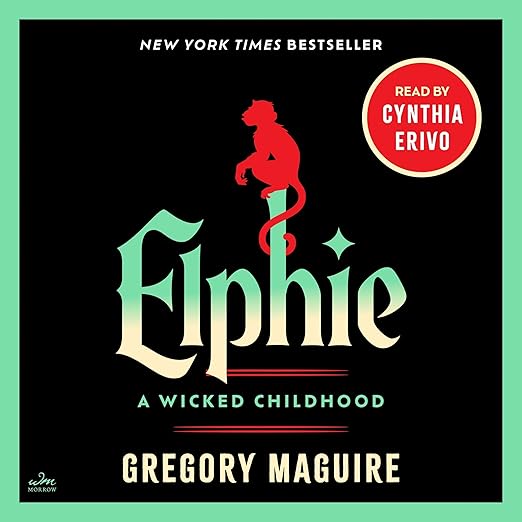
Gregory Maguire has been building his version of Oz for over thirty years, and Elphie, his latest addition to the Wicked universe, arrives in a new audio recording narrated by Cynthia Erivo, who played the film version of Elphaba in the 2024 adaptation. I listened to it on a series of late evenings after quiet days, the kind of schedule that suits Maguire’s particular register. His Oz is not a place of adventure in the conventional fantasy sense but a place of history, philosophy, and moral consequence, and it requires a certain kind of unhurried attention to receive properly.
Elphie is, as its positioning makes clear, a childhood story. It takes Elphaba from infancy through the early years at Shiz University where the great story of Wicked begins. If you have spent any time with Maguire’s original novel, or with the long-running musical, or with the 2024 film, and have ever wondered how Elphaba became who she was before she became the Wicked Witch of the West, this book provides Maguire’s answer. It is careful, literary, and at times unexpectedly moving in the way small moments of childhood cruelty and unexpected kindness can be when the reader knows what they are preparing a character to become.
What Cynthia Erivo Brings to This Recording
The casting decision here is not incidental or merely commercial. Erivo played Elphaba on screen and carries that identification into the narration in ways that are genuinely interesting for a listener who knows the film. She reads young Elphie with a quality of earned intimacy rather than performance, which suits Maguire’s register precisely. There is no theatrical excess; instead, there is a quiet attention to the child’s interior experience that makes the early sections of the book, the infant Elphaba in her strange family, the small jealousies and injuries of early childhood, more affecting than they might be with a narrator who had no personal investment in who this child becomes.
Reviewer Angela noted that the story was an admittedly slow read but one she could not pass up as a fan of both The Wizard of Oz and Wicked. That pace is exactly what Erivo’s narration honors rather than fights against. She does not try to manufacture momentum where Maguire has built deliberate stillness. For listeners attuned to literary fiction’s rhythms, the performance is one of the audiobook year’s more interesting pairings of narrator and text. For those expecting the musical’s energy and emotional directness, it will require adjustment.
Maguire’s Style and the Patience It Requires
The recurring observation across reviews of Maguire’s work is that his writing style takes time to settle into. Reviewer Dadannac described it as brilliant once the reader adjusts to it, which is a generous and accurate framing. Maguire writes with a density of reference and an indirection of plot that draws more from 19th century literary fiction than from contemporary genre fantasy. He is interested in the weight of the past on the present, in the way families shape and distort the people who come out of them, and in the moral ambiguity of characters who are neither good nor wicked in any simple sense. He gives you the childhood that Elphaba’s adult story requires and trusts you to make the connections without spelling them out.
Elphie is structured as what one reviewer accurately described as a collection of short stories about the same characters rather than a unified novel with a conventional plot arc. The chapters move through Elphaba’s childhood in episodes rather than in continuous narrative momentum, covering her promiscuous mother Melena, her pious father Frex, her saintly sister Nessarose, her junior-felon brother Shell, her first encounters with the mistreated Animal populations of Oz, her early bruising attempts at friendship. The effect is cumulative and atmospheric rather than propulsive. This is a deliberate artistic choice, not a structural flaw, but it means the book will frustrate listeners who come expecting the pace of contemporary fantasy.
The Position of This Book in the Wicked Canon
Nearly thirty years after the original Wicked novel, Maguire returns to Elphaba’s beginning. The timing is not incidental: the cultural saturation of Wicked through decades of Broadway and the 2024 film adaptation means Elphaba is now one of the most recognized characters in popular fantasy. Elphie functions partly as an origin story for that recognition, filling in the childhood that the musical elides and that even the original novel covers only briefly. For listeners who want to understand Maguire’s complete vision of his character across a life, this book is a necessary piece of the portrait.
For those who came to Wicked primarily through the musical and are expecting something with that emotional directness and theatrical energy, the novel’s literary register may feel unexpectedly quiet. That is not a flaw but a different kind of ambition. The Cynthia Erivo recording is, under any circumstances, the definitive audio version of this text, and the intimacy she brings to young Elphie’s difficult, peculiar, eventually transformative childhood is worth the pace it requires.
Reading Elphie Against the Broader Wicked Canon
There is something worth noting about how Elphie functions differently for different kinds of readers. Those who know only the musical will encounter a version of Elphaba considerably more ambiguous and harder to love than the character Idina Menzel and Cynthia Erivo made iconic on stage and screen. The musical streamlines the character’s moral landscape in ways that make her sympathetic almost immediately. Maguire’s Elphaba is prickly, strange, and at times genuinely difficult, which is what makes the eventual portrait of her adult witchhood feel psychologically true.
Those who know the original novel well will find Elphie filling in the spaces Maguire left deliberately open in Wicked, and those spaces turn out to be more significant than they might have seemed. The childhood sections of the original novel are brief and impressionistic; this book makes them full and specific. That specificity is what Erivo’s narration serves so well. She does not perform a character; she inhabits a history, and the difference is audible from the first chapter.
Frequently Asked Questions
Does Elphie require having read the original Wicked novel first, or does it function as a standalone?
It is designed as a prequel and can be followed without prior reading. However, it is most rewarding for listeners who know the original Wicked or the musical. The emotional resonance of Elphaba’s childhood depends partly on understanding what she eventually becomes, which this book assumes you already know.
How does Cynthia Erivo’s performance differ from other narrators of Maguire’s Oz books?
Erivo’s intimate, unhurried reading is shaped by her personal identification with the character from her film role. The narration has a quality of earned authority that distinguishes it from more neutral approaches. She does not perform the material; she inhabits it, which suits Maguire’s interiority-focused prose.
Is Elphie appropriate for younger readers who loved the Wicked musical or film?
Maguire’s Oz novels are written for adult readers and include mature themes handled with literary complexity. The emotional register is very different from the musical, which is emotionally direct and theatrically expansive. Younger fans of the stage show should be prepared for a substantially quieter and more reflective experience.
Does the book show Elphaba meeting Glinda, given how central that friendship is to the Wicked story?
The book ends as Elphaba arrives at Shiz University, precisely at the threshold of meeting Galinda. Maguire is deliberate about this: Elphie covers the childhood the original Wicked skipped over, stopping exactly where the larger story begins. The choice is artistically clean and leaves the meeting to the reader’s imagination and memory.