Quick Take
- Narration: Kevin Pariseau brings a warm, steady authority to this biography, pacing each chapter at a tempo that holds young listeners without talking down to them.
- Themes: Founding Father complexity, contradictions of slavery and liberty, intellectual curiosity
- Mood: Informative and measured, with flashes of genuine admiration and honest discomfort
- Verdict: A well-rounded introduction to one of history’s most fascinating and morally complicated figures, suited for classroom use or curious independent listeners ages 8 and up.
I put this one on during a long Saturday drive with my nine-year-old niece in the backseat. She had just finished a school unit on the American Revolution and was, in her words, “already bored of the Founding Fathers.” By the time Kevin Pariseau got to the part where John Adams essentially had to talk Jefferson into writing the Declaration of Independence, she leaned forward in her seat. That’s the hook this series knows how to find: the story behind the story that no textbook bothers to share.
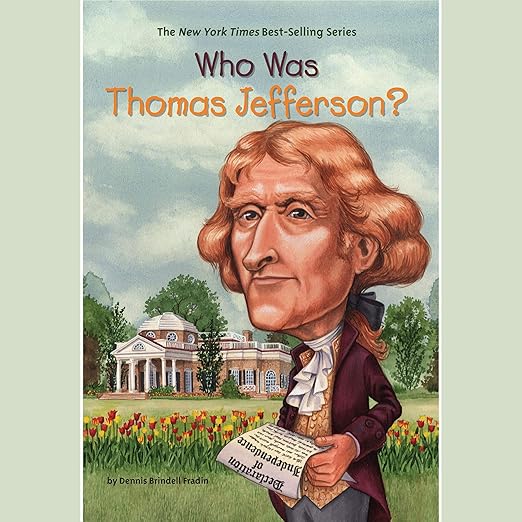
Dennis Brindell Fradin’s entry in the long-running Who Was? series does something that a lot of children’s biographies avoid. It doesn’t flatten Jefferson into either a marble statue or a villain. It holds the contradictions. This is a biography that tells young listeners about the man’s intellectual range, his architectural ambition, his work as a farmer and inventor, and then refuses to step around the fact that he enslaved hundreds of people on the very plantation where he theorized about liberty. For a book in a series aimed at kids, that honesty stands out.
What Kevin Pariseau Does With the Difficult Parts
Narrating biography for children is a trickier assignment than it sounds. Too grave and you lose the audience. Too chipper and you flatten historical reality into something false. Pariseau threads this carefully throughout. His delivery is measured and unhurried, giving the bigger ideas room to breathe, and he shifts register subtly when the material demands it. The passages about Jefferson’s slaveholding are read without editorial flourish but also without the kind of performative neutrality that lets difficult facts slide by unregistered. Young listeners notice tone even when they can’t articulate it. Pariseau earns their attention because he treats the subject with seriousness.
The Many-Sided Man
One of this audiobook’s genuine strengths is how thoroughly it sketches Jefferson’s range of interests. Fradin gives real time to Jefferson’s work as an architect, his invention of a wheel cipher, his obsessive interest in science, and his years in France that shaped his political thinking. The synopsis undersells this somewhat: the biography that emerges is less a political chronology than a portrait of a restlessly curious mind. For children who feel themselves pulled in multiple directions, there’s something genuinely encouraging about a historical figure whose achievements spanned so many fields. Listener Volsbowers notes that the series contains enough information to satisfy the reader while also encouraging them to go further, and that’s a fair description of how this one lands. It’s a starting point, not a conclusion.
Where the Series Format Works Against the Subject
The Who Was? format is, by design, compact. At just over an hour of listening, this biography cannot be everything. Jefferson’s time as Secretary of State, the Louisiana Purchase, the founding of the University of Virginia, his complex relationship with Sally Hemings: these are either handled briefly or touched lightly. The Hemings matter receives mention but not the depth a middle-grade listener might now encounter in a school discussion. For parents or teachers using this as a classroom supplement, it is worth knowing that you will need to add context. But that is also part of the series’ design: it opens doors, and the expectation is that you will walk through them with your child.
Who Should Listen
This is a strong fit for listeners ages 8 to 12, particularly those starting to encounter American history in school. It works well as a car-trip companion or bedtime listen for history-curious kids. Teachers and homeschooling families will find the honest treatment of Jefferson’s slaveholding useful as a discussion starter. Listeners who want a deeper, more critical examination of Jefferson’s contradictions will need to graduate to adult biography after this, but as an entry point, it earns its 4.7-star rating honestly.
Frequently Asked Questions
Does this audiobook address Jefferson’s slaveholding directly?
Yes. Fradin includes the fact of Jefferson’s slaveholding as a central part of the biography rather than a footnote. It is handled with honesty appropriate for the series’ audience, though it is not explored in great depth given the one-hour runtime.
Is this suitable for a classroom assignment on the American Revolution or Founding Fathers?
It works well as supplementary listening for grades 3 through 6. Several reviewers note using it specifically for school projects and homeschool history units, and the series is designed with Common Core-adjacent educational goals in mind.
How does Kevin Pariseau’s narration compare to other Who Was? audiobooks?
Pariseau is a reliable narrator in this series, bringing calm authority without theatrical overstatement. His pacing suits the short chapter structure well, making it easy for young listeners to absorb information in segments.
Does this audiobook cover the Declaration of Independence in detail?
It covers the writing of the Declaration as a central episode, including the anecdote about Adams persuading Jefferson to take on the task. It discusses the document’s significance but does not read the full text.