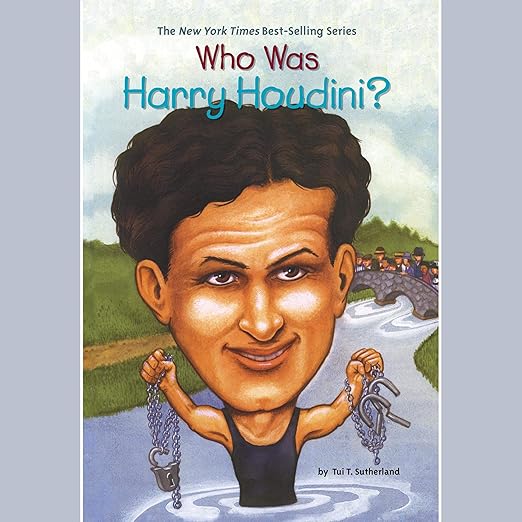
Quick Take
- Narration: Kevin Pariseau brings quiet professionalism to this biography, delivering the facts with an engaged but measured tone. He does not over-dramatize Houdini’s escapes, which actually works in the book’s favor, letting the facts speak for themselves.
- Themes: Ambition and reinvention, performance as identity, historical celebrity
- Mood: Informative and lightly energetic, appropriate for school-project season
- Verdict: An efficient, well-structured biography for middle-grade listeners with genuine curiosity about Houdini, and one of the stronger entries in the Who Was? series for the audio format.
There is a specific seasonal rhythm to biography audiobooks aimed at middle-grade readers, and I notice it every year around school project season. Parents who have been through the experience of a child needing a biography subject and finding every library copy checked out will recognize Tui Sutherland’s Houdini entry immediately. It is one of the more borrowed titles in any collection that stocks the Who Was? series. I came to it curious whether Pariseau’s audio performance justified the format over the print edition for the school-project use case that two separate reviewers explicitly describe.
The answer is more nuanced than a simple yes or no. But let me explain what Sutherland actually does with Houdini’s life before getting there.
The Details the Magic Act Hides
The synopsis promises details kids will really want to know, and that is not marketing language. Sutherland makes good on it. The biographical core is Houdini’s immigrant origins, the invention of his stage persona, and his relentless self-promotion, but the unexpected material is what lifts the book. Houdini as early film actor. Houdini as the first pilot to complete a controlled flight in Australia. His obsession with debunking fraudulent mediums after his mother’s death. These are not the facts children have already absorbed from magic kits and Halloween costumes.
Sutherland structures the life around Houdini’s extraordinary need to be impossible, to do the thing that everyone else said could not be done. That throughline gives the biography momentum without requiring invented drama. Houdini’s actual life has more than enough genuine incident to fill a book this length without embellishment.
One Hour and Eighteen Minutes: Why the Runtime Matters
At just over an hour of audio, this is a one-session listen for most children. A parent can put it on during a car ride to a grandparent’s house and have the biography essentially complete by arrival. That compression matters for the school-project context. The book does not feel truncated because Sutherland makes disciplined choices about what to include. Houdini’s failed business ventures are sketched quickly. His relationship with Bess is present but not dwelt upon. The Australian aviation moment, which sounds like a footnote, gets proportional space as a genuine historical claim.
This efficiency is a feature of the Who Was? series generally, but it works particularly well for Houdini because the life is almost too big for a short book. The constraint forces prioritization, and Sutherland prioritizes wisely.
What Pariseau Brings to the Performance
Kevin Pariseau reads the biography with what I would describe as appreciative restraint. He does not try to perform Houdini’s escapes dramatically, which would tip into camp. Instead, he reads the escape sequences with a kind of held tension that actually builds suspense more effectively than theatrical choice-making would. His tone suggests a narrator who finds the material genuinely interesting, which communicates to young listeners that this is a subject worth their attention.
The pronunciation of period-appropriate names and Hungarian-origin references is handled carefully and consistently. Children listening for school reports will hear names like Erich Weiss correctly delivered, which matters if they need to use them in presentations.
Who This Serves Best
Young listeners ages nine to twelve with school biography projects will find this the most complete single-source audio option available. Children who are drawn to performance, magic, or early twentieth-century history will find more here than they expect. The book is also appropriate for curious younger listeners around seven or eight who are accompanied by a parent who can field follow-up questions.
Adults looking for a substantive Houdini biography will need something longer. This is children’s nonfiction operating at its intended scope, and within that scope it is genuinely well done.
Frequently Asked Questions
Is this audiobook long enough to cover Houdini’s life properly for a school biography project?
For a middle-grade project it covers the essential biographical material efficiently: origins, career, major feats, film work, the Australian aviation claim, and his later work debunking mediums. The format is explicitly designed for school-level biography research, and multiple reviews confirm it served that purpose well.
What are the surprising facts about Houdini that go beyond the standard magic-and-escapes narrative?
Three stand out: Houdini was a significant early film actor who appeared in and produced several silent pictures. He was reportedly the first pilot to complete a sustained controlled flight in Australia. And after his mother’s death, he became deeply invested in exposing fraudulent mediums, a campaign that defined his later years.
How does Kevin Pariseau handle the dramatic escape sequences in the narration?
With restraint rather than theatrical exaggeration. He reads the escape accounts with measured pacing and held tension rather than performed excitement. This works well because it lets the facts build suspense without tipping into camp or sounding like a sports commentator.
Is this appropriate for a seven or eight-year-old, or is it too advanced for that age?
The vocabulary and concepts are pitched at nine-to-twelve primarily, but the narrative is engaging enough that a curious seven or eight-year-old with adult accompaniment would follow it. The magic and escape content is universally appealing to younger children even when some historical context goes over their heads.