Quick Take
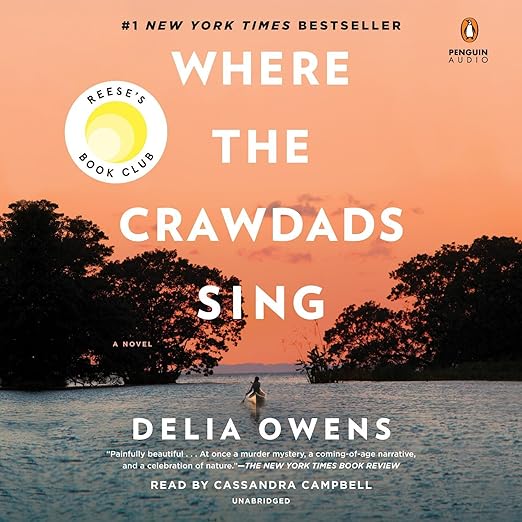
- Narration: Cassandra Campbell’s narration is widely considered one of the great audiobook performances of the 2010s, her voice for Kya Clark is indelible and essentially defines how many readers experience this story.
- Themes: Isolation and survival, nature as refuge, justice and prejudice
- Mood: Lyrical and slow-burning, with a thriller pulse running underneath
- Verdict: The hype is real, the narration is exceptional, and the marsh setting is unlike anything else in contemporary fiction.
I first listened to this one in the summer of 2019, on a long drive through coastal South Carolina, which I realize sounds almost too convenient. But that is genuinely when it happened, and the landscape, the flat light, the cordgrass, the haze, made Delia Owens’s world feel porous rather than fictional. I remember pulling into a gas station and not wanting to get out of the car. I have since recommended it to more people than I can count, and the responses have been nearly uniform: people finish it quickly and then sit with it for days.
More than 18 million copies sold worldwide is a number that risks becoming meaningless from overuse, but it is worth pausing on in the context of a debut novel by a wildlife ecologist in her late sixties. This is not a book that succeeded through platform or franchise. It succeeded because Kya Clark is one of the most fully realized characters in recent American fiction, and because Cassandra Campbell understood her completely.
Our Take on Where the Crawdads Sing
The story operates on two timelines that Owens braids together with increasing urgency. In one, we follow Kya from early childhood through her twenties, abandoned by her mother at age six, then progressively by every sibling, then by her father, she teaches herself to read using nature field guides and builds a life alone in the North Carolina marsh. In the other, it is 1969, and Chase Andrews, a popular local man, has been found dead at the base of a fire tower. The investigation slowly circles Kya, the so-called Marsh Girl that the town of Barkley Cove has always viewed with suspicion and contempt.
Reviewer Frank Donnelly noted the dual timelines as a structural choice that “slowly weaves together,” which is accurate and undersells the craft. Owens controls the information across both tracks with real precision, what you learn in the present shapes what you understand about the past, and vice versa. The ending, which I will not discuss, has generated genuine literary debate about what Owens is arguing with it. That debate is part of what makes the book worth revisiting.
Why Listen to Where the Crawdads Sing
Cassandra Campbell’s narration is the primary reason to choose audio over print. Her voice for Kya, wary, precise, carrying the cadence of someone who learned language from books and birds rather than people, is one of the defining audiobook performances in recent memory. She does not sentimentalize Kya’s isolation or play up the thriller elements. She lets both coexist, which is exactly what the text demands. The marsh descriptions, Owens’s most celebrated writing, land with particular force when spoken aloud. Campbell’s pacing in those passages gives them room to breathe.
At just over twelve hours, the runtime is substantial but never padded. Owens earns her word count.
What to Watch For in Where the Crawdads Sing
The novel has been critiqued for its idealized vision of self-sufficient solitude and for some of the choices Owens makes in the courtroom sections, where the legal proceeding at times strains plausibility. These are real observations, not manufacturer defects, the book has a particular emotional intelligence that occasionally outpaces its structural logic. Readers who come expecting gritty realism may find the marsh world more mythologized than the story warrants. That mythologization is, for many readers, a feature rather than a flaw. Your mileage will depend on your tolerance for lyricism deployed in service of justice-adjacent storytelling.
Who Should Listen to Where the Crawdads Sing
For readers who love nature writing, coming-of-age narratives, and legal thriller mechanics woven together in literary prose, this is a near-perfect convergence. It also works as a gateway book for people who do not normally read fiction, the plot is propulsive enough to carry readers who might otherwise lose patience with lyrical description. If you dislike open-ended moral questions or feel strongly that courtroom scenes should be procedurally accurate, you may find the ending unsatisfying.
Frequently Asked Questions
Do you need to watch the film before or after listening to the audiobook?
Listen first. The audiobook preserves the dual-timeline reveal more effectively than the film does, and Cassandra Campbell’s narration creates a Kya Clark that is distinct enough from the film’s casting that the two versions coexist rather than compete.
Is Cassandra Campbell’s narration as acclaimed as people say?
Consistently, yes. Multiple listener communities cite her performance as one of the reasons this story works as well in audio as it does in print, particularly her voice for Kya across different ages.
How much of the book is nature writing versus thriller versus romance?
It is genuinely all three in roughly equal measure across the runtime. The nature writing dominates the early sections, the romance builds through the middle, and the thriller structure becomes dominant in the final third. Owens shifts register fluidly rather than segmenting them.
Is Where the Crawdads Sing appropriate for teen listeners?
The themes include abandonment, poverty, sexual assault, and murder, handled with care but present. Most parents of older teens would consider it appropriate, but it is adult literary fiction rather than YA, and the emotional content is substantial.