Quick Take
- Narration: Susannah Jones inhabits the unnamed narrator with quiet authority, the first-person female perspective across two timelines is well-served by her measured, resilient delivery.
- Themes: survival and silence, the Donner Party as American mythology, the cost of what we carry and keep secret
- Mood: Bleak and harrowing with threads of genuine courage, not comfortable listening
- Verdict: A humanizing reimagining of the Donner Party through a fictional survivor’s eyes, the dual timeline adds complexity that some listeners will find disorienting but others will find formally purposeful.
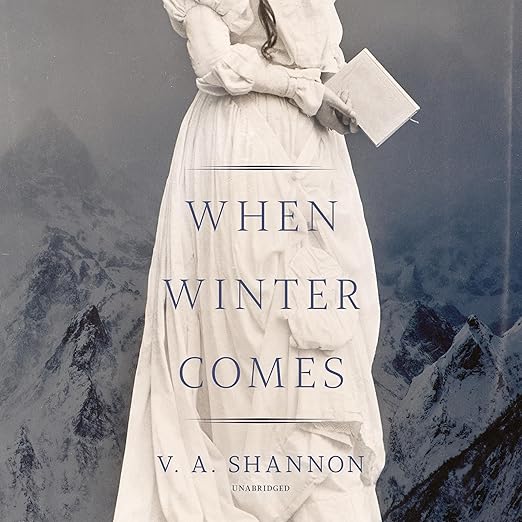
I started When Winter Comes on a cold evening in November, which felt appropriate and also slightly unwise in retrospect. V. A. Shannon’s novel about the Donner Party is not the kind of book that loosens its grip once it has it. I finished the nine-and-a-half hours over two sessions and spent the second one genuinely uncomfortable in the way good historical fiction sometimes makes you, not entertained exactly, but inhabited by something real that happened to real people who deserved better from history’s telling.
The Donner Party of 1846 is one of American history’s most sensationalized episodes. The name has become shorthand for a particular kind of desperation and, less fairly, for a particular kind of transgression that has largely stripped the actual people involved of their humanity. Shannon’s project is partial restitution. By telling the story through a fictional survivor, she can humanize the individual experience without being constrained by the documentary record, while still staying close to the historical facts of what happened in the Sierra Nevada mountains during that catastrophic winter.
Our Take on When Winter Comes
The unnamed narrator is a 15-year-old girl in 1846, escaping an abusive Cincinnati family with a few stolen dollars and enlisting as a helpmate to a married couple heading west. She is an outsider to the Donner Party proper, which gives Shannon a useful narrative vantage: close enough to witness everything, but not so central that the story becomes a simple defense of the party’s leadership decisions. The girl sees clearly and judges carefully, which makes her a good vehicle for the moral complexity Shannon is navigating throughout.
The dual timeline, 1846 and thirteen years later, when Mrs. Klein considers whether to tell her story, creates both the book’s greatest structural achievement and its most commonly cited weakness. Several reviewers found the parallel timelines confusing, noting that only fifteen years separate them. Shannon relies on contextual cues rather than heavy framing to keep the reader oriented, which works when it works and creates genuine temporal confusion when it does not. In audio, the lack of visual chapter markers makes this challenge more acute, and Susannah Jones’s performance modulates tone between the timelines without always making the shift unmistakable.
Why Listen to When Winter Comes
Susannah Jones is the right narrator for this material. The unnamed narrator’s voice requires a quality that is hard to name precisely, something like resilient restraint, the voice of someone who has survived things they cannot fully process but still must carry through daily life. Jones achieves this without melodrama. Her performance in the 1846 sections has a quality of forward momentum that suits the journey narrative, while the older Mrs. Klein sections carry a different weight: the heaviness of someone who has spent thirteen years choosing silence and is now reconsidering what that choice has cost her.
The historical research underlying the novel is solid without being intrusive. Shannon includes the actual Donner Party landmarks that historians and enthusiasts will recognize, the delay at Fort Bridger, the disastrous Hastings Cutoff decision, the increasingly desperate arithmetic of food and distance, while keeping the fictional narrator’s experience specific and intimate. This is not a historical survey. It is a novel that uses history as its skeleton and imagination as its muscle, and the combination largely succeeds.
What to Watch For in When Winter Comes
The ending has divided readers. One reviewer found it abrupt and felt the novel lacked organizational closure. Others found the ambiguity appropriate to a story about a woman who has spent thirteen years maintaining a protective silence. Both responses are legitimate and reflect a genuine formal choice Shannon makes rather than an oversight. Mrs. Klein’s decision about whether to speak is, in one reading, the book’s actual subject. The journey and the horror are the reason the decision matters, not the resolution itself, and Shannon’s willingness to leave that tension unresolved is either frustrating or honest depending on what you value in historical fiction.
The novel is genuinely difficult at times. The physical conditions of the mountain winter are described with enough specificity to convey the reality without exploiting it for sensation. The more extreme aspects of what some Donner Party survivors did to survive are handled with restraint. Shannon is interested in what it cost to survive, morally, psychologically, in terms of what you become afterward, rather than in making the reader suffer alongside the characters as voyeurism.
Who Should Listen to When Winter Comes
This is for historical fiction readers who want a human-scale account of a famous event rather than a panoramic historical narrative. Those who already know the Donner Party story will find Shannon’s fictional frame adds texture and meaning to familiar facts. Listeners who prefer their historical fiction neat and chronologically linear may struggle with the dual timeline structure. Anyone interested in frontier American history and the experience of women on the overland trails will find this a thoughtful, absorbing account. The nine-and-a-half-hour length is right for what the material demands, and Susannah Jones’s performance makes the commitment feel worthwhile from the first chapter.
Frequently Asked Questions
How closely does When Winter Comes follow the actual historical record of the Donner Party?
Shannon stays close to documented facts, the route, key decisions, and specific conditions, while using a fictional narrator to provide human interiority that the historical record cannot supply. The blend is research-grounded without being constrained by documentary limits.
Is the dual timeline structure easy to follow in audio format?
It is the book’s most commonly cited challenge. Only fifteen years separate the two timelines, and Susannah Jones modulates her performance between them, but some listeners still find the shifts disorienting. Paying attention to contextual cues helps maintain orientation.
Does the novel address the most extreme aspects of Donner Party survival, and how graphic is it?
Shannon is present with the historical reality but handles it with restraint. The focus is on what survival cost the people involved psychologically and morally, not on graphic depiction. It is difficult but not exploitative.
How does Susannah Jones’s narration serve the first-person narrator across the two time periods?
Jones delivers a performance of resilient restraint that suits the character’s particular burden. She distinguishes the younger narrator’s forward urgency from the older Mrs. Klein’s weighted deliberation, which is the key performance challenge of the dual-timeline structure.