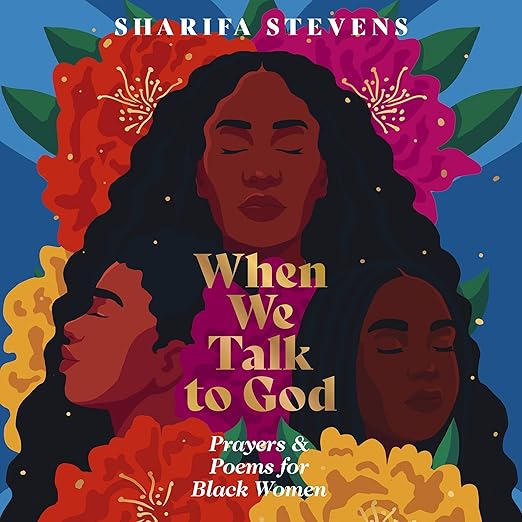
Quick Take
- Narration: Author-narrated with warmth and conviction; Stevens’ own voice gives the prayers their full emotional weight and spiritual authority.
- Themes: Lamentation and joy, Black womanhood and faith, prayer as embodied language
- Mood: Intimate and reverent, with moments of raw emotional honesty
- Verdict: An author-read devotional collection that earns its 4.8 rating through specificity and depth, written for Black women, but generously open to any listener willing to be present.
I picked this one up on a quiet Tuesday morning, the kind of day where nothing is particularly wrong but nothing feels quite settled either. I wasn’t expecting a collection of prayers and poems to stop me in my tracks the way this one did. By the time Sharifa Stevens read the piece about feeling invisible at a job interview, I had set down my coffee and was simply listening.
When We Talk to God is Sharifa Stevens’ offering to Black women of faith, though reviewer Jennifer Layte put it well when she noted the book was “not written for me” but that the author was “very hospitable in allowing people like me to listen in.” That hospitality is real, but the specificity is what makes it powerful. Stevens doesn’t write around the particular textures of Black women’s lives. She writes directly into them: braiding hair, feeling invisible in professional spaces, dancing, grieving, waiting.
Our Take on When We Talk to God
What Stevens achieves here is difficult. She holds lamentation and celebration in the same collection without letting either tone flatten the other. Some pieces read like sermons, some like testimonies, and some swim into a register that doesn’t have a clean name. Reviewer Tre L. Loadholt described them as pieces that “pull you from dark places and remind you of your worth,” and that description tracks. The arc of the collection moves through loss, waiting, gratitude, and joy, not in a tidy progression, but in the circling, layered way that spiritual life actually unfolds.
The decision to have Stevens narrate her own work is exactly right. This is not material that would survive a third-party narrator intact. The rhythms of her prayers are her rhythms. The pauses are hers. When she reads about groaning instead of words, you feel the weight of that wordlessness in her delivery.
Why Listen to When We Talk to God
At just over three hours, this is an audiobook you can finish in a single sitting, but it doesn’t ask for that kind of consumption. It’s better experienced in fragments, the way devotional literature is traditionally encountered. A piece or two in the morning. A prayer during a commute. The format suits the content: short, complete units of thought that hold up on their own while building into something cumulative over time.
For listeners who have felt that prayer had to arrive in a certain shape, clean sentences, formal address, theologically correct vocabulary, Stevens offers a different model. Her prayers include frustration, silence, confusion, and delight. Nothing is excluded on the grounds of being too small or too ordinary. A chapter on braiding hair becomes a meditation on care and inheritance. A poem about dancing carries more theological weight than many sermons I’ve heard.
What to Watch For in When We Talk to God
The collection is pitched specifically at Black women, and that specificity is a feature, not a fence. Listeners outside that specific experience will find the writing accessible and moving, but the primary audience will find something more: the particular relief of being seen in one’s own language. Stevens draws on personal experience and biblical examples in tandem, and her handling of scripture feels neither academic nor preachy. She uses it the way someone uses a letter from a trusted friend, as reference, as comfort, as ongoing conversation.
One reviewer purchased an additional copy for “one of my favorite women in the world.” That impulse makes sense. This is material that creates the desire to share. At a 4.8 rating across 151 Audible listeners, the response has been consistent: this collection reaches people where they are.
Who Should Listen to When We Talk to God
This collection is for Black women of faith looking for devotional material that reflects their actual lives, not an idealized version of spiritual experience, but the full, complicated reality of it. It’s also for anyone who appreciates lyrical, author-voiced poetry and isn’t looking for conventional audiobook narrative structure. Listeners who come expecting a straightforward nonfiction listen should know this is a poetry and prayer collection; the experience is contemplative rather than informational. If you need a driving narrative or a clear argument arc, this isn’t the entry point, but if you’re open to something quieter and more devotional in form, it delivers.
Frequently Asked Questions
Is When We Talk to God only for Black women?
Stevens wrote it explicitly for Black women, and that specificity is central to the collection’s power. That said, multiple listeners outside that audience have reported finding it moving and accessible. Think of it as written for a specific community but hospitable to anyone willing to listen respectfully.
Does Sharifa Stevens narrate the audiobook herself?
Yes, and it makes a significant difference. The prayers and poems carry the rhythms of her own speech, and her delivery brings a weight and intimacy that would be hard to replicate with a third-party narrator.
How should I listen to this, all at once or in segments?
The collection is structured in short, complete units and suits a segmented approach. Many listeners report returning to individual pieces rather than listening straight through. Think of it the way you might use a devotional: a few pieces at a time, with space to reflect.
What is the tone, celebratory or somber?
Both. Stevens moves through lamentation, waiting, gratitude, and joy across the collection. Some pieces are raw and grief-adjacent; others are warm and celebratory. The mix is intentional and reflects the full arc of spiritual life rather than a single emotional register.