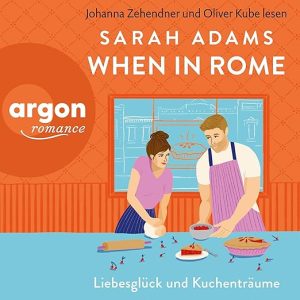
Open this listing expecting Sarah Adams in English and the sample will correct you. The title reads When in Rome. The language field reads German. The publisher is Argon Verlag, the credited reader is Johanna Zehendner, the description is written entirely in German, and all four written responses were filed in Germany. This is the German edition of an American small-town romance, and because the title was never translated, nothing at the top of the page warns anyone arriving from an English search. The audiobook runs eleven hours and thirty-three minutes and released on March 27, 2024.
Credit for the German goes to nobody. Sarah Adams wrote this novel in English; somebody rendered it into the language Zehendner speaks aloud for eleven and a half hours, and that person's name appears in no field on the record. On a printed book an uncredited translator is a professional discourtesy. On a recording it becomes a description problem, because what a listener hears is not the original sentences at all. Rhythm, joke timing, the exact register of a bad-tempered baker's refusals: all of it arrives through a second writer whose work is the literal content of the audio, and the page behaves as though that writer does not exist.
Four written responses sit beneath a counter of two hundred seventy-five ratings, and they carry five, four, three and two stars. Their average is 3.5 against a badge of 4.3, which is three-quarters of a star of daylight. That is reachable rather than suspicious. Displaying 4.3 requires a total between one thousand one hundred sixty-nine and one thousand one hundred ninety-six, so the two hundred seventy-one votes that arrived without text have to average somewhere between 4.26 and 4.36, which is entirely ordinary. What it does mean is that everyone who bothered to write graded the book below its own badge, and the only voices a shopper can actually read are the cooler ones.
Why When in Rome Works as an Audiobook
Premise first, because it is a good one and it carries most of the load. Amelia is a bright star of the pop firmament, lonely and burned out, so she gets into her car on an impulse to break out of her own life. She is aiming for a small town called Rome; she lands in the front garden of Noah Walker, a bad-tempered cake baker who is not remotely delighted about it, and while the car is being repaired she ends up in his guest room. The four-star note of July 19, 2024 sets out why the setup holds: two people who look completely unalike at first glance, with something underneath connecting them anyway, and a woman worn through by public life who wants one private week.
Warmth is the actual product, and the copy says so directly. The Walker family is where Amelia stops feeling like merchandise, and the description leans on that as hard as it leans on the romance. The five-star note of August 28, 2025 recommends the book without reservation, calls it exactly right for the gaps in a day, and mentions that the second part is worth having too, which is the only place on this page a sequel is mentioned at all. Zehendner has eleven and a half hours to spend on a grumpy baker, a burned-out singer and a household full of interruptions, which is a great deal of road for a story its own admirers describe as the thing you read between other things.
Weak Spots in When in Rome
Both critical notes aim at the same habit. The three-star of September 15, 2024 found the book funny and thoroughly predictable, no game-changer for the genre, and reports that reading it grew a little wearing because the author will not stop describing how wonderful and how attractive each of them finds the other. That is a checkable complaint about a prose tic rather than a vague objection to the plot. The two-star of February 6, 2025 is shorter and blunter: abandoned, which that reader says almost never happens, on the grounds that it was simply too bland. Eleven and a half hours is a long stretch to spend with a habit somebody has already warned you about.
Language is the practical trap and it deserves spelling out. A browser arriving from an English search for Sarah Adams, whose books are written and sold in English, reaches a page whose title, author name and series label all sit in the Latin alphabet and mean precisely what they appear to mean. Everything else on the record is German: the description, the responses, the publisher, the recording. Anyone who does not check the language field can pay for eleven and a half hours in a language they do not speak, and no other element on the page will stop them.
The Right Listener for When in Rome
German-speaking romance readers who like the grumpy-and-sunshine pairing are the audience, and this is a clean example of the type: an established audio imprint, an unabridged runtime, a series with at least one continuation somewhere out there. Listeners who want the original English prose should hunt down a different edition, because what plays here is a second writer's version of it however faithful that version may be. Anyone who reads romance for surprise rather than for comfort should treat eleven and a half hours as a long stay in a very familiar house.
Thin evidence is the last caveat. Two hundred seventy-five people have graded this and exactly four left words, which is a slender basis for an eleven-hour commitment at full price. The copy promises romantic, dreamy and sugar-sweet, and none of the four contradicts that; they disagree only about whether sugar-sweet sustains the distance. What the record does supply is a real publisher, a named reader, a full runtime and a genuinely charming setup. Check the language field before you spend anything.
Frequently Asked Questions
What language is this audiobook actually recorded in?
German. The language field says so, the publisher is Argon Verlag, the description is written in German, and every written response was filed in Germany. The title was left untranslated, so nothing at the top of the page signals it. Anyone expecting Sarah Adams in the original needs a different edition.
Is a translator credited anywhere on this audiobook listing?
No. The author field names Sarah Adams and the narrator field names Johanna Zehendner, with no translator named at any point on the page. Because the recording performs a German text rather than an English one, that uncredited translator wrote the sentences you would actually spend eleven and a half hours hearing.
Does this book open a series, and is a sequel listed?
The series field reads Rome Lovestory, volume one, and the German description calls this the opening book. No sequel title, number or release date appears anywhere on the listing, so a reader who finishes and wants the next volume has nothing on this page to follow.
At eleven and a half hours, does the pace hold for a light romance?
Eleven hours and thirty-three minutes, which is substantial for a small-town romantic comedy. The copy sells the book as light reading for spare moments, so the runtime and the register pull against each other. The sample is the quickest way to test whether the pace holds at that length.