Quick Take
- Narration: Tim Kreider reading his own essays is the only possible right call. His voice has the dry, slightly rueful quality of someone who has already diagnosed the joke at his own expense.
- Themes: The gap between near-death and genuine transformation, the irrational logic of who we love, the difficulty of changing even when we want to
- Mood: Late-night and candid, funny in the way that things are funny when they are also true and slightly painful
- Verdict: A short essay collection that earns its laughs by being honest rather than merely clever, and sounds exactly right in Kreider’s own voice.
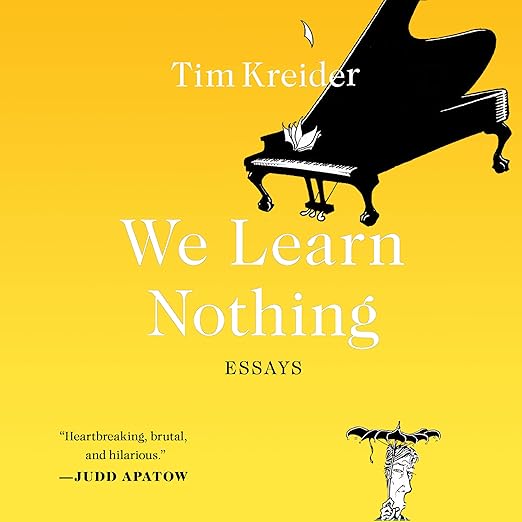
A friend sent me a link to Tim Kreider’s New York Times essay The Busy Trap years ago, and it has stayed with me the way good essays do, not as an argument I can paraphrase but as a way of seeing something I now cannot unsee. We Learn Nothing collects that kind of writing: essays that set up what looks like a comic premise and then, instead of going for the punchline, drop into something much more honest and difficult. One reviewer described watching Kreider rarely go for the punchline after setting up terrific premises, instead dropping in well-thought-out, brilliant observations. That is exactly it. The comedy is the method, not the destination.
The title itself is the theme. Kreider survived being stabbed in the throat and, by his own account, it did not make him a better or fundamentally different person. This is the kind of experience that memoirs usually deploy as transformation narrative, the event that divided before and after. Kreider declines that structure. He asks the harder question: what happens when you survive something significant and remain, essentially, yourself? The rest of the collection orbits that question in different registers and through different subjects, each essay a new angle on the gap between what we think should change us and what actually does.
The Title Essay and Its Particular Honesty
The opening essays establish Kreider’s method quickly. He has a gift for the kind of confession that does not feel performed, the admission of something genuinely embarrassing or contradictory that most writers would soften or redirect into something more flattering. Why do we fall in love with people we do not even like? he asks, and then proceeds to examine that question through his own experience with the specific uncomfortable focus of someone who is not going to let himself off the hook. The self-awareness is real rather than theatrical, and that quality is what makes the confessional material feel genuinely unguarded rather than calculated vulnerability.
The essay about a friend who changed genders, referenced briefly in the synopsis, is one of the collection’s best pieces, and the way Kreider navigates his own surprise and adjustment is handled with neither sanctimony nor defensiveness. He is someone genuinely working through something in public, and the honesty of that process is what makes it worth reading rather than any particular conclusion he arrives at. This is writing that trusts the reader to follow a thought that does not resolve neatly, and that trust feels rare.
Author Narration and the Essay Form
Essay collections are one of the formats where author narration is almost always the right call, and We Learn Nothing confirms this. Kreider’s voice has the slightly wary, self-deprecating register of his prose, the quality of someone who has already noticed the irony of his own position before you have. One reviewer described his work as incisive, confessional, and rueful, all accurate, and those qualities are delivered most effectively when you are hearing the author himself calibrate them.
At six hours and forty minutes, the collection is the right length for the format. Essays benefit from being listened to in shorter chunks, and this runtime is easy to manage across a few commutes or evenings. Kreider’s reading pace is natural and unhurried without dragging. The audio has been produced cleanly by Seneca and Marcus LLC, and the recording quality is consistent throughout. This is a case where the author-narrated version is definitively the version to choose.
The Political Essays and What to Expect From Them
One reviewer noted that they went into the book worried about political content, given that Kreider’s politics diverge from their own, and found their concern largely unnecessary because the political observations are embedded in personal experience rather than deployed as polemic. That is an accurate description of how Kreider’s politics function in the writing. He has opinions, and they surface, but they are not the point. The point is almost always the gap between what people believe about themselves and what their behavior reveals, and that subject is interesting regardless of which side of any given issue you are on. Kreider is too honest about his own contradictions to sustain the kind of righteous momentum that makes political writing feel like a lecture.
The Ideal Listener for Six Hours of Rueful Self-Examination
We Learn Nothing is for readers of personal essays who want their comedy earned rather than performed, and who can handle the particular discomfort of a writer examining his own failures with more accuracy than mercy. Fans of David Sedaris or Sloane Crosley will find Kreider adjacent in spirit if somewhat darker in register. The free audiobook version makes this an easy test: listen to the first essay and you will know within twenty minutes whether Kreider’s voice is one you want to spend six hours with. If it is, the rest of the collection will not disappoint you. These are the conversations you have only with best friends or total strangers, late at night, and Kreider has the rare gift of making that kind of conversation feel worth having on the page.
Frequently Asked Questions
Is We Learn Nothing a unified memoir or a collection of separate essays?
It is a collection of autobiographical essays unified by theme rather than by narrative continuity. Each essay stands alone, which makes it ideal for listening in shorter sessions across multiple sittings.
How does Kreider handle the essay about his friend’s gender transition?
With genuine honesty about his own surprise and adjustment process, rather than with either defensiveness or performed progressive virtue. Reviewers consistently identify it as one of the stronger pieces in the collection.
Does the political content make this a difficult listen for readers who do not share Kreider’s views?
One reviewer who disagreed with Kreider politically found the book far less polemical than expected. His political observations are embedded in personal experience rather than deployed as argument, which makes them easier to engage with even in disagreement.
What does Kreider’s narration add that a professional voice actor could not provide?
The essays depend on a very specific calibration of self-deprecation and dry observation that is native to Kreider’s voice. A professional narrator would smooth the rough edges that make the confessional material feel genuinely unguarded rather than performed.