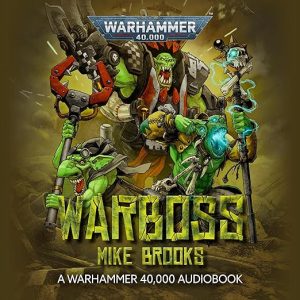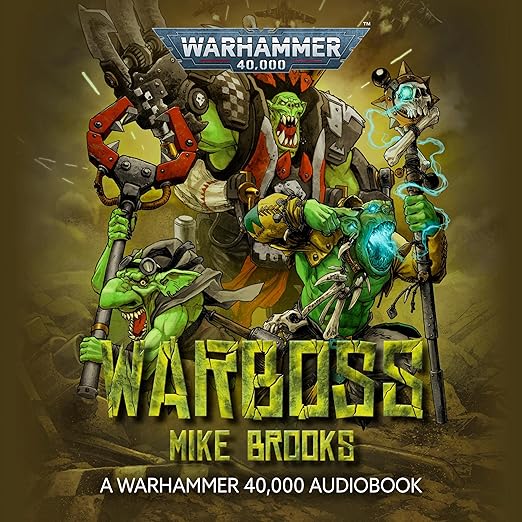
Warboss Gazrot Goresnappa lies dead beneath a decapitated Gargant's head at the opening of Mike Brooks's Warboss audiobook, and that image tells you everything you need to know about the register this novel operates in. The fortress world of Aranua is on the verge of falling to the greenskins, and yet the moment of apparent triumph has collapsed into a six-way brawl for succession. Ork fiction in the Warhammer 40,000 universe has a specific tonal challenge: it needs to be genuinely funny without becoming trivial, and violent without losing the satirical edge that makes the best entries in the range something more than combat theater. Brooks has navigated this better than almost any writer working in the Black Library stable, and Warboss is an extension of that track record rather than a departure from it.
The setup is tight and knowable: six clan bosses each believe they alone are destined to become the next Warboss. Da Genrul of the Blood Axes, Speedboss Zagnob of the Evil Sunz, Goff Big Boss Mag Dedfist, and three others step forward to duke it out. Into this already chaotic succession crisis arrives a prophecy: somewhere beneath the human city lies a mysterious gate, and the true Warboss will find it and use it to turn the galaxy green. The wildcard is Snaggi Littletoof, self-appointed prophet of Gork and Mork and leader of the grot uprising, who sees the entire situation as an opportunity to overturn grot oppression once and for all.
Is Warboss Worth Your Time?
Harry Myers brings genuine physical commitment to the narration, differentiating each clan boss by register and energy level rather than relying on accent alone. The result is a listening experience where the intertwining plot threads remain navigable even at their most chaotic, no small feat when you're tracking six factions plus the grot subplot across nearly nine hours. One reviewer called the blend of humor and interlocking plots fantastic and noted it kept them engaged through an entire road trip. Another, a clear veteran of Ork fiction, observed that while the book doesn't have the punch of Brutal Kunnin, Brooks still knows how to write Orks better than any writer working in the genre.
That more measured assessment is worth sitting with. Warboss is a pleasure, but it operates at a slightly lower temperature than its predecessor. The six-faction structure is entertaining in concept but occasionally diffuse in execution. There are stretches where the novel cycles between bosses in ways that feel procedural rather than escalating. The Snaggi Littletoof subplot is consistently the most inventive thread in the book, and some listeners will wish it had been given more room at the expense of the more conventional clan-boss jockeying.
The Best Parts of Warboss
The audio format is a natural home for Ork fiction. The dialect, the physical comedy, the sheer noise of six competing ambitions all translate well to performance, and Myers leans into the boyz-eye-view of the war for succession with evident enthusiasm. The 8-hour-48-minute runtime is manageable for the genre, and the novel's structure provides satisfying forward momentum even when individual sections feel like they're idling between the big confrontations.
The humor in Brooks's Ork writing is also distinctly literary in a way that rewards close attention. The narrative bits about 'Fatso' Johnson's culinary memoirs, the naming conventions of the clans, and Snaggi's theological grandiosity - these are jokes that only land if you're following the logic of the world carefully. This is Warhammer 40,000 fiction that takes its premise seriously enough to be funny, rather than simply winking at the camera and expecting the audience to supply the comedy through sheer franchise familiarity alone.
Before You Commit to Warboss
Listeners new to Warhammer 40,000 fiction can enter here without prior reading, though familiarity with the six Ork clans and their stereotypes will deepen appreciation for what Brooks is playing with and occasionally subverting. The six-boss structure takes a few chapters to fully establish, so new listeners should resist the urge to skip ahead. Once the faction dynamics are set, the plot moves with considerable drive toward its prophetic showdown beneath the human city.
The novel's violence is enthusiastic and occasionally gruesome, consistent with the Warhammer 40,000 house style. If you've read Brutal Kunnin and found yourself wanting more of that specific energy, Warboss delivers most of it, even if the assembly of six competing storylines dilutes the focus slightly compared to that earlier book's tighter, more single-minded construction. Fans of the series will likely find the structural looseness forgivable given how much pleasure the individual sections generate.
Should You Listen to Warboss?
Warhammer 40,000 fans who enjoy the Ork side of the setting will find this an easy recommendation for their next audiobook session. Mike Brooks fans specifically will want it as a continuation of his work with greenskin fiction, and anyone who enjoyed the energy of Brutal Kunnin should approach with the expectation of a similar register at a slightly lower sustained intensity. Readers who encountered the Ork faction through other media - the video games, the miniatures range - and want to understand how the fiction approaches the same characters will find this a solid entry point: entertaining, broad, and energetic. Those looking for the kind of tight single-protagonist narrative that Black Library does well with its other series may find the six-faction sprawl a harder listen to settle into, but most Ork enthusiasts will find the reward-to-investment ratio comfortably in positive territory across the full runtime.
In Brief
- Voice: Harry Myers attacks the material with the physical energy that Ork fiction demands, giving each clan boss a distinct enough voice to track six competing factions without losing the comedic momentum.
- Big ideas: Power succession, tribal loyalty, prophecy and belief, comic violence
- Atmosphere: Raucous and chaotic, with enough genuine menace underneath the comedy to keep the stakes real
- Worth it?: A boisterous entry in Mike Brooks's Ork catalog that rewards Warhammer 40,000 fans even if it doesn't quite hit the heights of Brutal Kunnin.