Quick Take
- Narration: Robb Moreira brings consistent energy to Victor’s world, holding eighteen-plus hours of combat and character work together without fatigue.
- Themes: Rising legend vs. mounting vulnerability, betrayal within ancient power structures, arcane growth and its costs
- Mood: High-octane and immersive, with occasional quieter character moments that longtime series readers will appreciate
- Verdict: A satisfying tenth entry that takes some interesting risks with its protagonist while delivering the arena combat and power progression the series is built on.
I should be upfront that I came to Void Forged as someone who has not followed the Victor of Tucson series from the beginning. Reviewing the tenth entry in a LitRPG progression fantasy series without the preceding nine books is a bit like walking into a long-running television drama midway through the final season. The world has its established rules, its developed relationships, and its accumulated weight of consequence, and a new listener is going to feel some of that density without being fully inside it.
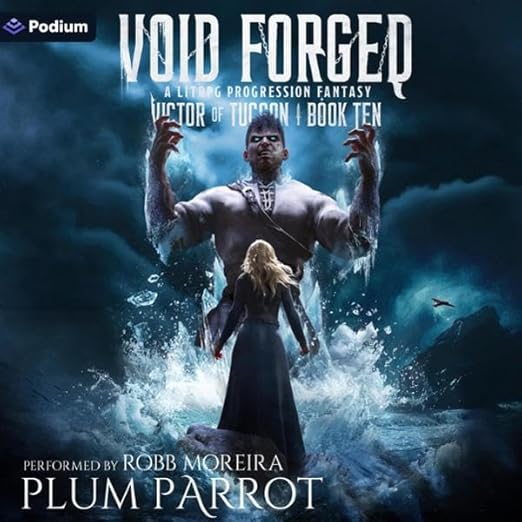
Published by Podium Audio and running nearly nineteen hours, this is a substantial audiobook by any measure. Plum Parrot, who built an initial audience on Royal Road before moving to traditional publication, has a clearly established following, and the reviews for this tenth volume reflect readership that has been with Victor Sandoval through significant evolution.
Our Take on Void Forged
The premise for this volume places Victor, now established as Lord Victor, Duke of Iron Mountain, in two kinds of danger simultaneously. The political threat comes from veil walkers, enigmatic figures who have been observing his arena duels and among whom whispers of betrayal are beginning to stir. The physical threat comes in the form of a warrior wielding something called the Curse of the Void, a weapon of darkness with a single purpose: destroy Victor entirely.
What makes this entry interesting, according to readers who have followed the whole series, is that Parrot does something slightly unexpected. Victor starts talking about his feelings. One reviewer describes this with the kind of affectionate exasperation that comes from genuine investment: he’s using his brain more, thinking rather than just swinging. The same reviewer notes that Victor returns to form by the end, but the willingness to show the character’s interior life rather than just his capacity for violence gives the book a texture that pure action fantasy can sometimes lack.
Robb Moreira’s narration handles nearly nineteen hours of material with solid consistency. He maintains the energy the genre demands in combat sequences without losing the quieter register the character moments require. For a series built on duels and power escalation, finding that balance matters, and Moreira earns his place in a long series by now.
Why Listen to This LitRPG Entry
The LitRPG format translates particularly well to audio for listeners who enjoy immersive world-building. When the progression mechanics, the leveling, the skill acquisition, the arcane power growth under Tes’s tutelage, are woven through a consistent narrative voice, they become less like game statistics and more like the internal logic of a living world. Parrot has more than a million views on Royal Road, which suggests the world-building has depth that sustains long engagement.
The romantic triangle element mentioned in the trope list and the tutelage relationship with the dragon woman Tes add human stakes to what might otherwise be purely competitive fantasy. Victor is a character readers clearly feel for, not just root for, and that distinction matters over nineteen hours.
What to Watch For in This Volume’s Pacing
One reviewer noted there is repetition alongside mild story growth. That is a common structural tension in long-running series: the need to satisfy established reader expectations while also pushing the narrative forward. Void Forged manages this reasonably, though listeners new to the series may feel the weight of accumulated lore that is referenced but not fully explained.
The book is clearly written for existing fans. The emotional payoff of Victor facing an opponent who genuinely overmatches him, and the revelation that nobody is invincible, lands harder when you have spent nine previous volumes watching him climb. Coming in at book ten does diminish some of that resonance, though Parrot’s prose is clear enough that the immediate stakes read without prior context.
Who Should Listen to Void Forged
Existing fans of the Victor of Tucson series and readers comfortable with LitRPG progression fantasy who are looking for a new long-running series to enter will get the most from this. Fans of Solo Leveling or Red Rising who enjoy high-stakes arena combat with character investment alongside the action will find familiar pleasures here.
Listeners new to LitRPG or unfamiliar with Plum Parrot’s work should start at the beginning of the series rather than here. There is enough world-building weight and relationship history that jumping in at book ten is genuinely difficult, and the payoffs of this volume are earned over the preceding nine.
Frequently Asked Questions
Can Void Forged be listened to as a standalone, or is it essential to start from book one?
Starting from the beginning of the Victor of Tucson series is strongly recommended. This is the tenth entry, and the character relationships, world rules, and emotional payoffs all depend on prior context that Parrot does not re-establish for new listeners.
How does Robb Moreira’s narration hold up over the nearly nineteen-hour runtime?
Consistently well. Moreira maintains energy through combat sequences without losing the quieter character moments, which is the primary challenge in a long LitRPG audio production.
Does this volume change Victor’s character significantly, or does it deliver more of the same?
Reviewers note a meaningful shift in that Victor engages more with his feelings and relies more on strategy than brute force, at least initially. The book returns to its signature violence by the end, but longtime readers describe the emotional development as a welcome addition.
What makes this series comparable to Solo Leveling and Red Rising, as the publisher suggests?
All three feature protagonists who rise through competitive combat systems, face existential threats from powerful enemies, and accumulate power through repeated trials. The tone of Plum Parrot’s work is more grounded and character-driven than Solo Leveling, and less dystopian than Red Rising, but the core power-progression appeal is shared.